

Dr Shuvendu Majumder
mukhopadhyay.dinabandhu@gmail.com
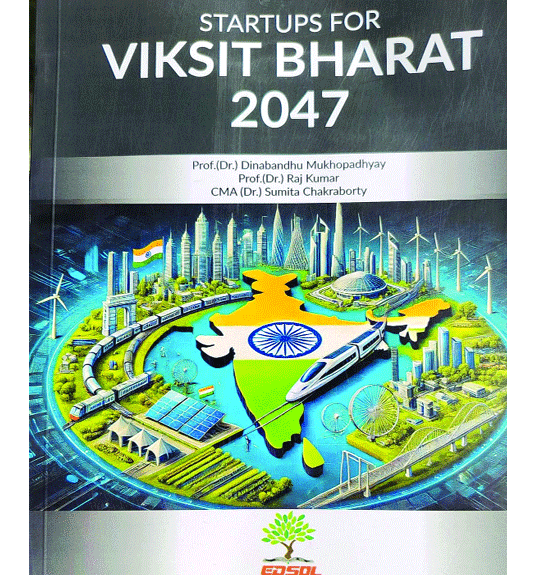
The maiden volume “Startups for Viksit Bharat-2047” represents a monumental scholarly and policy-oriented contribution to the discourse on entrepreneurship, economic development, and nation-building in contemporary India. Authored by distinguished academicians and policy thinkers including CMA CS CA Prof. (Dr.) Dinabandhu Mukhopadhyayaka Prof. D. Mukherjee], Prof. (Dr.) Raj Kumar, and CMA (Dr.) Sumita Chakraborty, this time-honoured volume stands as a comprehensive intellectual treatise on the strategic role of startups in India’s journey towards becoming a developed nation by the year 2047. Published by Edsol Informatics Private Limited under patronage of International Institute of Medical Science and Technology Council(IIMSTC), the book attributed with ISBN 978-81-996609-2-2, Hard Cover Jacket, Price INR 1,995/ reflects a synthesis of academic scholarship, policy insight, and managerial pragmatism. The Foreword, thoughtfully penned by Major General Dr. Soures Bhattacharya(Rtd.), VSM, PhD, Consultant-Defence Manufacturing and AI Startups , New Delhi, India lends the work intellectual gravitas and national perspective, setting the tone for a volume that is both visionary and methodologically rigorous.
To speak in the context of intellectual architecture and conceptual foundations, the book is remarkable for its breadth, depth, and historical sweep. The authors commence with an evolutionary account of Indian trade, commerce, and enterprise-from Vedic and ancient mercantile traditions through colonial disruptions to post-independence industrial development and the contemporary technology-driven entrepreneurial ecosystem. This historical contextualisation is not merely descriptive but analytical, demonstrating that entrepreneurship in India is not a recent phenomenon but deeply rooted in civilizational and socio-economic traditions. From globally respected Business School-style analytical perspective, the authors adopt a macro-to-micro framework: beginning with the historical and economic foundations, moving through policy and institutional frameworks, then addressing strategy, business models, technology, sustainability, and finally national transformation. This structured progression reflects a strategic management approach wherein environmental scanning, institutional analysis, strategy formulation, and execution frameworks are integrated into a cohesive narrative. The conceptual clarity provided in defining startups and MSMEs-drawing upon global institutions such as the World Bank, United Nations, and leading entrepreneurship scholars-demonstrates the authors’ commitment to academic rigour. The definitional frameworks are not merely theoretical but are linked to operational realities, regulatory frameworks, and policy implications.
The authors masterfully navigated into the startups coupled with MSMEs as Engines of Economic Transformation for India to becoming self-reliant by 2047.A central argument advanced throughout the book is that startups and MSMEs are not peripheral economic actors but constitute the core engines of economic growth, innovation, employment generation, and social transformation. The authors convincingly argue that the transition from a developing to a developed economy cannot be achieved solely through large corporations or public sector undertakings; rather, it requires a vibrant ecosystem of entrepreneurial enterprises operating across sectors and regions. The discussion aligns closely with modern management thought, particularly the Harvard Business School emphasis on innovation-driven growth, entrepreneurial ecosystems, and strategic competitiveness. The authors demonstrate how startups contribute to GDP growth, attract foreign direct investment, foster innovation, and create employment opportunities, particularly for youth and skilled professionals.
The book appears to be a blueprint of technology integrated Strategy, Innovation, and Algorithmic Decision-Making and the authors made it point with string conviction and clarity that technology integration is sine qua non for achieving economic success .A distinctive and forward-looking contribution of the book lies in its discussion on algorithmic strategy, data-driven decision-making, artificial intelligence, machine learning, and predictive analytics in startup management. The authors argue that modern startups must be data-driven organisations capable of leveraging analytics for market research, customer acquisition, operational efficiency, and risk management. This reflects contemporary strategic management thinking where competitive advantage is derived from information, analytics, and technological capability rather than merely capital or labour. The emphasis on ethical considerations-algorithmic bias, data privacy, transparency, and accountability-demonstrates the authors’ awareness of the ethical dimensions of technology-driven entrepreneurship. The snapshot of intellectual photography of Viksit Bharat -2047 testified in this volume is just not a narrative of forecasting economic development by startups initiatives but it suggested time-honoured Business Models for Sustainability and operating under the anatomical premise of the ‘Triple Bottom Line’. Another major intellectual contribution of the book is its detailed treatment of startup business models, including lean startup methodology, business model canvas, sustainable business models, and financial planning frameworks. The authors provide analytical comparisons between startup models in India and those in advanced economies such as Germany, Japan, and the United States, drawing lessons for Indian entrepreneurs and policymakers. Particularly noteworthy is the emphasis on sustainability and the Triple Bottom Line approach-People, Planet, and Profit. The authors argue that the startups of the future must not merely be profitable but socially responsible and environmentally sustainable. This aligns with modern global management thinking on ESG (Environmental, Social, and Governance) frameworks and sustainable capitalism.
The thesis of the authors has skilfully been incorporated in this volume is not only theoretical framework but also the applicational aspects of ‘Blue Ocean Strategy’, Risk Management, and Market Creation deserve appreciation due acknowledgment. The discussion on Blue Ocean Strategy and market creation is another intellectually stimulating section of the book. The authors encourage startups to move beyond competitive markets and create new demand spaces through innovation, affordability, accessibility, and customer-centric design. This strategic perspective reflects modern innovation management and disruptive innovation theory. The book also provides extensive analysis on risk management-financial risk, market risk, technological risk, legal risk, and operational risk-along with practical tools such as SWOT analysis, risk matrices, and scenario planning. This makes the book not only theoretical but also a practical managerial handbook for entrepreneurs. Achieving the Vision-Viksit Bharat by 2047 by Startups as the catalysts in Nation Building has prominently been discoursed how to take off and navigate is well articulated throughout the length and breadth of the book .The concluding chapters synthesize the entire discussion into a strategic vision for India in 2047. The authors argue that startups and MSMEs will play a pivotal role in making India a self-reliant, technologically advanced, globally integrated, and socially inclusive economy. They emphasise investment in human capital, research and development, infrastructure, digital public infrastructure, export promotion, and global collaboration. The book thus transcends the boundaries of entrepreneurship literature and enters the domain of national development strategy. It positions entrepreneurship as a nation-building activity and startups as instruments of socio-economic transformation.
The book is notably a testimony of a pioneering roadmap for self-reliant India by 2047 through startups initiatives, innovation and digital technology adaptation but it remained silent about patenting process and sketching an outline why patenting is necessary for innovative and novel business incubation under the platform of startups including MSMEs. However, Startups for Viksit Bharat-2047 is a scholarly, comprehensive, and visionary work of the authors that integrates economics, management, public policy, technology, and sustainability into a unified framework for entrepreneurial development and national transformation. The authors deserve due honour, kudos, and scholarly recognition for producing such a monumental and time-honoured volume. The book is not merely an academic text, nor merely a policy document, nor merely a managerial handbook-it is a strategic blueprint for India’s economic future.
Penned in an analytical, lucid yet accessible style, it will be of immense value to policymakers, academicians, researchers, entrepreneurs, corporate professionals, and students of management and economics. This volume stands as a significant intellectual contribution to the literature on entrepreneurship and economic development, and it is likely to remain a reference work for years to come for those interested in the role of startups in shaping the economic destiny of India and beyond the boundaries of India, Startups for Viksit Bharat-2047 has the potential to serve as a lighthouse for developing and emerging economies across Asia, Africa, and Latin America.
(The reviewer is Director (Academic) RKVM- Institute of Advanced Studies Kolkata)
 Follow our WhatsApp channel
