

Rayees Ahmad Kumar
rayeeskumar31@gmail.com
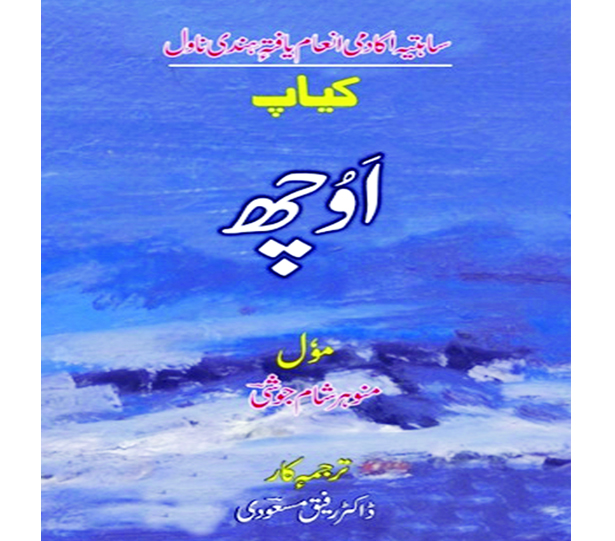
Name of Book: Kyap
Name of Author : Shyam Joshi
Translator : Dr Rafiq Masoodi
Manohar Shyam Joshi, a noted Hindi writer from Almora region of UP now Uttrakhand was the son of a renowned educationist and musicologist. He died in 2006, upon his death Prime Minister Dr Manmohan Singh called him as “one of the most influential writers and commentators in Hindi in recent times”. Hum Log, Buniyaad and Kakaji Kahin are some of his masterpiece script writings for television. His best selling novels include Kasap and Kyap. For Kyap he was awarded the prestigious Sahatya Academy Award in 2005. Dr Rafiq Masoodi, a prominent literary figure of Kashmir valley and chief patron of Adbi Markaz Kamraz – one of the oldest and vibrant literary organizations of Jammu Kashmir has translated this masterpiece Kyap / Avuch into native Kashmiri language. The Kashmiri translation of Kyap – Avuch, rendered by Dr Rafiq Masoodi has added a valuable regional dimension to this important work. This translation is an important contribution to Kashmiri literature, as it makes a complex and thought provoking text accessible to Kashmiri readers in their mother tongue. Kyap is not an ordinary story, rather it is an unbearable disturbance. While going through this meticulously crafted work, the reader is disorganized not through an overt drama or rhetorical excess, but through a silent and playful narration that gradually results in unveiling an unsettling tragedy. A reader finds this work as an artfully gentle literary work which reveals its depth slowly, almost in a clandestine manner. On one hand, this work has been presented lightly as a casual tale narrated with ease, humor and irony, yet it’s simplicity has been so nicely portrayed that it appears to be so unsettling. The prose lines of this work flow effortlessly, often provoking a smile and amusement. The story unfolds in a playful and disarming conversational tune. Author has weaved it naturally, evoking familiarity and comfort. The language of the work is so conversational that it seems almost gossiping which lulls the reader and gives him a long lasting comfort. It seems the author has made a deliberate attempt to make it so interesting by composing it stylistically. The story is a powerful exploration of life in a society caught between different worlds. While going through the pages of the book, a reader comes to know that, cultural and emotional landscape has been shaped by half realized modernity and an uncritical post modern mindset. Traditional customs, values and rituals have no place while modern ideals have not been fully accommodated. As a result of this, there is no room for morality and human emotions but sincerity, selflessness and pure intentions are viewed as suspicion and emotional vulnerability is treated as weakness. The story of Kyap is a love story, not a romantic one in the conventional sense or in idealized form but the love in this story is fragile, vulnerable and unprotected constantly threatened by societal expectations and frequently colliding head-on with social hypocrisy, intellectual vanity and moral confusion. The characters of this story do not suffer because they lack feeling while as they suffer because feelings have no legitimate space in a society obsessed with appearances, progress and borrowed ideas. In other words we can say that it isn’t destroyed by overt cruelty or dramatic betrayal but by neglect, hesitation and the inability of society to grant it legitimacy. In this world dominated by mere appearances, progress and borrowed intellectual framework, love becomes expendable, something to be set aside or we can say neglected rather than to be defended. In these situations, love becomes an inconvenience, a liability rather than a strength. The pseado- intellectualism or intellectual pretension has been strongly criticized in Kyap which is it’s striking feature. By the devastating critique of intellectuals, the narrative has been so built that it exposes how intellectual postering – detached, ironic and emotionally evasive can become morally irresponsible. Characters engage in ideas, debates and postures of sophistication, yet fail to acknowledge the human consequences of their choices. The narrative suggests that when intellect separates itself from empathy and responsibility, it ceases to be enlightening and instead becomes complicit in emotional harm. Tragedy in Kyap doesn’t appear loudly, instead it arrives noiselessly, almost in invisible form, mirroring real life where dreams often fade without dramatic collapse. This subtlety of the book is it’s greatest strengths. The reader is not confronted with overt sorrow but with a creeping realization that something precious has been lost. The emotional climax of the book is not marked by a dramatic event but by a sudden inner response in the reader. A staunch and enthusiastic reader of this book makes this announcement that the most powerful achievement of Kyap is it’s ending, not in terms of plot but in emotional effect. The reader who has been smiling throughout, suddenly halts, startled by an unexpected heaviness – an unanticipated emotional blow. The moment of realization, encapsulated in the noiseless question, “Why tears are rolling down my face, why have my eyelids grown moist? Truly it reveals the real impact of story. This moment is the true climax of the book. It marks the point where irony collapses and truth is revealed. The reader of Kyap realizes that what earlier seemed casual was in fact deeply personal, what previously appeared humorous was quietly tragic. A reader realizes that in contemporary times Kyap remains deeply relevant , when societies continue to negotiate identity, progress and tradition without fully understanding any of them. In its broader significance, Kyap speaks powerfully to contemporary readers living in times of transition. It captures the emotional displacement of individuals navigating societies that are intellectually ambitious but emotionally undernourished.
This book doesn’t offer solutions, instead presents an honest portrayal of what happens when societies become clever without becoming wise and educated without becoming humane. Ultimately Kyap is a work of quiet intensity, it is small work with a long echo. It’s power doesn’t lie in dramatic story telling but demands introspection. It is a book that doesn’t demand attention through a loud noise or spectacle but through subtlety and truth. At last It gives an inspiring message to the reader that literature need not to shout a deep wound, instead sometimes a whisper is enough. Dr Rafiq Masoodi’s rendering preserves the sprit, cultural nuances and stylistic texture of the original while giving it a natural Kashmiri expression. This translation, a 159 page work, boasting an alluring cover, published by Sahatya Academy New Delhi thus serves as a meaningful bridge between languages and literary traditions, enriching the contemporary Kashmiri landscape. I hope this translation will be well received by the readers with accolades and commendation like his earlier works Bey Pie Talash and Panun Doud Panin Dag. It is a massive addition to Kashmiri language and literature.
 Follow our WhatsApp channel
