

Dr. Rashpal Singh
rashpalsingh786bari@gmail.com
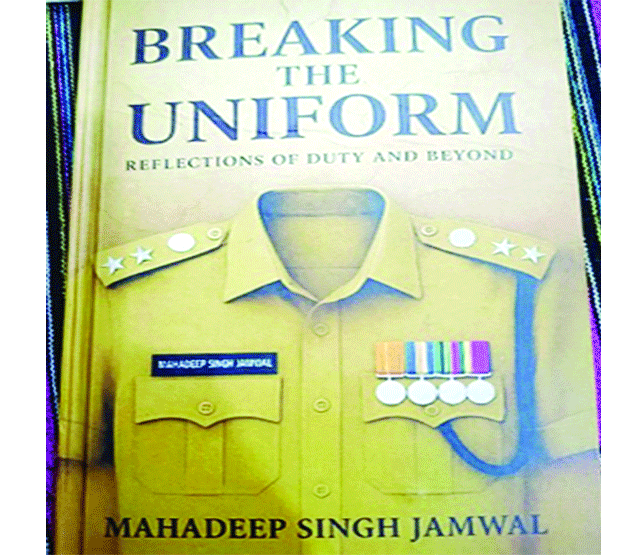
Name of the Book: BREAKING THE UNIFORM
Name of the Author: Sh. Mahadeep Singh Jamwal (Rtd. SSP)
Pages: 110
It is my pleasure to review a book namely “Breaking the Uniform,” which itself is unique and pertains to the most dedicated and disciplined Jammu and Kashmir Police force. This book is written by a veteran who rendered his services in the J&K Police department and retired as an SSP. The author is himself a columnist for many newspapers of J&K and President of the Senior Citizens’ Club, District Udhampur.
This book is written in a continuous sequence, and there are 22 chapters, all interconnected, and I am sure that readers will love to read it. While going through the book, the author has highlighted the importance of the KHAKI UNIFORM, calling it a second skin of the individual who wears it. The khaki is not just a length of cloth, but it shows discipline, dedication, determination, honesty, and commitment. The title of the book justifies its content inside. This book will enhance the morale of young officers and cadets who are dreaming of becoming part of the J&K Police.
The colour of the cover page is also khaki, which shows the emotions and respect towards the J&K Police. The author starts with the history of the Jammu and Kashmir Police, from modest Kotwals to the commanding DGPs of today. The first specific J&K Police force came into existence in 1873 with one police officer known as Kotwal and 14 Thanadars in Srinagar city. In 1913, the state requisitioned the services of an Imperial Police officer and appointed Broadway as the first IGP in June 1913. After Independence, S. Prithve Nadadan Singh was the first Police Chief (1948-1954). The first DGP in 1982 was Peer Ghulam Hassan Shah (1982-1985).
The author also seems to highlight how politics and bureaucracy chain the spirit of policing in such a way that balance is needed here, because one has to serve, but serving selectively sometimes becomes challenging. One phrase on page no. 29 of the book appeals to me a lot: “The bravest battles are fought in silence, not against enemies, but against the storm within.”
The book has such vast material that it cannot be summarised within the limited space provided, but I have tried to highlight important lines. On page no. 36, the author again catches the reader’s attention when he says:
“When the court adjourns, the robe rests.”
“When the operation ends, the white coat hangs.”
“But the khaki has no off hours; it lives between the sunrise and the siren.”
Khaki is not just a colour; it is a conscience tested every day. The book highlights the importance of police-public relationships. Although it is working nowadays, it still needs more reforms in the actions of the police department so that one may not have to travel from pillar to post.
The book is of great importance, showing that justice cannot bend, but humanity must prevail even inside the uniform. Although it is tough, punishment may be necessary, but the innocent should not be hurt. Chapter 8 of the book highlights when, where, and why police deteriorate. The author feels that this happens when a police officer starts bargaining with convenience, and when power grows and overshadows the corridors of justice.
I feel this book must reach the libraries of police training camps and other institutions so that maximum readers can benefit from it. Especially young officers must read this book to understand the true meaning of wearing the uniform. It is not just about authority; it is about responsibility, sacrifice, and moral courage.
In conclusion, Breaking the Uniform is not merely a book, but a mirror that reflects the soul of policing. It educates, inspires, and provokes thought. The author deserves appreciation for presenting such a sincere and meaningful work. This book will remain relevant not only for police personnel but also for anyone interested in understanding the human side of law enforcement.
(The author is Sr. Lecturer, SED Ramnagar)
 Follow our WhatsApp channel
