

Vijay K. Sazawal
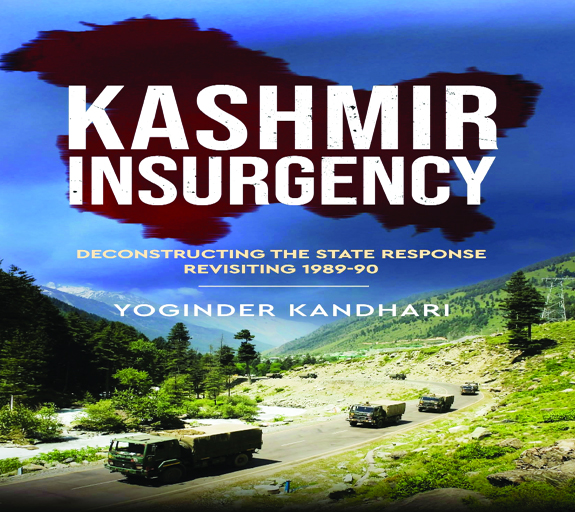
Name of Book : “Kashmir Insurgency”: Deconstructing the State response Revisiting 1989-90
Name of Author : Yoginder Kandhari
When people describe Kashmir as a bundle of contradictions, they merely unpack conflicting truths that shroud the reality of the beautiful vale. Kashmir is indeed a phenomenon, more than the sum of its land and inhabitants; an enigma wrapped in narratives from surreal to sublime.
Retired Colonel Yoginder Kandhari, who served in the Counter-Insurgency (CI) operations of the Indian Army in Kashmir from 1993 to 1997, was intrigued enough by the turmoil in the valley during the 1989-1991 period to write a book about it. The book titled, “Kashmir Insurgency,” conducts a post-mortem of sorts on the insurgency, and describes how it detrimentally affected valley inhabitants in general, and Kashmiri Pandits (KPs) in particular. Col. Kandhari is a native son belonging to the minority community of KPs.
The book actually is an amalgam of two separate and yet inter-connected themes. One deals with what happened in the valley viz-a-viz politically and security wise in the defining years of 1989-1991, the other being what happened to KP’s in the same period during which they fled from their homes and hearths to the misery of refuge camps in the Jammu area. Only a few KP’s remained in the valley and they provided eye-witness accounts of what happened, especially on the night of 10-20 January 1990. No one among this unfortunate community knew two important facts on that fateful night. One that Kashmir was going to see the flag of Pakistan being raised, along with an announcement of a parallel insurgent Government on 26th January 1990, and two, that civil security establishment, meaning the state police chiefs and local heads of the Union Home Ministry intelligence services had mentally accepted its inevitability. Fortunately for its people, the Indian Army rose to the occasion and the rest is history.
However, as clear as that may seem to some, yet others in the Government differed from that point of view. It is here that the author does a superb job of recording events and details through a series of personal interviews. What comes out can be best described as the battle of narratives, including umpteen conspiracy theories, among various vested parties in the valley (Government officials, civil administration, politicians, state police, the Army, the civil society, the insurgents, journalists, and common public), which only exposed the incompetence, malfeasance, corruption, communal bigotry, and anti-nationalism among a broad spectrum of authorities in-charge of ensuring public safety and national security, as well as fanatical elements among the Muslim populace unwilling to accept India as their nation. The author spares no one in his lucid and thought-provoking analysis.
There are several interesting revelations in the book. At the height of insurgency, one could hear calls made by bus drivers running public transportation from Srinagar, “Come on Board – this bus will take you to Sopore or “apore” (across LOC),” or the fact that Mufti Sayeed (or so it is alleged) gave a media house in New Delhi a photograph of Farooq Abdullah with Amanullah Khan and Maqbool Bhat taking an oath on the Quran to liberate Kashmir from the early 1970’s. Even the author, a serving army officer in November 1990, was initially denied assistance by the Chinar Corps HQ, when the same command headquarters was freely dispensing such logistic assistance and protection to local Muslims.
The author’s list of persons with whom he held interactive sessions is fairly long and impressive. However, there appears to be too much made from statements in the book from a few dubious characters that perhaps did not deserve as much space in the book as they received.
Finally, as mentioned previously, this book is really two books in one. Chapters1, 2 and 3, describe the events unfolding in Kashmir during that tumultuous period with a great degree of depth and detail. I believe anyone interested in shaping future policy on Kashmir will be better off in reading these chapters. Its importance lies in the fact that following the recent Assembly elections in the Union Territory, the same set of politicians from the valley are not only heading the Government but also populating the State Assembly, and hence the future does not bode well.
Chapter 4 addresses the fate of Kashmiri Pandits in a comprehensive manner starting from 1931 events that are now recognized as the starting point for the battle of narratives between the local Muslims and Pandits that has only exasperated over time. Sadly, being a miniscule minority, the burden of pain and injustice has fallen mostly on the shoulders of KPs. This book provides a “must read” chapter on the life and times of Pandits today, including the detailed list of KPs killed during the insurgency. The data was painstaking collected by the local Pandit organization, the Kashmiri Pandit Sangharsh Samiti (KPSS).
This book is a valuable addition to the collection of books on Kashmir.
 Follow our WhatsApp channel
