

Arun Srivastava
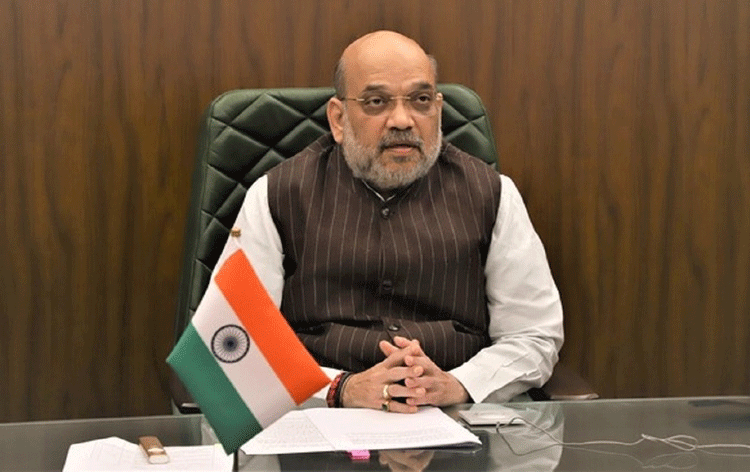
After a long five years’ of enigmatic predicament, Union Home Minister Amit Shah has come out with the repaired manifesto of creating the ninth Union Territory (UT) in India comprising of five districts of Bihar and carving out two districts from West Bengal including ‘Chicken’s Neck’ area or ‘Siliguri Corridor’ in West Bengal and for accomplishing the mission he has even fashioned Demography Commission.
It is worth mentioning that some years back while addressing the nation on Independence Day Prime Minister Narendra Modi from the ramparts of the Red Fort had announced the formation of a “high-powered demography mission” to find the infiltrators. Unambiguously he made his intentions clear. He had said “No country can hand itself over to infiltrators. No nation in the world does so – how then can we allow India to do so?” He said that through the mission, “the severe crisis now looming” over the country will be addressed in a “deliberate and time-bound manner”.
Prime Minister had a well defined mission; to weed out Muslims. Usually Hindu rightist groups use the term “Bangladeshi infiltrator” to target Bangla-speaking Muslims mainly in the states of Bihar, West Bengal and Assam. In Assam, where Modi’s BJP has been in power since 2016, the state government has been running a campaign against Bangla-speaking Muslims, labelling them “outsiders” and accusing them of trying to alter the regional demography.
An insight into the implication of the two phrases would unravel the real intention of Shah, whether it has got a connotation of hate Muslim politics, or simply an administrative exercise. A Union Territory (UT) and a Demography Commission (or related initiatives regarding demographic shifts) are entirely different concepts in the Indian administrative structure. A Union Territory is a type of administrative division, while a Demography Commission is a body tasked with studying or acting upon population data. UT is a federal territory in India that is, unlike a state, is governed directly by the Union (Central) Government. The UT is formed for region that is too small to be an independent state and had distinct cultural identities, or held strategic/national importance.
While a Union Territory is an administrative unit directly controlled and governed by an Administrator or Lieutenant Governor appointed by the President of India. They do not have the same level of legislative and executive autonomy as states. Demography Commission refers to bodies or studies aimed at analysing population changes, often to address security challenges or socioeconomic shifts, especially in sensitive border areas. It focuses on analysing population trends, immigration, and security concerns related to demographic changes in particular regions. It also refers to the broader, political, and security-focused investigation of population structure, often with the aim of addressing changes in that structure. The five demographics include age, gender, religion, income, and education. These are referred to as the family life cycle and socioeconomic status.
A closer look makes it apparent that creation of the ninth UT is not at all an administrative. It is purely a political move. If it really has an administrative orientation, Shah should have directed his ministry officials to carry out the basic studies long back, at least coinciding with the move when the idea of creating UT was mooted. The architypes of creation of UT are well defined: it can be created for Political and administrative reason to ensure better governance, or, to conserve and secure culture of a region distinctive from surrounding state. None of the reasons apply to the latest move of Amit Shah for creating India’s ninth UT. Even after 1947 partition of India, these districts continued to exist and the compulsion to create a UT was never felt. True enough Malda and West Dinajpur are like any other district of Bengal.
Pre-requisite for clubbing the areas for creating a UT is basically similarity in the language, culture, food habit and social relations. None of these four indices has similarity in both the regions. For Amit Shah the only commonality is the Muslims domiciled in the regions of Seemanchal and Malda have their roots in present Bangladesh. Historically the migration of Urdu-speaking Muslims—often referred to Biharis in East Pakistan— are from Bihar’s Nalanda and Nawada. They had shifted to East Pakistan at the time of Pakistan. Following riots in 1950, a reverse migration occurred where Muslims returned from East Pakistan to West Bengal (including Malda) and Seemanchal. These migrants, many of whom were poor artisans, farmers, or labourers, often found themselves in a state of flux, shifting between the two countries due to safety concerns and economic hardships.
In the Seemanchal region, particularly during election cycles, these migrants are referred to by terms “Bhatia” or “Maldahiya”. A specific community mentioned in this context is the Shershahbadi Muslims, who claim to be the original inhabitants of the Malda-Murshidabad region, though they are sometimes wrongly labelled as “Bangladeshi infiltrators”. The seven districts which will constitute UT have a high concentration of Muslim residents. Around 28% of Bihar’s 2.31 crore Muslim population resides in this region. The average Muslim population in these four districts of Seemanchal is approximately 49%. Kishanganj has highest concentration of around 68% of the population.
While Malda has 52 per cent of Muslims, Uttar Dinajpur has 49.92% of the population. Both regions are highly sensitive due to their border location and high Muslim demography, often featuring prominently in election analyses and discussions about population shifts. Seemanchal region has highest percentage of Muslim population in eastern state. Though Modi, Amit Shah and other saffron leaders consistently harped Seemanchal being the heaven for Ghuspaithiya and illegal migrants, the SIR conducted in Bihar could not corroborate the narrative of the BJP. However poll panel cut 65.6 lakh names from draft voter list, published on1 August. Seemanchal region encompasses five districts of Saharsa, Araria, Kishanganj, Purnia and Katihar.
It is worth mentioning that Amit Shah had vowed to remove every infiltrator from Seemanchal (Kishanganj, Araria, Purnia, and Katihar districts in Bihar) and Bengal (west Dinajpur and Malda), claiming that illegal migration has significantly altered the region’s demography.. Obviously the entire region has become a major strategic target for RSS and the “saffron system”. The initiative specifically targets border districts that are considered sensitive gateways, including the “Chicken Neck” (Siliguri Corridor) to the Northeast.
The only common element between the people of these two regions is of their being Muslims but their food habits, culture and social relations are quite apart. Bengalis have high inclination towards non-veg food. They love to have fish and rice where as Biharis prefer normal food. Rabindranath Tagore and Kazi Nazrul Islam are the cultural icons for Muslims of Malda and Dinajpur, the settlers are not their followers. Territories that have distinct cultural identities were made UTs to protect their unique heritage, preventing them from being submerged into neighbouring states. Since the people of two regions did not have same identical cultural identities, no need for creating a UT was felt in the past.
Obviously there is no denying that the latest move has an ulterior design. Initially, areas in the Northeast (e.g., Mizoram, Manipur, Tripura) were made Union Territories to provide special care and development for their tribal populations before they were later granted statehood. If the need was felt, this too could have been created long back. No doubt this is purely an attempt to polarise the Hindu voters in Bihar and especially in Bengal, that is too just ahead of the assembly election. the BJP leaders have planned to whip up the issue of infiltration, carve out a UT, and indulge in the politics of polarisation to reap its benefits in the 2029 Lok Sabha elections. Incidentally RSS has been systematically raising the issue of change of demography in the Seemanchal since Independence, and attribute it to the presence of Bangladeshi infiltrators who have settled illegally.
In the wake of the recent election to Bangladesh Jatiyo Samsad it was alleged that Muslims settled in Bangladesh, adjoining the Indian border had voted for Jamiat e Islami, a party nursing soft corner for Pakistan. But the fact also cannot be ignored that most of the settlers were related to the Mukti Vahini or are the victims of Rajakar terror carried out at the behest of Pakistan during liberation war. During the 1971 war, approximately 10 million people fled East Pakistan to India. While most returned, a significant number, including those who participated in or supported the struggle (Mukti Bahini), settled on the Bangladesh border states like Tripura and West Bengal. The border population is a complex mix of residents with deep historical ties to the land, partition-era refugees, and later migrants, rather than a monolithic group of 1971, combat veterans. (IPA Service)
 Follow our WhatsApp channel
