

Excelsior Correspondent
Name of Book: Valleys of Jammu & Kashmir
Name of Author: Mahmood A Shah
Valleys of Jammu and Kashmir is a coffee table book that takes readers on an extraordinary journey through the remote mountains, passes, peaks, meadows, and high-altitude lakes of Jammu and Kashmir. With 114 stunning images, including flora and fauna, and detailed information on 54 high-altitude lakes, this book offers a unique visual and geographical documentation of the region. Each photograph is accompanied by waypoints, including latitude, longitude, and altitude, making the locations easily traceable on Google Earth. This level of precision not only enhances the book’s authenticity but also makes it a valuable guide for trekking enthusiasts.
The foreward of this book has been written by Garry Weare, a famous Australian trekking who has been trekking in Himalayas for more than 50 years, he has authored lonely planet guide books on Himalayas for 18 years and has written acclaimed books like “A long walk in the Himalayas” “Kashmir A Journey Through History”, he is presently compiling his upcoming book “British in Kashmir”
What sets Valleys of Jammu and Kashmir apart is its exclusivity. While most coffee table books on Kashmir focus on popular locations like Dal Lake, Pahalgam, Gulmarg, and Sonmarg, this book captures the raw, untamed beauty of Jammu and Kashmir’s remote highlands. The images were taken during treks performed over the past 20 years, with only four photographs captured from roadheads-the rest were shot on trekking trails, often in areas inaccessible for most of the year and where weather remains hostile allowing only few photographic opportunities .
The book also showcases the highest lake in Kashmir, Durinar, situated in between the watershed of Sind and Lidder at an altitude of 4,600 meters. This spectacular lake offers breathtaking views of Mount Kolahoi and the Greater Himalayas that extend from Zoji la and beyond . In its neighbourhood, rare alpine flora, such as Rhodiola and Saussurea gossypiphora, can be seen, adding to its charm and grace .
The book is chaptered according to the watersheds of Jammu and Kashmir in an anticlockwise manner starting from the Pir Panjal range, though not in a strict manner however concluding in Kupwara (Lolab). The penultimate image features the High altitude lake Marsar that flows through Dachigam National Park, which, serves as a vital drinking water source for Srinagar and replenishes the Dal Lake. The final panoramic image is of the endangered Hangul, symbolizing the region’s fragile ecosystem and underscoring the need for conservation in the face of global warming and habitat loss.
A unique feature of the book is the inclusion of a detailed map highlighting the occurrence of High-altitude water bodies. This map provides a clear sense of direction and context, helping readers visualize the geographical distribution of these remote and pristine locations around the Kashmir Valley.
Throughout the book, a human element is deliberately included in most images to provide a sense of scale and context. For example, the image from the trail connecting Panikhar with wadwan over the Lonvilad Gali illustrates the effects of global warming. The Glacier, once displayed striking blue ice. Today, due to rising temperatures, the glacier has retreated, and the pass itself transforms into a water body during summers-an alarming testament to climate change in the Himalayas.
The book also showcases Kashmir’s iconic peaks: Kolahoi , Kashmir region’s highest mountain; Harmukh, featured in the Sindh Valley chapter as the second highest; and Trattakuti , peak located in the Pir Panjal range.
In addition to the mountains, the book captures remote passes that connect Kashmir with other regions, such as Chor Gali and Jamian wali Gali, which links Kashmir with Poonch. It also features Zambkash Pass and Drinyan sar Pass, which connect the Chenab Valley with the Jhelum Valley, and Umasila Pass, one of the highest at 5,400 meters, connecting Kishtwar with Zanskar, besides a number of meadows are also showcased, the most famous being Mohano marg where ,Aurel Stein translated Rajtarangni from Sanskrit into English .
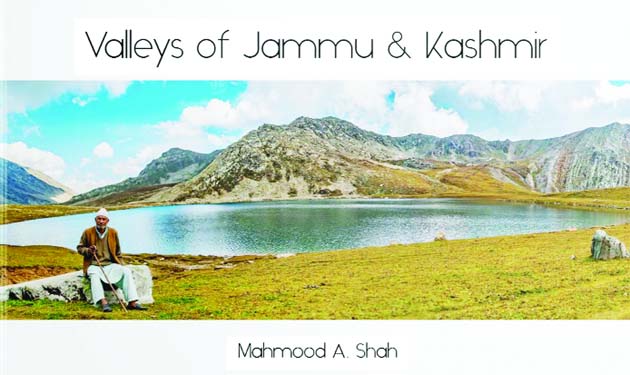
The cover image is a portrayal of Kashmir’s spirit. It features a grand old man sitting on a rock near Chor Nag. During a trek, the author encountered this gentleman, who gladly posed for a photograph. He was visiting his family near the lake, who had brought their cattle for grazing as is often the case during the summer months.
To the author, this man symbolizes the timeless relationship between the people of Kashmir and their mountains-a relationship built on sustainability. The lake in the background embodies the raw and untamed beauty of Kashmir. The image conveys the message that only by preserving this harmonious relationship can we continue to coexist with nature. Over-exploitation, on the other hand, will invite the wrath of Mother Earth.
The back cover image is that of Nandan Sar with a trekker ascending from the lake, capturing the rugged beauty of the middle Himalayas and the spirit of exploration and adventure that defines the book.
Creating this book was a labour of love. While trekking and capturing the images was the fun part, the photo collation and writing the text was laborious and painstaking. The book went through multiple stages-from image curation and processing to designing and final printing. This endeavour took five years to complete, with invaluable contributions from the designer, Mr. Jibran, and the dedicated support of Mr Sehran and Mr Sair, who assisted with the fine-tuning. Despite the challenges, the book stands as a testament to the author’s passion and commitment.
The book also aims to promote lesser-known trekking trails to prevent the over-exploitation of popular ones. The Great Lakes trek, for example, is now operating beyond its carrying capacity. By dispersing trekking activity to other equally spectacular trails, the book hopes to encourage sustainable tourism and provide livelihood opportunities for people living in remote regions.
Valleys of Jammu and Kashmir is more than just a coffee table book-it is a visual tribute to Jammu and Kashmir’s grandeur and a clarion call for its conservation. It highlights how Jammu and Kashmir complements and supplements the trekking landscape of the country. During summers, when the rest of India is drenched in monsoons, Kashmir offers perfect trekking conditions. Conversely, when Kashmir becomes cold from October to May, trekking activities shift to other regions of the country. This seasonal complementarity makes Kashmir an indispensable part of India’s trekking ecosystem.
Ultimately, Valley aims to present the adventure and beauty of trekking in Jammu and Kashmir to both domestic and international audiences. It stands as a testament to the region’s safety, as the author’s two decades of trekking experience demonstrate that the mountains of Kashmir are ready to welcome nature enthusiasts and adventurers from around the world.
The book is available for sale within India on Amazon and Kashmir Box, while for international sales, it can be purchased through KashmirBox.com
 Follow our WhatsApp channel
