

Production Linked Incentive (PLI) Scheme
S K Sharma
India has recently emerged as the most populous country in the world, surpassing China with a population exceeding 147 crore, compared to China’s 141 crore. This demographic shift presents both an opportunity and a challenge. With nearly 65% of its population falling within the working-age group,
India possesses a significant demographic dividend. However, generating adequate employment opportunities for such a vast and youthful population has remained a persistent challenge for policymakers.
Historically, employment in India was largely associated with government jobs. Over time, however, the concept of employment has undergone a transformation. Today, it encompasses all forms of gainful economic activity, including self-employment, private sector jobs, and entrepreneurial ventures. Despite this evolution, unemployment continues to be a critical concern.
When the present government assumed office in 2014, the unemployment rate stood at approximately 4.9%. In the years that followed, unemployment witnessed fluctuations, at times rising before stabilizing in the range of 4.7% to 5% in recent years. Managing unemployment alongside sustaining economic growth has therefore remained a delicate balancing act.
Structure of India’s Economy
India’s national income is broadly derived from three major sectors:
* Primary Sector (Agriculture and Allied Activities):
This sector includes agriculture, livestock, forestry, and mining. It currently contributes around 15-20% to India’s Gross Domestic Product (GDP), with agriculture being the dominant component.
Secondary Sector (Industry and Manufacturing):
This sector comprises manufacturing, construction, and electricity generation. It contributes approximately 25-30% to GDP and plays a vital role in industrial development and job creation.
Tertiary Sector (Services):
The services sector is the largest contributor, accounting for nearly 50-60% of GDP. It includes activities such as finance, real estate, trade, transport, tourism, and public administration.
A notable structural transformation has taken place since independence. In 1947, agriculture contributed around 50-55% to national income. Over the decades, this share has declined significantly to approximately 16-18% today. This shift reflects the growing importance of manufacturing and services in driving economic growth. However, a large proportion of the population still depends on agriculture for livelihood, highlighting structural imbalances within the economy.
Genesis and Objectives of the PLI Scheme
In response to these challenges, the Government of India introduced the Production Linked Incentive (PLI) Scheme in 2020. The scheme forms a cornerstone of the broader initiatives of Aatmanirbhar Bharat (Self-Reliant India) and Make in India.
The primary objective of the PLI scheme is to transform India into a global manufacturing hub. It achieves this by offering financial incentives to companies based on incremental production and sales of goods manufactured within the country. With a total outlay of approximately ^1.97 lakh crore, the scheme represents one of the most ambitious industrial policy interventions in recent times.
Scope of the PLI Scheme
The PLI scheme covers 14 strategic sectors, selected for their potential to generate employment, reduce import dependence, and enhance export competitiveness. These sectors include:
* Electronics and IT hardware
* Pharmaceuticals and medical devices
* Automobiles and auto components
* Advanced chemistry cell batteries
* Telecom and networking products
* Textile products
* Food processing
* Specialty steel
* White goods such as air conditioners and LED lights
* High-efficiency solar photovoltaic modules
* Drones and drone components
The selection of these sectors reflects a strategic focus on areas where India can build competitive advantage and achieve scale.
Key Objectives of the Scheme
The PLI scheme is not merely a subsidy program; it is designed to bring about structural changes in the economy. Its core objectives include:
* Import Substitution:
Reducing dependence on imports, particularly from countries like China, in critical sectors such as electronics and pharmaceuticals.
Export Promotion:
Encouraging domestic manufacturers to achieve global standards and use India as a base for exports.
Value Addition:
Promoting deep manufacturing by incentivizing production of components and intermediate goods, rather than mere assembly.
Employment Generation:
Creating large-scale job opportunities across sectors, with an estimated potential of generating over 60 lakh jobs in the coming years.
Mechanism of the PLI Scheme
The scheme operates on a performance-based incentive model. This ensures that incentives are linked directly to actual production and sales performance.
* A base year is identified for each sector.
* Companies are required to achieve incremental sales over this base year.
* Incentives, typically ranging from 4% to 6% (and higher in some sectors), are provided on these incremental sales.
* The scheme generally operates for a duration of five to six years.
This design ensures efficiency, accountability, and optimal utilization of public funds.
Impact and Achievements
Since its launch, the PLI scheme has yielded significant results:
Production: Over Rs 7.5 lakh crore worth of production has been generated.
Investment: Investments exceeding Rs 3.2 lakh crore have been attracted.
Employment: Approximately 11.5 lakh direct jobs have been created.
Exports: Exports worth Rs 3.2 lakh crore have been recorded, with notable growth in smartphone exports.
India has emerged as the world’s second-largest smartphone manufacturer, a testament to the effectiveness of the scheme. Furthermore, the scheme has strengthened supply chains and enhanced India’s strategic autonomy in key sectors such as electronics, pharmaceuticals, and telecommunications.
Countries such as the United States (through the CHIPS Act), China (Made in China 2025), Japan, and South Korea have implemented similar initiatives, underscoring the global relevance of such policies.
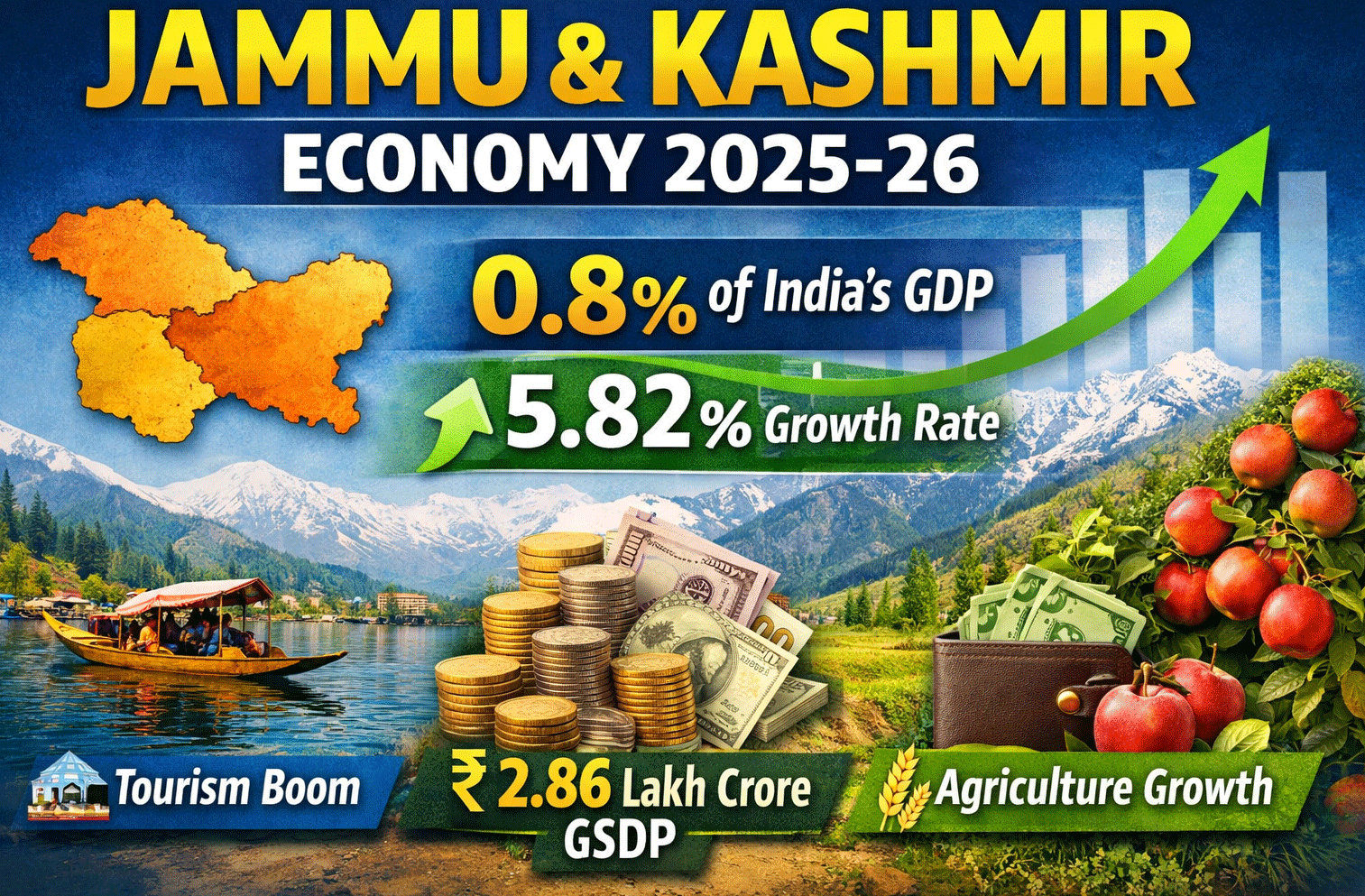
Jammu & Kashmir: Sources of Income
The economy of Jammu & Kashmir (J&K), now a Union Territory, presents a unique case. It is characterized by a high dependence on central government assistance, alongside growing internal revenue generation.
Overall Revenue Composition
The revenue structure of J&K comprises three major components:
* Grants-in-Aid from the Central Government: Approximately 56%-65%
* Own Revenue: Around 22%-30%
* Borrowings and Other Receipts: About 10%-15%
The substantial share of central assistance reflects the region’s developmental and security requirements.
Internal Revenue Structure
J&K’s own revenue can be broadly classified into:
* Tax Revenue (Approximately 65%)
* State Goods and Services Tax (SGST)
* Excise duty
* Motor vehicle taxes
* Stamp duty and registration fees
* Sales tax/VAT (primarily on petroleum products)
* Non-Tax Revenue (Approximately 35%)
* Power sector receipts (major contributor)
* Water usage charges
* Forestry and wildlife revenue
The power sector, in particular, plays a crucial role in non-tax revenue generation.
Sectoral Contribution to J&K’s Economy
The Gross State Domestic Product (GSDP) of J&K is distributed as follows:
* Services Sector: Approximately 61 %
Driven by tourism, trade, and public administration. Tourism serves as the backbone of the private economy.
* Agriculture and Allied Sector: Around 20%
Includes horticulture products such as apples, saffron, and walnuts.
* Industrial Sector: Approximately 19%
Dominated by handicrafts, handlooms, and small-scale industries.
Unemployment Scenario in J&K
Despite these contributions, unemployment remains a significant issue in the region. As per recent data:
* Unemployment Rate: Approximately 6.7%
* National Average: Around 3.5%
* Job Seekers: Nearly 4.73 lakh individuals
This indicates that unemployment in J&K is considerably higher than the national average, necessitating targeted policy interventions.
Need for Industrial Development in J&K
The industrial sector’s contribution of around 19% to the region’s economy is relatively low. Given the high unemployment rate, there is an urgent need to strengthen this sector.
J&K’s geographical constraints, including its remote location and challenging terrain, make industrial development difficult. Therefore, special incentives and policy support from both the Union Government and the UT administration are essential.
In this context, extending and adapting schemes similar to the PLI scheme for J&K could play a transformative role. Such initiatives can:
* Encourage domestic manufacturing
* Attract private investment
* Generate employment opportunities
* Reduce regional economic disparities
Innovative and “out-of-the-box” approaches will be crucial in unlocking the region’s economic potential.
The Production Linked Incentive (PLI) scheme has emerged as a powerful tool for promoting manufacturing, enhancing exports, and generating employment in India. By incentivizing performance and encouraging investment, the scheme has contributed significantly to economic growth.
In regions like Jammu & Kashmir, where unemployment remains a pressing concern and industrial development is limited, similar targeted interventions can yield substantial benefits. Strengthening the manufacturing base in such regions will not only boost economic activity but also provide sustainable employment opportunities to the youth.
In conclusion, the PLI scheme stands as a testament to the government’s commitment to fostering self-reliance, economic resilience, and inclusive growth. With continued policy support and effective implementation, it has the potential to reshape India’s economic landscape and address one of its most critical challenges-employment generation.
(The author is IRS Officer, Retd.)
 Follow our WhatsApp channel
