

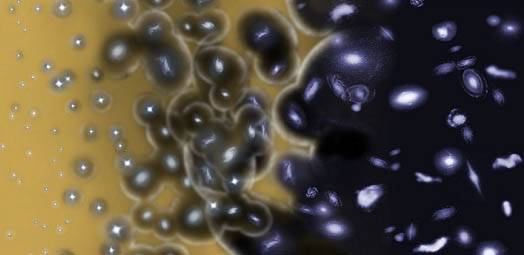
LONDON : The first stars in the universe started forming much later than previously thought, a new study has found.
The new analysis of data from European Space Agency’s Plank space telescope shows that the stars were the only sources needed to account for reionising atoms in the cosmos, having completed half of this process when the universe had reached an age of 700 million years.
At that early phase, the universe was a hot, dense primordial soup of particles, mostly electrons, protons, neutrinos, and photons – the particles of light.
In such a dense environment the universe appeared like an ‘opaque’ fog, as light particles could not travel any significant distance before colliding with electrons.
As the cosmos expanded, the universe grew cooler and more rarefied and, after about 380,000 years, finally became ‘transparent’.
By then, particle collisions were extremely sporadic and photons could travel freely across the cosmos.
Today, telescopes can observe this fossil light across the entire sky as the Cosmic Microwave Background or CMB.
Its distribution on the sky unveils tiny fluctuations that contain a wealth of information about the history, composition and geometry of the universe.
The release of the CMB happened at the time when electrons and protons joined to form hydrogen atoms. This is the first moment in the history of the cosmos when matter was in an electrically neutral state.
A few hundred million years passed before these atoms could assemble and eventually give rise to the universe’s first generation of stars.
As these first stars came to life, they filled their surroundings with light, which subsequently split neutral atoms apart, turning them back into their constituent particles: electrons and protons.
Scientists refer to this as the ‘epoch of reionisation’. It did not take long for most material in the universe to become completely ionised, and – except in a very few, isolated places – it has been like that ever since.
Observations of very distant galaxies hosting supermassive black holes indicate that the universe had been completely reionised by the time it was about 900 million years old.
The starting point of this process, however, is much harder to determine and has been a hotly debated topic in recent years.
In 2015, the Planck Collaboration showed that the reionisation epoch process was about half-way through when the universe was around 550 million years old.
A new analysis of data from Planck’s High-Frequency Instrument (HFI) shows that reionisation started even later.
“The highly sensitive measurements from HFI have clearly demonstrated that reionisation was a very quick process, starting fairly late in cosmic history and having half-reionised the universe by the time it was about 700 million years old,” said Jean-Loup Puget principal investigator of Planck’s HFI. (AGENCIES)
^^
 Follow our WhatsApp channel
