

Excelsior Correspondent
JAMMU, Aug 13: Amid unrest and curfew restrictions, the holy mace of Lord Shiva, ‘Chhari Mubarak’, today joined the annual Amarnath yatra, marking the concluding phase of the 48-day long pilgrimage to 3,880 metre cave shrine in deep Himalayas of south Kashmir district of Anantnag.
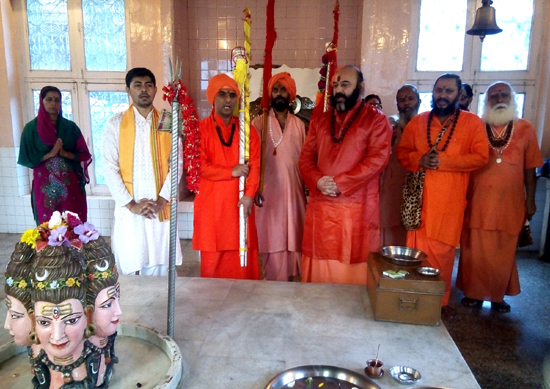
Amid chanting of Vedic hymns, Sadhus and devotees led by, Mahant Deependra Giri, custodian of saffron robed-mace left from its abode at Amareshwar Temple Dashnami Akhara near Lal Chowk, Srinagar this morning for Pahalgam base camp along the traditional 42-km route to the holy cave, officials said.
On way to Pahalgam, they said, holy mace was taken to various temples, including historic Martand Temple at Mattan, and prayers were offered.
The officials said special prayers were also offered at Sureshwar Temple in Srinagar, Shiv Temple at Pampore in Pulwama, Shiv Temple at Bijbehara, Ganesh Temple across river Lidder, Ganeshbal and Gouri Shankar temple in Anantnag district.
The Chhari Mubarak will reach the holy cave on Shravan Purnima falling on August 18 and coinciding with ‘Raksha Bandhan’ festival which officially marks the culmination of the annual yatra.
The yatra began on July 2 from the twin routes of Pahalgam in Anantnag district and the shorter 12-km Baltal route in Ganderbal district. So far over 2.19 lakh pilgrims had paid obeisance at the cave shrine.
Early this month, the Chhari Mubarak was taken to various temples, including Shankaracharya and Sharika Bhawani in the city, and special prayers were offered in accordance with the tradition.
‘Chhari-Sthapana’ and ‘Dhwajarohan’ ceremonies were also performed at Dashnami Akhara on August 5 followed by traditional Chhari-Pujan on August 7.
After a night halt at Pahalgam, special prayers would be offered at Pahalgam tomorrow before the start of the onward foot journey to the cave shrine next day.
After leaving Pahalgam, the officials said the Chhari Mubarak will be taken to Chandanwari for the second night halt on ‘Dwadashi’.
It will be taken to Sheshnag on ‘Tryodashi’ (August 16) and would leave for Panchtarni on ‘Chaturdashi’ (August 17). On August 18, the Chhari Mubarak would proceed to holy cave for prayers from Panchtarni on the occasion of ‘Raksha Bandhan’ and ‘Shravan Purnima’.
Traditional rituals would be performed for the whole day at the cave and the holy mace would leave for night halt at Panchtarni before dusk.
On August 19, the holy mace would be taken to Pahalgam for night halt, he said adding ‘Pujan’ and ‘Visarjan’ ceremonies would be performed on the banks of river Lidder next day followed by traditional ‘Kari Pakouri Bhandara’, which is the last ritual in connection with the religious pilgrimage.
The holy mace would return to its abode at Amareshwar temple in Srinagar on August 20, the officials said.
The ongoing unrest has badly affected the arrival of the pilgrims from different parts of the country as only over 19,000 pilgrims could perform the yatra during the past 16 days.
Last year, a total of 3.52 lakh pilgrims had visited the cave shrine for ‘darshan’ of the naturally formed Shivlingam.
Meanwhile, on 43rd day of the yatra, 193 pilgrims paid obeisance at holy cave today. With this the total number of pilgrims performing darshan in cave shrine till date has touched 2,19,794.
According to an official spokesman 82 pilgrims left from Chandanwari base camp to cave shrine while five pilgrims left by chopper from Pahalgam base camp. He said 15 pilgrims are staying at Nunwan –Pahalgam base camp for night halt.
He said 77 pilgrims left the Baltal base camp for holy cave this morning while no pilgrim came from Jammu to Baltal base camp for darshan today.
 Follow our WhatsApp channel
