

Suhail Bhat
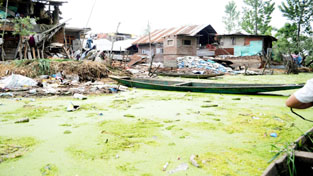
SRINAGAR, May 25: Ridiculing the National Wetland conservation mission and lack of Ecological centric models is pushing the Khushar Sar – a lake converted into wetland on the fringes of Old City here – to extinction.
Everyday thousands of gallons of untreated sewage is being dumped into the wetland which has turned the waters poisonous leading to extinction of natural vegetation, fish and other aquatic life besides engulfing the neighbourhood with a foul stink thereby putting the inhabitants vulnerable to life threatening diseases.
Nestled between Hawal and Zadibal areas, Khushalsar is connected to another wetland, Gilsar, which receives waters from Dal Lake. Both gradually flow into Anchar which in itself is connected with the Dal Lake through a waterway called Nullah Aamir Khan.
Unregulated urbanisation along the wetland peripheries which has finally resulted in its encroachment has shrunk to a few square kilometres. Ironically, no one owes the wetland and authorities are shifting the blame from one department to another. Srinagar Development Authority (SDA), Srinagar Municipal Corporation (SMC) and Lakes and Water Ways Development Authority (LAWDA), formed to look after water bodies, said that it did not come under their domain.
As per the survey conducted by the Kashmir University Earth Sciences Department, there has been nearly 40 percent decrease in the size of this wet land during last half century.
In year 1965, it was spread over a sprawling 0.96 square kilometres but now it has been left to mere 0.6 square kilometres which is a worrying sign for the environmentalists owing to its importance in the biodiversity and climate change.
“These wetlands trap the excess carbon dioxide and nitrogen from the atmosphere thereby directly reducing chances of global warming. Degradation of these wetlands has visible consequences as we receive less snowfall and normal cycle of seasons has changed to some extent,” said Maqsood Ahmad, a PhD scholar at Kashmir University.
When contacted, Fayaz Ahamd Khan, who is the Joint Commissioner of SDA, said: “Unfortunately it has been no man’s land and everyone is having gala time here. We have had several meeting with different stake holders but none has come up with a feasible plan to conserve it. It is ultimately our collective loss. Lack of vision has lead to its degradation.”
Head of the Department Earth Sciences, Professor Shakil Romshoo, while explaining the importance said that the it was one of the urban wetlands which are just like sponges that soak all the natural drainage and the fact that these wetlands were linked together. They were excellent means to divert water during floods besides being helping in maintaining ecological and hydrological balance.
“It is linked to Nigeen Lake along with Gilsar Lake via Nalamar canal. So almost all the water bodies were linked together and in case of emergency or excess of water in the major water bodies they used to house the extra water,” he said.
Sarmand Hafeez, the Vice Chairman of LAWDA, has recently revealed in a compliance report filed before High Court that a pre-feasibility report was submitted to Government of India for conservation of Anchar, Khushalsar and Gilsar wetlands but it was refused with observation that such projects can be considered only after sewage of the area was taken care of.
 Follow our WhatsApp channel
