

A Reflection on Environmental Responsibility and Sustainable Communities
Divya Sharma
biotech.divyakhajuria@gmail.com
Earth is my mother and I am her child.
As the world prepares to observe World Environment Day, humanity is once again reminded of a truth that is both simple and profound: Earth is not merely a physical space where life exists—it is our only home. It is the silent foundation of our survival, the source of every breath we take, every drop of water we drink, and every form of life that sustains our existence.
Yet despite depending entirely upon nature, modern society has increasingly distanced itself from it. In the race for urbanization, industrial growth, convenience, and consumption, we have forgotten that human progress can never exist separately from environmental well-being. The environmental crisis we witness today is not the result of a single event—it is the cumulative outcome of years of negligence, unsustainable practices, and weakening civic responsibility.
There was once a time when nature was deeply woven into everyday human life. Childhood meant running barefoot on soft green grass, climbing trees without fear, sitting beneath open skies, and playing near rivers untouched by pollution. The air felt cleaner, surroundings appeared healthier, and public spaces reflected a stronger sense of collective care. Nature was not viewed as a separate entity to be exploited; it was respected as a companion and protector of life itself.
Today, however, those memories stand in sharp contrast to the reality surrounding us.
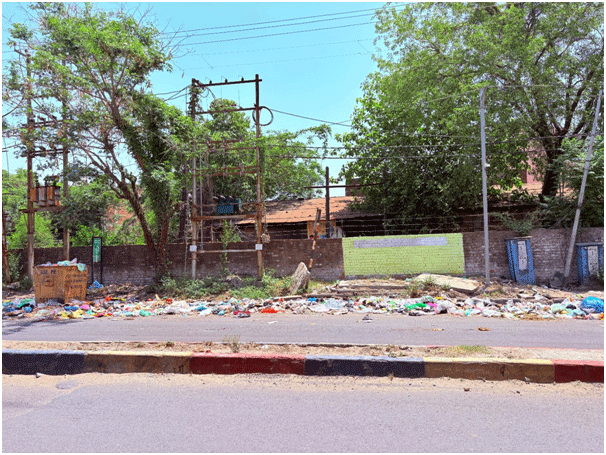
The image from Ward No. 1, Jawahar Nagar, Kathua, showing unchecked garbage accumulation along the roadside, is not merely an unpleasant visual—it is a disturbing reflection of a much deeper societal problem. At first glance, it may appear to be a simple sanitation issue or an instance of inefficient waste management. But in reality, it symbolizes the gradual decline of civic consciousness and the normalization of environmental neglect within our communities.
The waste scattered outside residential areas does not emerge overnight. It accumulates slowly through repeated acts of carelessness—plastic wrappers thrown casually onto roads, household garbage dumped in open spaces, and a collective tendency to assume that cleanliness is solely the responsibility of municipal authorities. Over time, these seemingly “small” actions create serious environmental and public health consequences.
What we often dismiss as “just garbage” becomes a source of pollution, disease, and ecological damage. Open waste attracts stray animals, creates breeding grounds for flies and mosquitoes, contaminates soil and water sources, and produces foul odours that affect the quality of life of nearby residents. During rainfall, this waste blocks drainage systems, resulting in waterlogging and unhygienic conditions that can quickly escalate into larger public health crises.
However, perhaps the most alarming aspect is not the existence of garbage itself, but our growing acceptance of it.
Repeated exposure to polluted surroundings gradually desensitizes society. Streets filled with waste become ordinary sights rather than matters of concern. Public spaces lose their value, and environmental degradation slowly becomes normalized. When people stop questioning polluted surroundings, society enters a dangerous state of indifference where negligence replaces accountability.
This raises deeply important questions:
• Why does civic responsibility often end at the boundaries of our homes?
• Why are public spaces treated as somebody else’s responsibility?
• Why do we continue blaming systems while ignoring our own daily behaviour?
• And most importantly, what kind of environment are we leaving behind for future generations?
The truth is uncomfortable but unavoidable: environmental destruction is not caused only by industries, governments, or large-scale systems. It is also shaped by everyday human behaviour. Every act of littering, every unnecessary use of plastic, every tree cut without replacement, and every instance of environmental ignorance contributes to a crisis that eventually affects everyone equally.
The environmental challenges faced globally today—including climate change, pollution, deforestation, biodiversity loss, rising temperatures, shrinking water resources, and extreme weather events—are all interconnected consequences of human actions.
In ecologically sensitive regions like Jammu & Kashmir, these impacts are becoming increasingly visible. Irregular rainfall patterns, landslides, rising temperatures, changing seasons, and environmental instability clearly indicate how fragile our ecosystem has become. Nature continuously sends warnings, yet human society often responds only after disasters occur.
One of the greatest environmental threats today is plastic pollution. Single-use plastics have entered every corner of human life—from streets and drains to rivers, oceans, and even food chains. Plastic waste not only pollutes ecosystems but also harms animals, destroys soil fertility, and remains in the environment for hundreds of years. Similarly, uncontrolled urbanization and deforestation are reducing green spaces and weakening nature’s ability to restore ecological balance.
Despite these alarming realities, hope still exists.
Across the world, growing environmental awareness among students, educators, youth groups, and local communities demonstrates that positive change is still possible. Educational institutions can play a transformative role by nurturing environmentally conscious citizens through eco-clubs, plantation drives, awareness campaigns, waste management education, and sustainable practices.
Environmental education must move beyond textbooks and become part of everyday behaviour. Cleanliness should not be limited to symbolic campaigns conducted once a year; it should become a social habit rooted in responsibility and respect for shared spaces.
True environmental change begins with simple but consistent actions:
• Avoiding littering in public places
• Segregating household waste responsibly
• Reducing plastic consumption
• Conserving water and electricity
• Planting and protecting trees
• Participating in community cleanliness initiatives
• Encouraging environmental awareness among children and families
Individually, these actions may appear small. Collectively, however, they possess the power to transform communities and protect ecosystems.
A truly developed society is not measured solely by modern buildings, roads, or technological advancement. Real development is reflected in the behaviour of its citizens—their respect for public spaces, their awareness towards environmental protection, and their willingness to act responsibly even when nobody is watching.
The image from Kathua should therefore not be viewed as just another instance of urban waste. It should serve as a mirror for society—a reminder that environmental degradation often begins with ordinary negligence and silent acceptance.
It should compel every reader to pause and reflect:
Am I contributing to this problem in any way?
Because the environmental crisis of today is not created by one major act alone. It is the outcome of countless small acts of irresponsibility repeated over time until they become normalized within society.
A truly developed society is not measured solely through infrastructure, technology, or urban growth. Real development is reflected in the awareness, civic sense, and responsibility of its people towards the environment they share.
The Earth does not need temporary speeches or symbolic campaigns—it needs genuine awareness, responsible action, and collective accountability. The garbage lying outside residential areas is not merely waste on the roadside; it is a reminder of what happens when society ignores its environmental responsibilities.
If we continue neglecting nature today, future generations will inherit not a healthy planet, but a polluted and weakened world struggling to sustain life. Therefore, environmental protection can no longer remain optional—it has become a necessity and a shared responsibility of every citizen.
Because when nature suffers, humanity cannot remain untouched.
And when Earth is gone, there will be no second home left for us to return to.
 Follow our WhatsApp channel
