

Ranbir Singh Pathania
rspathaniamla@gmail.com
The national conversation on illegal immigration, border security, and citizenship has now been pushed to the centre stage of India’s public discourse. Union Home Minister Amit Shah has repeatedly affirmed the Government of India’s resolve that illegal infiltration and unlawful settlement cannot be allowed to undermine India’s sovereignty and internal security.
In that backdrop, recent developments in West Bengal deserve serious attention.
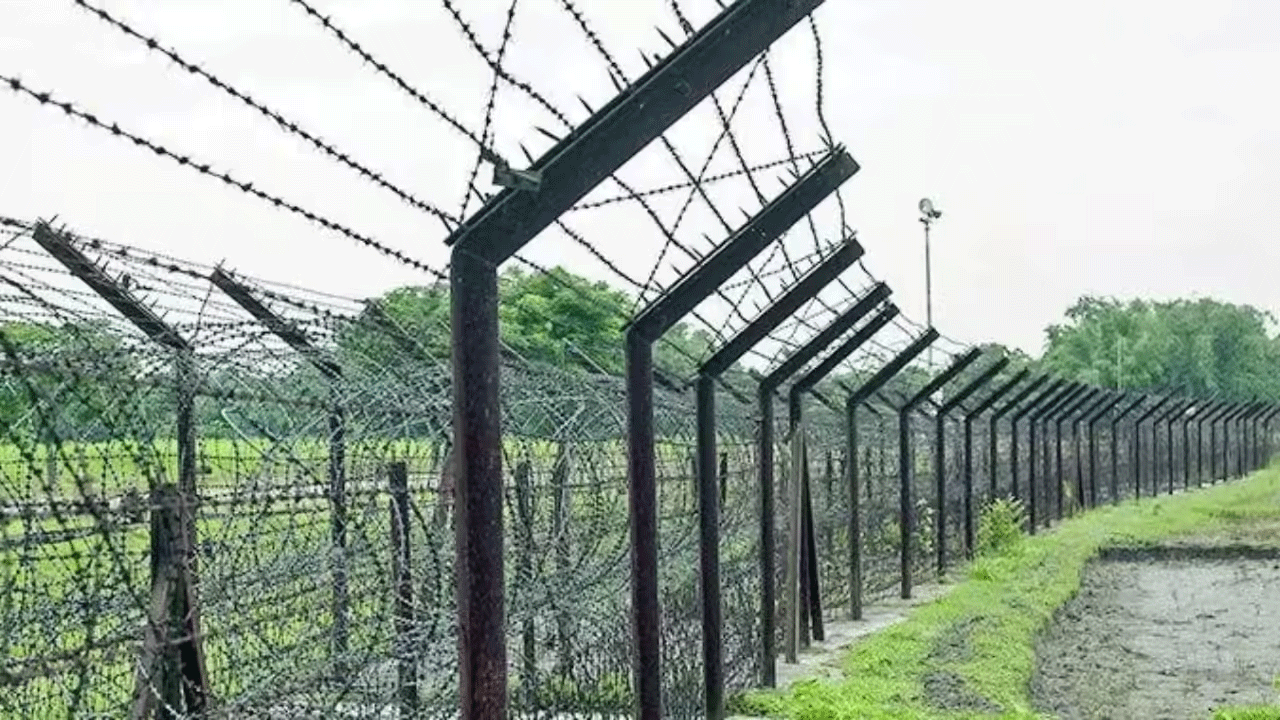
For decades, concerns over illegal immigration, cross-border trafficking and security vulnerabilities along Bengal’s long border with Bangladesh remained trapped between policy paralysis and administrative inertia. But recent measures relating to border infrastructure and greater coordination with central agencies indicate a visible shift towards a sturdier and more security-conscious approach.
This shift is not merely administrative; it is strategic. Chronological. Calculated. With a long-term vision.
The Siliguri Corridor – India’s Achilles Heel – ‘Chicken Neck’ – connects the entire North-East with the Indian mainland. Any disturbance in this narrow stretch has direct implications for national security and military logistics. The Doklam standoff had already exposed the strategic fragility of this geography. Any hostile disruption there would threaten connectivity and supplies to the entire North-Eastern region.
The message is loud and clear – border management is too sensitive an issue to be looked over lightly in a country facing persistent security challenges.
With the Citizenship Amendment Act and an increased emphasis on internal security, the issue of citizenship is no longer merely bureaucratic. It lies at the heart of sovereignty of our country and its day to day governance.
Every nation ultimately rests on two essentials – non porous borders and an identifiable citizenry. Once uncertainty or frailty builds around them, pressure inevitably builds on law enforcement, public resources, social stability and institutional trust.
Issues relating to undocumented foreign nationals, illegal settlements and security-sensitive encroachments cannot simply be brushed aside as routine administrative matters. They demand seriousness, transparency and lawful enforcement.
At the same time, this debate must remain within constitutional boundaries. It should not descend into prejudice or political hysteria. A democratic State must always act with fairness, due process and humanitarian sensitivity. But democracy also cannot become an excuse for administrative paralysis where illegality is allowed to acquire permanence.
Few regions in India have suffered the consequences of infiltration, proxy warfare and externally sponsored destabilisation as intensely as Jammu & Kashmir. Here, the scars of history are not distant memories; they remain part of a live reality.
Rather the matter in issue carries an even deeper historical and security dimension.
It is worth remembering that after the tribal invasion of 1947, Maharaja Hari Singh enacted the Enemy Agents Ordinance of Jammu & Kashmir. Though framed during wartime, its central principle was unambiguous: the State cannot remain indifferent to forces acting against its sovereignty, security and public order.
That principle remains relevant even today.
Rohingya settlements in J & K having forged documents, living on encroached lands and their family members committing crimes and involved in anti-social and even anti-national activities are really a tiger we all have to ride on.
For decades, Jammu & Kashmir has confronted terrorism, infiltration and organised attempts to disturb peace through networks operating both across and within the border. The challenge has never been merely territorial. It has consistently pivoted around attempts to convert external infiltration into internal instability.
West Bengal’s evolving administrative approach demonstrates that when the Union and a State Government act with coordination and clarity, difficult security questions can be addressed institutionally rather than politically.
Jammu & Kashmir requires a similarly focused framework.
The roadmap is neither extreme nor complicated.
First, a transparent district-wise verification and documentation exercise involving the civil administration, police and intelligence agencies.
Second, lawful action concerning Rohingyas, undocumented foreign nationals and unauthorised settlements strictly within constitutional safeguards and due process.
Third, stronger coordination between the Union Territory administration and central agencies on border management, intelligence-sharing and security infrastructure.
The rule of law has meaning only when it is enforced fairly, consistently and without hesitation. Jammu & Kashmir has always stood at the frontline of India’s unity and sovereignty. It cannot afford drift or ambiguity on matters directly linked to national security and demographic stability.
The moment demands clarity, political maturity and administrative resolve.
Peace, stability and security in Jammu & Kashmir are not merely regional concerns. They are inseparable from India’s national strength.
Let us we all stand united and tall.
(The author is a member of J&K Legislative Assembly.)
 Follow our WhatsApp channel
