

Sadaket Ali Malik
sadaketjammu@gmail.com
The Chenab Valley region, comprising the districts of Doda, Kishtwar, and Ramban in the Union Territory of Jammu and Kashmir, represents one of the most intricate and historically layered linguistic landscapes in the Indian subcontinent. This mountainous region, marked by geographical isolation and cultural continuity, has preserved a distinct ethnolinguistic identity that is deeply rooted in the Western Pahari linguistic tradition. Despite this, the official statistical representation of the region, particularly in the Census of India 2011, fails to accurately capture the true linguistic character of its population. This analytical study seeks to examine the linguistic composition of the Chenab Valley, identify discrepancies in official data, and establish the predominance of Pahari languages through a critical evaluation of available statistics and scholarly evidence.
The foundation of the Pahari identity in the Chenab Valley lies in the classification established by the Linguistic Survey of India conducted under Sir George Abraham Grierson, which categorizes the Indo-Aryan languages of the Himalayan belt into three major groups: Eastern (Nepali), Central (Kumauni and Garhwali), and Western Pahari. The languages spoken in Doda, Kishtwar, and Ramban-such as Bhaderwahi, Kishtwari, Padri, Sarazi, Pogali, and Rambani-have been consistently identified by linguists as belonging to the Western Pahari group. These languages share structural, phonetic, and lexical similarities, forming a continuous linguistic chain that transcends administrative boundaries and reflects a shared historical evolution.
An examination of the Census 2011 mother tongue data reveals a fragmented and inconsistent representation of this linguistic reality. In Doda district, with a population of approximately 4.1 lakh, Kashmiri is recorded as the dominant language with over 2,27,543 speakers, often exceeding three lakh when sub-entries are combined. However, this category includes localized variants that are significantly different from standard Kashmiri and exhibit strong affinities with Western Pahari dialects. Bhaderwahi, recorded with 81,999 speakers, stands out as a major indigenous language, while Siraji or Sarazi dialects account for approximately 50,000 to 60,000 speakers. Hindi is recorded with approximately one to one and a half lakh speakers, though its role is largely administrative. Gojri contributes around 30,000 speakers, reflecting the presence of pastoral communities. When these figures are analyzed collectively, it becomes evident that a substantial portion of the population speaks languages that are either part of or closely related to the Pahari linguistic group.
In Kishtwar district, with a population of approximately 2.3 lakh, the linguistic profile further strengthens the case for Pahari predominance. Kishtwari, an indigenous language recognized by linguists as part of the Western Pahari group, is recorded with approximately 38,459 speakers along with an additional 33,127 under related entries, bringing the total to over 70,000 speakers. Kashmiri again appears as a dominant category, with figures ranging between 1.5 to 2.5 lakh when combined entries are considered, while Hindi and Gojri account for approximately 64,000 and 33,000 speakers respectively. The presence of a large Kishtwari-speaking population, combined with the overlap of Kashmiri and Pahari linguistic features, indicates a strong and cohesive Pahari linguistic base in the district.
Ramban district presents a more complex but equally revealing linguistic scenario. With a population of approximately 2.8 lakh, Kashmiri is recorded with more than 1.6 lakh speakers, while Hindi accounts for around 70,000 speakers. Gojri and Dogri contribute approximately 30,654 and 29,078 speakers respectively. A particularly significant feature of the Ramban data is the “Others” category, which includes nearly 48,000 speakers. This category likely encompasses languages such as Pogali, Rambani, and other Western Pahari dialects that have not been individually classified. In addition, direct entries of “Pahari” are recorded in regions such as Banihal (6,816 speakers), further confirming the presence of Pahari identity, albeit in an underrepresented form.
The cumulative analysis of these statistics reveals a pattern of systematic fragmentation. Languages that are linguistically related and historically classified under the Western Pahari group are recorded under separate categories such as Bhaderwahi, Kishtwari, Kashmiri, Hindi, and “Others,” thereby obscuring their common identity. This fragmentation is further compounded by the presence of linguistically incongruent entries such as Magadhi, Rajasthani, Haryanvi, and Dhundhari, which indicate possible errors in enumeration and classification. As a result, the true extent of the Pahari-speaking population is significantly underreported in official data.
When the available statistics are reinterpreted by grouping all Western Pahari languages under a unified framework, a different picture emerges. Directly identifiable Pahari languages such as Bhaderwahi (81,999 speakers), Kishtwari (over 70,000 speakers), and Siraji (approximately 50,000-60,000 speakers), along with smaller but significant entries of Pahari in Banihal and Gandoh, collectively account for more than two lakh speakers. When the “Others” category in Ramban (approximately 48,000 speakers) and the Pahari-influenced variants recorded under Kashmiri are taken into account, the total number of Pahari speakers rises significantly, reaching an estimated 5 to 6 lakh. This constitutes approximately 65 to 75 percent of the total population of the Chenab Valley, clearly establishing it as a predominantly Pahari ethnolinguistic region.
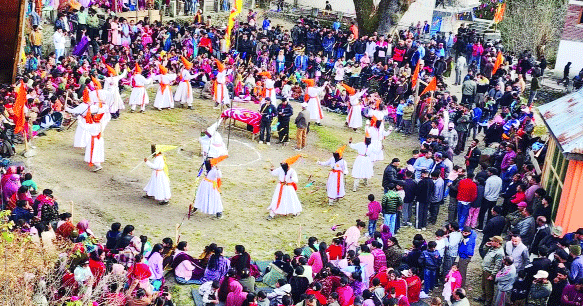
Beyond statistics, the Pahari identity of the Chenab Valley is reinforced by its cultural and social characteristics. The practice of transhumance, or Dhok culture, involving seasonal migration to high-altitude pastures, is a defining feature of the region’s lifestyle and reflects a deep connection with the mountainous environment. This tradition, along with a rich heritage of folklore, oral literature, and community-based social structures, aligns closely with the characteristics of tribal societies and further strengthens the claim for recognition of the Pahari identity.
In conclusion, the linguistic evidence, when critically examined and correctly interpreted, provides a compelling case for recognizing the Chenab Valley as a predominantly Pahari region. The discrepancies in Census 2011 data do not negate this identity; rather, they highlight the need for a more accurate and scientifically informed approach to linguistic classification. A comprehensive and properly conducted linguistic survey, supported by expert analysis, is essential to correct these anomalies and to ensure that the linguistic and cultural identity of the region is accurately represented in official records. Such recognition is not only a matter of statistical accuracy but also a prerequisite for ensuring social justice, cultural preservation, and equitable development for the people of Doda, Kishtwar, and Ramban.
 Follow our WhatsApp channel
