

Ankit Patel
ankitpatelkonch508@gmail.com
Mountains have a special kind of quiet. It is not an empty quiet, but one full of many things. Imagine standing at the edge of Bhaderwah town. Down in the valley, the Neeru stream flows softly, and dark trees cover the steep hills. You can feel the heavy quiet all around you. It is full of history and faith. Suddenly, you notice the surprising, sweet smell of lavender.
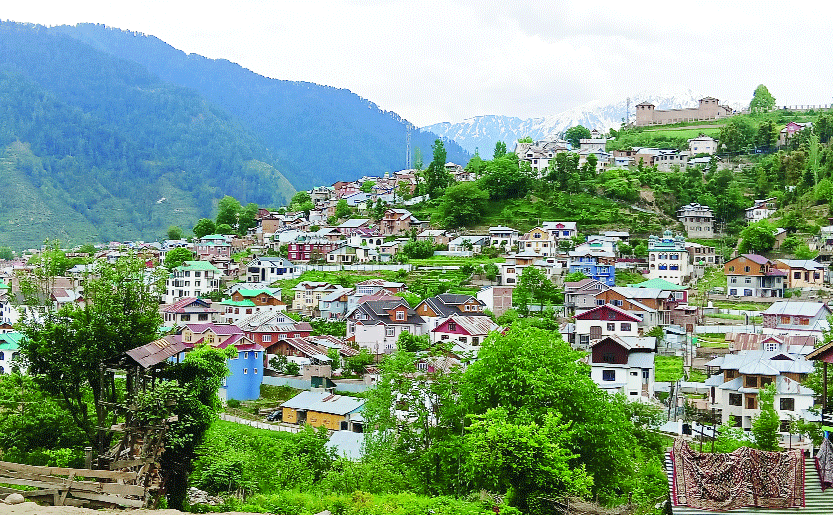
Bhaderwah is sitting high up in the mountains. Visitors often call it “Mini Kashmir” because its beautiful meadows look like the famous Kashmir valley. However, that nickname does not do it justice. Bhaderwah is not just a smaller copy of another place; it is completely unique. It is an oval-shaped valley, about 12 kilometers wide, surrounded by very tall mountains.
Bhaderwah has a very exciting story right now. Many different things are mixing together in this Indian mountain town. People enjoy traditional mountain food and exciting adventure tourism. At the same time, the government is helping farmers grow new crops. However, to truly understand this town, you cannot just look at today. You must start the story in the past, in the land of the snakes.
Nag Bhoomi: Where the Snake Gods Rule
The ancient Vasuki Nag Temple, whose Gandharan-style stone sculptures suggest trade routes that once reached deep into the northwest of the Indian subcontinent.
Bhaderwah is called Nag Bhoomi the land of serpent deities. It is not just a name. It is a living identity. The entire valley worships Shri Vasuki Nag Maharaj- the mythical king of serpents. His primary shrine is the Vasuki Nag Temple at Vasak Dhera. King Maharaja Dhuri Pal built it over a thousand years ago. Inside, a massive black stone idol stands without any external support. The sculptures carry Gandharan art influences -a Greco-Buddhist style from India’s northwest. How it reached this isolated Himalayan valley remains a mystery. The temple’s founding legend is darker. During construction, an evil spirit kept collapsing the walls. Priests demanded a human sacrifice. A Brahmin agreed to be beheaded. As his headless body walked the land, Vasuki Nag appeared as a cow and stopped it. The kingdom was saved. Even today, that legend governs rituals between the Brahmin’s descendants and the temple priests.
Faith here is not quiet. The Jaatra ritual involves iron chains, bell necklaces, and snake-shaped iron pieces. A village shaman- the chela enters a trance. Possessed by the deity, he delivers prophecies and identifies wrongs. At night, the Kud dance begins. Devotees move around sacred fires till dawn. It has happened this way for centuries. Nothing here has been forgotten.
THE STORY OF MELA PATT
In 1580 AD, Akbar invited Raja Nagpal of Bhaderwah to his royal court in Delhi along with other hill rulers. According to local history and oral traditions, Emperor Akbar witnessed a spiritual miracle connected to Nagraj Vasuki through the Raja. Deeply impressed, he sent many royal gifts to Bhaderwah. These included ceremonial drums, gold urns, silver ritual items, jewelry, and beautiful silk cloth. When Raja Nagpal returned, the silk cloth was placed on a wooden frame called Ghorhi and shaped into a sacred temple-like structure known as Patt. Even today, ten respected local families, known as Dashnaan, prepare this holy Patt and follow strict religious discipline during the festival. The famous Mela Patt is celebrated for three days. During the festival, a chela carries the Patt on his head while drums, horns, and traditional music fill the valley with devotion and celebration.
THE FLAVOURS OF THE HIGH VALLEY
Bhaderwah’s food is as unique as its landscape. The cuisine of Bhaderwah reflects its culture, climate, and natural resources. It combines traditional Dogra cooking with ingredients found in the mountains. Every dish tells a story of the valley and its people.
One of the most loved dishes here is Rajma Chawal. The rajma of Bhaderwah is very special. It is smaller, darker, and creamier than the rajma found in other parts of India. It also has a naturally sweet taste because it grows in the mineral-rich soil of the valley. Bhaderwah Rajma has also received the Geographical Indication (GI) tag, which recognizes its unique identity and quality. The beans are soaked overnight and cooked slowly with local spices. People usually enjoy rajma chawal with Anardana Chutney, made from dried pomegranate seeds, which adds a tangy flavor. It is also served with a local fermented pickle called Auriya. Another famous delicacy is Gucchi, also known as wild morel mushrooms. These mushrooms grow naturally in the forests of the Pir Panjal Range after rain and thunderstorms. They are rare and highly valued. In Bhaderwah, Gucchi is cooked in pulao or rich curry dishes. Its deep earthy taste makes it a prized local food. For special occasions, families prepare Keyur, a traditional Dogra dish. It is made from fermented flour batter and fried carefully in hot ghee to create a delicate net-like shape. Keyur is especially important during weddings and family celebrations. It is seen as a symbol of love, respect, and hospitality. Bhaderwah’s food also shows Himalayan and Tibetan influences. Warm noodle soups like Thukpa and Bathuk are popular in winter. These dishes help people stay warm in the cold mountain climate.
THE TEMPLES OF BHADERWAH
Chandi Mata Temple is one of the most respected temples in Bhaderwah. It is located in the village of Chinote, a few kilometers from Bhaderwah. The temple is dedicated to Goddess Chandi, a powerful form of Goddess Durga. Local people believe that the temple has protected the valley for many generations. According to local traditions, the present temple structure was built in 1929 by King Suchat Singh, but the main idol is believed to be much older. Some local beliefs connect the idol with Adi Shankaracharya, who is said to have visited this region centuries ago. The temple is built in traditional hill style and is surrounded by forests and mountains, which make the place peaceful and spiritual. Every year, thousands of devotees visit the temple to seek blessings. Special prayers are held during Navratri, when the temple becomes full of faith, music, and devotion. The temple is also closely connected with the famous Machail Yatra. Every year, the holy Chhari Yatra starts from Chinote and moves toward Machail. This journey attracts devotees from across Jammu and Kashmir. For the people of Bhaderwah, Chandi Mata is not only a goddess but also a symbol of strength, protection, and community faith.
Gupt Ganga Temple
Gupt Ganga Temple is one of the oldest and most sacred temples in Bhaderwah. It is dedicated to Lord Shiva and is located on the bank of the Neeru River, close to Bhaderwah town. Historians believe that this temple dates back to the 9th or 10th century. The temple is built completely from stone slabs, giving it a unique ancient look. A natural stream of water flows from inside the temple and falls directly on the Shivling day and night. After that, the water flows into a sacred pond called Bawali. The water remains cool in summer and warm in winter, which many visitors find surprising. Because the water appears from a hidden source, the temple came to be known as “Gupt Ganga,” meaning hidden Ganga. Local legends connect this temple with the Pandavas from the Mahabharata. People believe that during their exile, the Pandavas stayed here. A large footprint inside the temple is believed to belong to Bhim. There was also an old cave and tunnel, which local stories say connected Bhaderwah to Kashmir. Even today, devotees visit this temple for prayers, spiritual peace, and holy bathing rituals. It remains one of Bhaderwah’s most important religious and historical landmarks.
A VALLEY OF DESTINATIONS: FROM GULDANDA TO KAILASH KUND
Bhaderwah has become one of the fastest-growing tourist destinations in Jammu and Kashmir. Earlier, the valley welcomed around 2.15 lakh tourists every year, but after 2019, tourism grew rapidly. This growth also helped local families, as many opened homestays and created new sources of income. Guldanda has become a major winter attraction, drawing visitors for snowfall, winter festivals, and adventure activities. Another famous destination is Seoj Dhar, often called the crown jewel of Bhaderwah because of its beautiful meadows, streams, and views of the Kailash Kund peaks. An 8.8-km ropeway is planned here to improve year-round access. Padri, located at about 10,500 feet, is known for heavy snowfall and stunning mountain views. Other popular spots include Hanhga Nallah, Khani Top, and Jai Valley, famous for trekking, camping, and peaceful natural beauty.
THE PURPLE REVOLUTION: LAVENDER
The numbers are hard to believe, until you see the fields. Under the national Aroma Mission, CSIR-IIIM introduced medicinal lavender to Bhaderwah. Farmers who once earned Rs. 40,000-60,000 per hectare growing maize now report Rs. 3.5 lakh to Rs. 6 lakh. Fifty distillation units operate in the valley. Essential oils reach Maharashtra, pharmaceuticals, and cosmetic buyers internationally. Young entrepreneurs are earning upwards of Rs. 65 lakhs annually. Prime Minister Modi has cited Bhaderwah by name. The annual Lavender Festival draws national media. Even the 60-plus generation is farming lavender. The ecological dividend surprised everyone. Monkeys, a chronic menace across the Himalayas avoid lavender entirely. No culling needed. The scent does the work. And then there is agro-tourism. Visitors arrive not to trek. Not to pilgrimage. Simply to stand inside the purple. To photograph it. To breathe it. That, too, is now an industry.
THE WEIGHT OF THE BOOM
Bhaderwah’s boom carries a cost. The National Green Tribunal has flagged a crisis: no sewage treatment plants. Untreated waste is contaminating the Neeru river, the valley’s lifeline for centuries.Cultural pressure is quieter but equally dangerous.The valley’s insulation is lifting fast. The roads are open. The tourists are arriving. The lavender is blooming. But the question remains: can Bhaderwah grow without losing itself? The serpents are watching. In Bhaderwah, they always have been.
 Follow our WhatsApp channel
