

Excelsior Correspondent
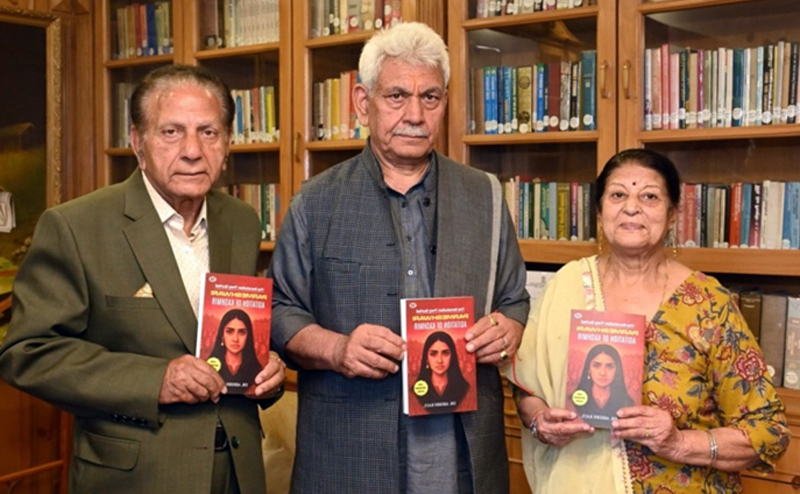
JAMMU, May 25: Dr. Ashish Kaul’s landmark book, The Revolution They Hurried: Parmeshwari Agitation of Kashmir, was presented to Manoj Sinha, Lieutenant Governor of Jammu & Kashmir, by the author’s parents Rattan Kaul and Pushpa Kaul.
The Lieutenant Governor received the work with warmth, acknowledging its significance as both historical record and national reckoning, and affirming the importance of restoring such suppressed chapters to the public imagination of contemporary Kashmir.
The book itself is no ordinary publication. It is the first authoritative, deeply researched chronicle of what may well be independent India’s greatest civilian revolution : the 1967 Parmeshwari Agitation, born from the forced conversion of a young Kashmiri Pandit girl, which erupted into a movement that brought the entire Valley to a grinding halt, saw nearly 5,000 arrests, witnessed multiple deaths, and stood as the country’s earliest organised cry for a Uniform Civil Code and for legal safeguards against what is today recognised as love Jihad.
Earlier, in a separate and equally significant moment, the book was presented to Kavinder Gupta, Governor of Himachal Pradesh, whose long-standing engagement with Jammu & Kashmir’s political and cultural life lent particular weight to the occasion; he lauded the work as an indispensable contribution to the recovery of national memory.
In another distinct landmark event, the Indira Gandhi National Centre for the Arts (IGNCA) organised a formal release and discussion around the book, anchored by Rambahadur Rai (President, IGNCA) and Dr. Sachchidanand Joshi (Member Secretary, IGNCA), and joined by Prof. Ramesh Gaur, Prof. Amitabh Mattoo, Jaideep Karnik, and noted social activist Utpal Kaul – voices that collectively underscored that Parmeshwari is not a footnote but a foundation, the moment when the Kashmiri Pandit, long mischaracterised as politically dormant, rose as a moral force anticipating by more than half a century the very debates that now define modern India’s legal and civilisational discourse.
 Follow our WhatsApp channel
