

Sunny Dua
Sunnydua55@gmail.com
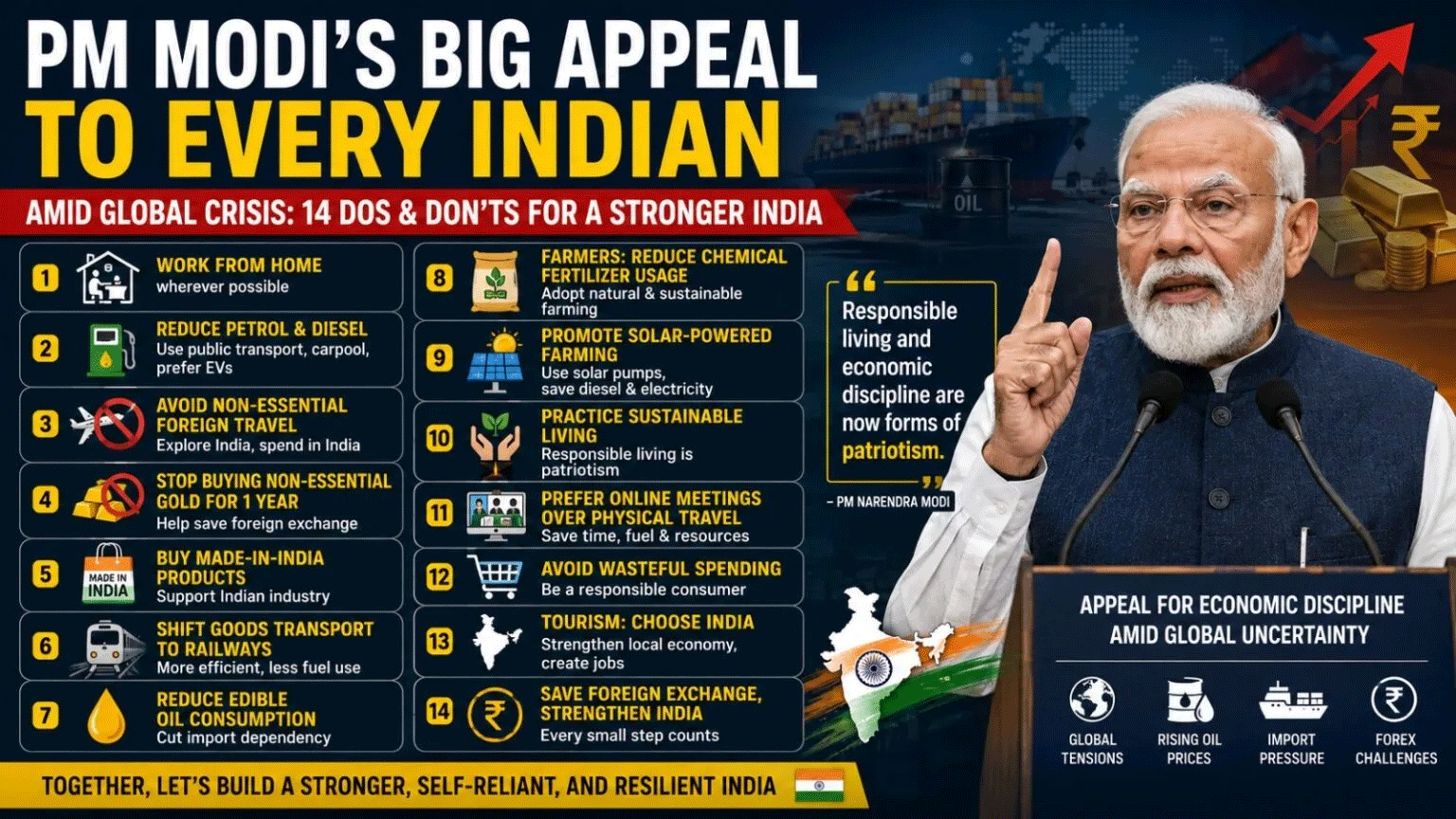
At a time when wars and conflicts in West Asia are disturbing global markets, Prime Minister Narendra Modi has appealed to Indians to adopt certain temporary lifestyle changes for one year in order to protect the country’s economy and conserve precious foreign exchange reserves. For many people, these suggestions may appear simple or even complex, rather burdened but behind every appeal lies a deep economic concern connected with rising oil prices, global instability, inflation, pressure on the Indian rupee, and the increasing cost of imports.
India is one of the world’s largest importers of crude oil and also imports large quantities of gold. Whenever international conflict increases oil prices or disrupts trade routes, countries like India face direct economic pressure. The Prime Minister’s message is essentially a call for collective national responsibility asking citizens to contribute not through sacrifice on battlefields, but through disciplined economic behaviour in daily life.
Why West Asia conflict impacts India?
India depends heavily on imports for crude oil. Most of this oil comes from West Asian countries. When wars or conflicts erupt in the region global crude oil prices rise sharply, shipping and supply chains become uncertain, transportation costs increase, inflation rises and India has to spend more dollars to buy fuel. This creates pressure on India’s foreign exchange reserves, the pool of dollars and foreign currency that the country keeps for imports, trade stability, and economic security.
If reserves decline rapidly, the rupee weakens, imported goods become expensive, petrol and diesel prices can rise, inflation affects common households and economic growth slows down. That is why Modi’s appeals are aimed at reducing unnecessary foreign exchange outflow and making India economically stronger during uncertain global times. Let’s study these one by one:
Avoid buying gold for one year
One of the most significant appeals made by Narendra Modi was to avoid purchasing gold for one year in view of the ongoing global economic uncertainty and instability caused by conflicts in West Asia. India is among the world’s largest importers of gold, and every year billions of dollars leave the country for gold imports. At a time when rising crude oil prices are already increasing India’s import burden, excessive spending on imported gold can place additional pressure on the nation’s foreign exchange reserves and weaken the rupee.
The Prime Minister’s appeal is aimed at conserving foreign currency during a sensitive economic phase. India requires strong foreign exchange reserves to pay for essential imports like crude oil, maintain trade stability and protect the economy from global shocks. If citizens collectively reduce gold purchases even for a year, the country can save billions of dollars that would otherwise flow out of the economy. These savings can help India maintain stronger reserves and reduce financial pressure during international uncertainty.
Economists believe that if people adhere to this appeal, the impact can be significant. Stronger foreign reserves can help stabilize the rupee, control inflation and protect the economy from external economic pressures. In this sense, postponing luxury purchases like gold for one year is being viewed not merely as financial restraint, but as a form of economic patriotism where ordinary citizens contribute towards strengthening the nation during challenging global conditions.
Reduce unnecessary foreign travel
Another important appeal made by Narendra Modi was to reduce unnecessary foreign travel for some time in view of the ongoing global economic uncertainty. Foreign travel involves substantial spending of dollars on hotels, shopping, transport, food and tourism-related activities abroad. At a time when India is already facing increased import costs due to rising crude oil prices and global instability caused by conflicts in West Asia, excessive foreign expenditure can place additional pressure on the country’s foreign exchange reserves.
The Prime Minister’s appeal is aimed at conserving foreign currency and reducing avoidable dollar outflow during a sensitive economic period. India requires strong foreign exchange reserves to manage imports, stabilize the rupee and maintain economic balance amid international disruptions. If millions of Indians temporarily reduce non-essential foreign vacations and overseas spending, a significant amount of foreign currency can remain within the country instead of flowing abroad.
Economists believe that if citizens choose domestic destinations over foreign travel even for one year, the impact can be beneficial on multiple levels. More money will circulate within India, domestic tourism will receive a boost and local businesses such as hotels, transport operators, restaurants and handicraft sectors will benefit. At the same time, foreign exchange reserves will remain better protected, helping India maintain economic stability during challenging global conditions. In many ways, choosing to travel within India for a year can become both an economic and national contribution.
Use public transport, carpooling and electric vehicles (EVs)
One of the strongest and most practical appeals made by Narendra Modi was for citizens to reduce petrol and diesel consumption by increasingly using public transport, carpooling and electric vehicles (EVs). India imports a major portion of its crude oil requirements from abroad, particularly from West Asian countries. Whenever conflict or instability erupts in that region, international crude oil prices rise sharply, directly increasing India’s fuel import bill. Higher oil prices mean India has to spend more dollars on importing petrol and diesel, putting additional pressure on the country’s foreign exchange reserves and the overall economy.
The Prime Minister’s appeal is therefore aimed at reducing unnecessary fuel consumption at a time when global economic conditions remain uncertain. By encouraging people to use metros, buses, shared transport systems and EVs, the government is attempting to lower national fuel demand and reduce dependence on expensive imported oil. Every litre of fuel saved means fewer dollars leaving the country. In a nation of more than a billion people, even small behavioural changes adopted collectively can create a massive economic impact. Reduced fuel consumption can help India control its import expenditure and better withstand the effects of rising global oil prices caused by international conflicts.
Economists believe that if citizens seriously adopt these measures, the benefits will extend beyond economic savings alone. Lower fuel consumption would reduce India’s oil import burden, conserve foreign exchange reserves and help stabilize the economy during periods of global uncertainty. At the same time, increased use of public transport and EVs would reduce air pollution, ease traffic congestion and improve urban mobility in major cities. What may appear to be a small personal adjustment such as taking the metro, sharing rides or shifting to electric mobility can collectively save the nation enormous amounts of money and strengthen India’s economic resilience in difficult times.
Encourage work from home and virtual meetings
Narendra Modi also appealed to companies, institutions and offices to encourage work-from-home systems and virtual meetings wherever possible in order to reduce unnecessary fuel consumption during a period of global economic uncertainty. The Prime Minister’s appeal comes at a time when rising crude oil prices, triggered by conflict and instability in West Asia, are increasing the financial burden on oil-importing countries like India. Every day, millions of people commute to offices using personal vehicles, taxis and public transport, consuming enormous quantities of petrol and diesel. This daily movement, while essential in many sectors, also contributes significantly to India’s fuel demand and import expenditure.
The reasoning behind Modi’s appeal is rooted in simple economic logic: reduced travel directly translates into lower fuel consumption. If companies adopt hybrid work models, virtual meetings and remote working systems even partially, the cumulative reduction in daily commuting across major cities can be substantial. Fewer vehicles on roads would mean reduced consumption of imported fuel, lower traffic congestion and less pressure on India’s foreign exchange reserves, which are used heavily for crude oil imports. In the backdrop of rising global energy prices, conserving fuel has become not merely an environmental concern, but an important economic necessity as well.
Support “Made in India” products
Narendra Modi also emphasized the importance of strengthening domestic manufacturing and encouraging citizens to support “Made in India” products at a time when the global economy is facing uncertainty due to conflicts and rising international tensions. The Prime Minister’s appeal is rooted in the belief that excessive dependence on imported goods increases the outflow of foreign currency and weakens economic self-reliance. Whenever India imports products from foreign markets, large amounts of dollars leave the country. During periods of global instability, when foreign exchange reserves are already under pressure because of rising oil import bills, reducing avoidable imports becomes economically important. Supporting Indian industries, therefore, is not merely a matter of business preference, but a step towards strengthening the national economy.
The reasoning behind Modi’s appeal is closely linked to long-term economic resilience. If citizens consciously choose Indian-made products over imported alternatives wherever possible, domestic industries receive greater support, production within the country increases and employment opportunities expand. Increased demand for local goods strengthens small businesses, manufacturers, traders and startups, while simultaneously reducing India’s dependence on foreign markets. Economists believe that a stronger domestic manufacturing ecosystem can help India better withstand global disruptions and build a more self-reliant economy capable of sustaining itself during difficult international conditions. Every Indian product purchased contributes towards keeping money circulating within the country instead of flowing abroad.
If millions of Indians collectively reduce unnecessary spending on imported goods, conserve fuel, avoid wasteful foreign exchange expenditure and support local industries even for one year, the cumulative impact can be enormous. India can maintain stronger foreign exchange reserves, reduce pressure on the rupee, control inflation and strengthen its economic resilience. In many ways, the message reflects a modern form of patriotism where national service is expressed not only through words and slogans, but through disciplined and responsible choices made in everyday life for the larger good of the country.
Why these appeals matter?
The Prime Minister’s appeals are not aimed at creating fear or panic. They are precautionary economic measures designed to prepare India against the impact of global instability caused by wars and international conflicts. India, despite being one of the world’s fastest-growing economies, is not completely insulated from these international developments. That is why the government is encouraging citizens to contribute through responsible economic behaviour for one year.
(The writer is senior journalist)
 Follow our WhatsApp channel
