

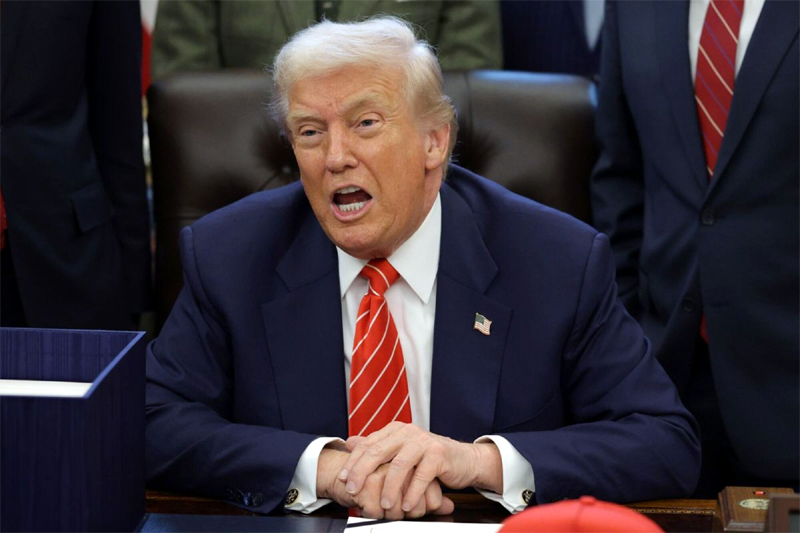
TEHRAN, May 18 : As US President Donald Trump said Iran is “dying to sign” a peace agreement with Washington,conflicting reports from Tehran suggested that the United States had agreed to temporarily ease sanctions on Iranian oil exports as negotiations are underway and the exchanges of proposals have taken place through Pakistan, the mediator in the talks.
In an interview published Monday by Fortune magazine, Trump accused Tehran of backtracking on understandings reached in talks with Washington.
“They scream all the time. I can tell you one thing , they’re dying to sign (a deal),” Trump said. “But they make a deal, and then they send you a paper that has no relationship to the deal you made. I say, ‘Are you people crazy ‘”
Soon after the interview was published by the Fortune magazine, Iran’s Tasnim News Agency reported that Washington had accepted a proposal to waive sanctions on Iranian oil exports for the duration of negotiations, marking what could be a significant concession amid efforts to ease tensions.
According to a source close to the Iranian negotiating team cited by Tasnim, “The new US proposal differs from earlier drafts by allowing a temporary suspension of sanctions linked to Iran’s oil trade until a final agreement is reached.”
The report said the proposed relief would involve waiving restrictions imposed by the US Office of Foreign Assets Control (OFAC), enabling limited Iranian oil exports during the negotiation period.
Iran, however, continues to insist that the complete removal of sanctions must form part of any final agreement with Washington.
Iranian Foreign Ministry spokesman Esmail Baghaei said that Tehran had formally conveyed its response to recent US proposals and amendments concerning a possible settlement.
Baghaei said that although Washington had initially rejected Iran’s proposal directly, Tehran later received additional proposals through Pakistan, which has been acting as an intermediary in the dialogue process.
During the interview to Fortune Magazine, Trump also acknowledged that the conflict with Iran and rising global oil prices are complicating the US administration’s battle against inflation and may delay further interest rate cuts by the Federal Reserve. “You can’t really look at the figures until the war is over,” Trump told Fortune, referring to the economic uncertainty created by the Iran conflict and volatility in energy markets.
Despite the geopolitical tensions, Trump argued that the US economy remained resilient, pointing to record highs in US stock markets and strong corporate earnings.
In the same interview, Trump defended the US government’s investment in chipmaker Intel, saying he “should have asked for more” than the 10% stake acquired by the administration last year as part of a roughly $10 billion industrial support package.
The US government’s Intel stake is now reportedly valued at more than $50 billion.
“Do I get credit for it Does anybody even know I did that ” Trump said, adding that the US should have protected Intel earlier from foreign competition.
Referring to TSMC, Trump said Intel could have dominated the global semiconductor market if tariffs had been imposed sooner on imported chips.
“If I had been president when all these companies started sending their chips in from China, I would have put a tariff on that would have protected Intel,” he said. (UNI)
 Follow our WhatsApp channel
