

Nishikant Khajuria
nishikantkhajuria@gmail.com
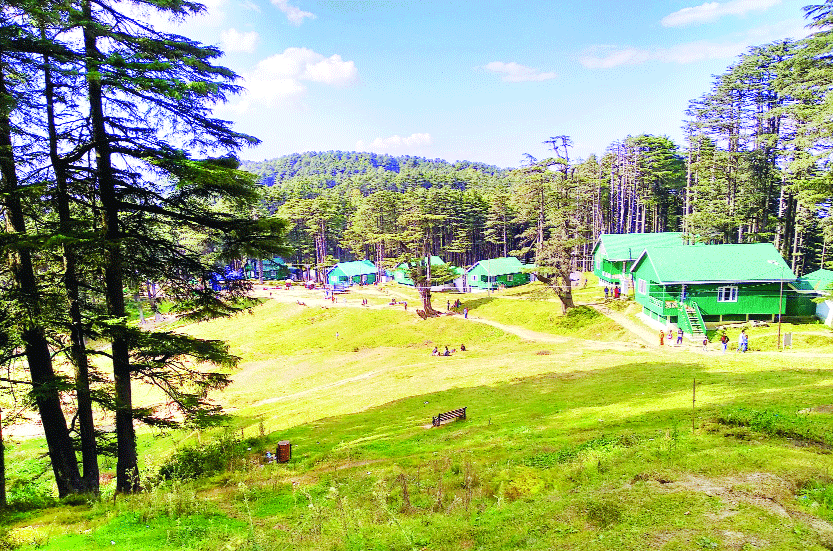
Perched amid dense pine forests and rolling meadows, Patnitop has long been Jammu’s most cherished hill destination—a place where generations of families escaped summer heat, couples found solitude, and travellers on the old highway paused to admire the Himalayan foothills. Located just a few hours from Jammu, Patnitop once enjoyed a natural advantage few destinations could rival: accessibility, pleasant weather, and scenic beauty.
But today, beneath its postcard-perfect landscape lies a crisis. Local hoteliers, restaurant owners, tourism entrepreneurs and some stakeholders allege that years of Government neglect, policy confusion, and inadequate infrastructure have pushed Patnitop into a slow decline.
Hotel owners complain that litigation related to land use, forest permissions, and building regulations has effectively paralysed development. Properties that once hosted a steady stream of visitors are aging rapidly, unable to undergo renovation or expansion due to regulatory uncertainty. “Patnitop has not failed because of lack of potential. It is being strangled by indecision,” said a hotelier.
Many hotels built decades ago now require modernization to meet contemporary tourist expectations. However, unclear building norms and pending legal disputes have made even routine upgrades difficult. Entrepreneurs who invested heavily in tourism infrastructure during Patnitop’s golden years now find themselves locked in endless procedural hurdles. The result is visible across the hill station—aging buildings, underutilized assets, and a sense of stagnation.
Ironically, Patnitop’s troubles have intensified during a period of unprecedented connectivity expansion in Jammu and Kashmir. Projects such as Chenani-Nashri Tunnel, expansion of railway infrastructure and the introduction of train service to the Kashmir Valley have unintentionally bypassed this hill station.
Earlier, travellers moving by road often stopped overnight at Patnitop, boosting hotel occupancy and local business. The tunnel, while reducing travel time, diverts traffic away from the station, sharply cutting footfall. “Better connectivity should have made Patnitop stronger, not weaker. But without a strategy, we are being turned into a forgotten bypass,” says another hotelier.
Beyond policy paralysis, Patnitop suffers from glaring infrastructure deficiencies that undermine visitor experience. Despite being one of Jammu’s premier tourist destinations, the hill station continues to struggle with inadequate parking facilities during peak season, poor waste management and sanitation systems, inconsistent water supply, insufficient public conveniences, weak street lighting and pedestrian infrastructure, poor last-mile connectivity to nearby attractions such as Sanasar, Nathatop, and Sudh Mahadev.
Roads connecting adjoining destinations remain narrow and poorly maintained. Public transport options are limited, forcing tourists to depend on private vehicles. Signage is inadequate, and recreational facilities have seen little meaningful expansion in years.
“While the natural beauty remains intact, basic tourist infrastructure is far below expectations. In an era where travellers increasingly compare destinations online, such shortcomings prove costly,” said Amit Kumar, a hill station enthusiast from Jammu.
Patnitop’s alleged decline is not merely a tourism issue—it is an economic concern also for the wider Jammu region. Businesses that once flourished on seasonal demand now operate with falling occupancy rates and rising operational costs. Tourism stakeholders note that a thriving Patnitop could generate large-scale employment in hospitality, transport, adventure tourism, handicrafts, and local food businesses.
“With its proximity to Jammu and railway connectivity, Patnitop should ideally be promoted as an independent destination for the tourists across India. However, the absence of planning and promotion has prevented the destination from capitalizing on this strategic advantage,” rued Lovneesh Sathe, President of Patnitop Hotels Association.
Even as the tourism stakeholders welcome the major investments transforming the Kashmir Valley, they, however, question why similar urgency has not been shown toward Jammu’s tourism assets. They argue that while destinations in Kashmir have received sustained branding, infrastructure upgrades, and tourism promotion, Patnitop has largely been treated as an afterthought.
The stakeholders have demanded time-bound resolution of pending litigations, a clear tourism master plan with realistic building and renovation norms, dedicated destination management with stakeholder participation, targeted marketing of Patnitop as a rail-linked mountain destination and infrastructure upgrades in roads, utilities, sanitation, parking, and connectivity etc. Most importantly, they want policy clarity. “Patnitop does not need charity. It needs clarity. It does not need new projects. It needs permission to complete old one,” said Abhishek, owner of a hotel at Patnitop.
However, Chief Executive Officer (CEO) of the Patnitop Development Authority, Varinder Manyal claimed that popularity of the hill station is not on decline, but is still tourism jewel of Jammu, which is evident from the fact that the footfall has been continuously increasing.
“Last year 9.7 lakh tourists visited Patnitop and the number increased to more than 11 lakh this year,’ he said and added that besides Rs 6 crores sanctioned under Capex budget, DPR for development of Circular Road costing Rs 10 crores has been recently approved while preparing of Kud Mall Road DPR is also under process.
Admitting that new projects of infrastructure development face hurdles as Supreme Court has declared the hill station as “no construction zone”, the CEO informed that the area between Kud and Patnitop has been identified for raising new facilities like multi-storeyed parking and restaurant, etc.
We believe that Patnitop possesses what many destinations spend years trying to create—natural beauty, climate advantage, proximity to an urban center, and strong brand recall. With strategic planning, regulatory reform, and infrastructure investment, Patnitop can be promoted as a year-round world class tourism hub offering leisure, adventure, wellness, and eco-tourism.
 Follow our WhatsApp channel
