

Dr Goldi Hazari
oldihazari@gmail.com
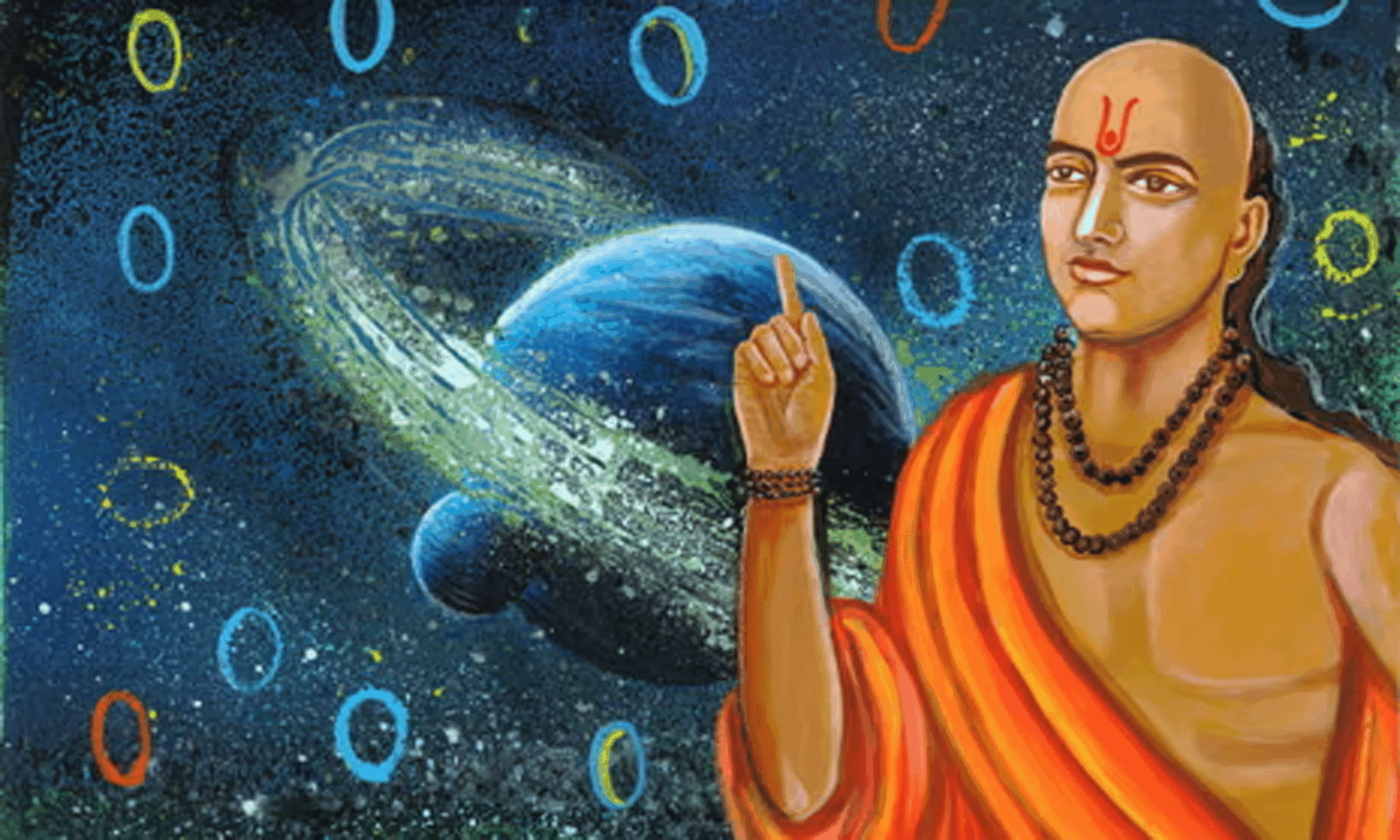
Imagine measuring the entire planet without ever leaving your city. This feat, seemingly impossible in our modern age of satellites and advanced technology, was achieved centuries ago by a brilliant mind in ancient India. Back in 500 CE, the renowned mathematician and astronomer Aryabhata accomplished precisely this, laying the groundwork for our understanding of the cosmos and the planet we inhabit.
Long before the advent of sophisticated instruments, Aryabhata, working from his astronomical observatory, demonstrated a profound understanding of geometry and mathematics. His most astonishing achievement, in the context of this narrative, was his remarkably accurate calculation of the Earth’s circumference. He achieved this seemingly impossible task not through distant observations or advanced apparatus, but by ingeniously harnessing the simple geometry of shadows. This method, rooted in fundamental principles, speaks volumes about his intellectual prowess and his ability to distill complex problems into elegant solutions.
Using his keen observation and mathematical acumen, Aryabhata estimated the Earth’s circumference to be approximately 24,835 miles. This figure, when compared to modern satellite measurements, which place the Earth’s circumference at roughly 24,901 miles, is astonishingly close. The difference is a mere 0.2%, a margin of error that is almost negligible, especially considering the era in which the calculation was made and the tools available to him. This wasn’t a lucky guess; it was a testament to precision learning and mathematical mastery at its absolute finest.
Aryabhata’s contributions, however, extended far beyond just measuring the Earth. He was a true polymath, a visionary whose work profoundly impacted the fields of mathematics and astronomy. He is credited with several groundbreaking discoveries and conceptualizations that have had a lasting legacy.
One of his most significant contributions, often overlooked in popular discourse, is his profound understanding and dissemination of the concept of zero. While the precise origins of zero are debated among historians, Aryabhata’s work, particularly his astronomical tables and mathematical treatises, clearly utilizes and expounds upon the concept of zero as a placeholder and a number in its own right. This was a revolutionary idea that paved the way for algebraic advancements and a more sophisticated numerical system. The decimal place-value system, which we rely on daily, owes a great debt to the conceptual clarity provided by Aryabhata and his contemporaries.
Furthermore, Aryabhata made significant strides in calculating the value of Pi (π), the ratio of a circle’s circumference to its diameter. His approximation for Pi was remarkably accurate for his time. He stated that Pi is approximately equal to 62832/20000, which simplifies to 3.1416. This value is incredibly close to the actual value of Pi and demonstrates a deep understanding of geometric principles and the calculation of irrational numbers. His ability to derive such an accurate value for Pi, a constant that appears in countless mathematical and scientific formulas, was another feather in his cap and a testament to his advanced mathematical thinking.
Aryabhata’s astronomical contributions were equally revolutionary. He proposed a model of the solar system where the Earth rotates on its axis, a concept that challenged the prevailing geocentric views of his time. He accurately explained the phenomena of solar and lunar eclipses, attributing them to the shadows of the Moon and Earth, respectively, rather than to mythological explanations. He also calculated the length of the sidereal year (the time it takes the Earth to orbit the Sun relative to the stars) with remarkable accuracy. His astronomical tables, known as the Aryabhatiya, provided precise positions of celestial bodies and predicted astronomical events, solidifying his reputation as a preeminent astronomer.
The depth of ancient Indian scientific and mathematical engineering is, to say the least, truly mind-blowing. Aryabhata stands as a towering figure in this rich intellectual tradition. His work, characterized by rigorous logic, empirical observation, and elegant mathematical formulation, has inspired generations of scholars and continues to be studied and admired today. The fact that ancient civilizations, without the aid of modern technology, could achieve such profound insights into the workings of the universe and the dimensions of our planet is a humbling reminder of the power of human intellect and curiosity.
The story of Aryabhata is not just a historical footnote; it is a narrative of human ingenuity, a beacon of intellectual achievement that transcends time and geography. It challenges our assumptions about the trajectory of scientific progress and underscores the fact that groundbreaking discoveries can emerge from the most unexpected places and times. His legacy continues to resonate, reminding us of the enduring power of mathematics and the unquenchable human spirit of exploration and discovery. His ability to meticulously chart planetary motions, calculate fundamental mathematical constants like Pi, and even measure the vastness of our planet from a grounded perspective, highlights a scientific and mathematical sophistication that continues to inspire awe and wonder. The precision of his calculations, far from being mere academic exercises, had practical implications for timekeeping, navigation, and a deeper understanding of our place in the cosmos. Aryabhata’s work is a profound testament to the intellectual heritage of ancient India, a heritage that has enriched the global scientific landscape in ways that are still being fully appreciated.
 Follow our WhatsApp channel
