

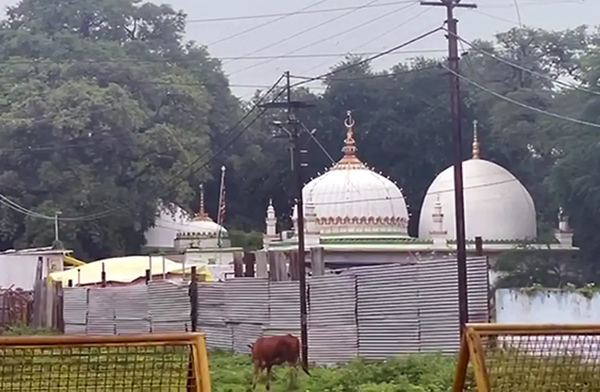
INDORE, May 15: In a landmark ruling, the Madhya Pradesh High Court on Friday declared that the disputed Bhojshala complex in Dhar district is a temple dedicated to Goddess Saraswati, and also quashed the 2003 ASI arrangement allowing Muslims to offer namaz on Fridays at the site.
The HC’s Indore bench, which heard the case related to the long-running dispute over the religious nature of the 11th century monument, underlined that the continuous practice of Hindu worship at the site, associated with the legacy of King Bhoj of the Parmar dynasty, has never ceased.
The court, in a 242-page verdict, accepted the plea for exclusive Hindu worship rights at the disputed complex and also quashed the Archaeological Survey of India’s (ASI) order of April 7, 2003, which allowed Muslims to offer prayers at the monument every Friday.
The HC established the religious nature of the medieval monument as a temple dedicated to Goddess Saraswati, worshipped as the “Goddess of knowledge” in Hindu mythology.
The Hindu community considered Bhojshala to be a temple dedicated to Vagdevi (Goddess Saraswati), while the Muslim side called it Kamal Maula Mosque. A petitioner from the Jain community claimed the complex was a medieval Jain temple and gurukul (traditional learning centre).
A division bench Justices Vijay Kumar Shukla and Alok Awasthi delivered the much-awaited verdict on five petitions and one writ appeal related to the matter in the light of archaeological and historical facts, ASI notifications and its scientific survey of 2024, and legal provisions.
The bench dismissed four petitions filed by Muslim and Jain parties.
In its order, the High Court also referred to the principles laid down in the Supreme Court’s judgment in the Ayodhya Ram Janmabhoomi-Babri Masjid dispute case.
The bench, while allowing two PILs filed by social organisation ‘Hindu Front for Justice’, Kuldeep Tiwari and others, said, “The religious character of the disputed area of the Bhojshala Complex and Kamal Maula Mosque is held to be a Bhojshala with a temple of Goddess Vagdevi (Saraswati).”
It further said, “We have noted the continuity of Hindu worship at the site through regulated over time has never been extinguished.”
The HC also referred to historical records and literature.
The court stated, “We find on record that historical literature placed established that the character of the disputed area was Bhojshala as a centre of Sanskrit learning associated with Raja Bhoj of the Parmar dynasty, and the literature and architectural references, including those connected with the period of Raja Bhoj, indicate the existence of a temple dedicated to goddess Saraswati at Dhar.”
The Hindu petitioners had pleaded for return of a Vagdevi statue, housed in the British Museum in London, to India and its reinstallation within the Bhojshala complex. On this, the court stated that the petitioners had already submitted several representations to the Government of India in this regard,
and the Centre could consider them.
The High Court ruled that the Government of India and the ASI would decide on the administration and management of the Bhojshala temple and the affairs of Sanskrit education within it, and that the ASI would continue to administer and manage the property in accordance with legal provisions.
The bench clarified that the ASI, a central government body, would have “full supervisory control” over the preservation, protection, and regulation of religious access to the complex.
The court said “Every government has the constitutional obligation to ensure preservation and protection of not only the ancient monuments and structures including temples of archaeological and historical importance, but also of sanctum sanctorum as well as the deity of spiritual importance.”
There is a constitutional duty even to sanction funds for providing basic amenities to pilgrims, proper arrangements for shelter places, maintenance of law and order and the preservation of purity and pristine character of the deity, emphasised the Judges.
During the HC hearing, petitioners from Hindu, Muslim, and Jain communities presented detailed arguments and sought exclusive rights to worship at the disputed monument for their respective communities
While dismissing petitions filed by the Muslim side, the court, however, stated that if the community applies for land allotment for the construction of a mosque in Dhar district, the state government may consider it in accordance with legal provisions.
After the Bhojshala controversy erupted, the ASI issued an order on April 7, 2003, allowing Hindus to worship at the complex every Tuesday and permitting Muslims to offer prayers at the site every Friday.
On March 11, 2024, the HC ordered the ASI to conduct a scientific survey of the Bhojshala Temple-Kamal Maula Mosque complex. The ASI began the survey on March 22, 2024. It completed the survey within 98 days after which a detailed report was presented in the HC on July 15, 2024.
The HC said, “It is noteworthy to remember that archaeology as a branch of knowledge draws sustenance from the science of learning, it is the wisdom and experience and the vision which underlines the process of interpretation. Therefore, the court can safely rely upon the conclusions derived on the basis of such multidisciplinary scientific studies by the ASI and the fundamental rights guaranteed under Article 25 and 26 of the Constitution of India.”
The court, citing the ASI’s scientific survey report on the disputed monument and other documents on record, stated that the structure was associated with King Bhoj of the Parmar dynasty, a Rajput kingdom that ruled the Malwa region of present-day central India between the 9th and 14th centuries.
A prominent cleric said the HC verdict will be challenged in the apex court.
Asked about the judgement, Dhar Shahar Qazi or cleric, Waqar Sadiq, told PTI Videos “We have not seen the full judgement. We respect the High Court decision, but will appeal against it in the Supreme Court after going through it.”
Nearly 1,200 police personnel were deployed in and around the complex ahead of the HC ruling.
Dhar Collector Rajeev Ranjan Meena warned of strict action against anyone spreading objectionable content on social media, as the administration erected barricades at the site where Friday prayers coincided with the court verdict.
The ASI indicated in its over 2,000-page report that a massive structure dating back to the reign of the Parmar kings of Dhar predated the mosque, and that the current disputed structure was built using repurposed temple components.
The Hindu side claimed that coins, sculptures, and inscriptions found by the ASI during its scientific survey prove the complex was originally a temple.
However, the Muslim side argued in court that the ASI’s survey report was “biased” and prepared to support the claims of the Hindu petitioners.
Refuting this, the ASI told the court the scientific survey process was carried out with the help of experts, including three from the Muslim community. (PTI)
 Follow our WhatsApp channel
