

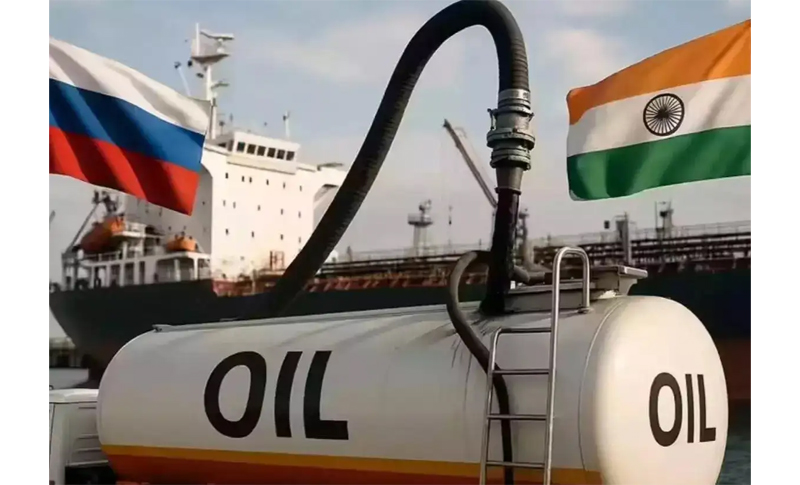
NEW DELHI, May 12 : India’s crude oil purchases from Russia dropped over 15 per cent in April after the country’s buyer shut the refinery for routine maintenance, European think tank Centre for Research on Energy and Clean Air (CREA) said in a report.
India imported Euro 4.5 billion worth of crude oil (raw material for making fuels like petrol and diesel) from Russia in April, down from Euro 5.3 billion worth of imports in the preceding month.
CREA said India was the second-largest buyer of Russian fossil fuels in April 2026, importing a total of Euro 5 billion of Russian hydrocarbons.
“Crude oil constituted 90 per cent of India’s purchases, totalling Euro 4.5 billion. Coal (Euro 297 million) and oil products (EUR 209 million) constituted the remainder of their monthly imports,” it said.
In March, India imported a total of Euro 5.8 billion of Russian hydrocarbons. That month, crude oil products constituted 91 per cent of India’s purchases, totalling Euro 5.3 billion. Coal (Euro 337 million) and oil products (Euro 178.5 million) constituted the remainder of their monthly imports.
“India’s total crude import volumes recorded a 3.7 per cent reduction in April. This is partially explained by a 19.4 per cent month-on-month decrease in Russian imports.
“There was a substantial change in the installations’ unloading of Russian crude, with Vadinar and Jamnagar refineries’ imports decreasing by almost 92 per cent and 38 per cent, respectively, while the state-owned IndianOil Vadinar’s increased by 87 per cent,” CREA said.
The decline in Russian crude imports by Nayara Energy’s Vadinar refinery was driven by maintenance-related shutdowns beginning on April 9, 2026, as the refinery runs exclusively on Russian feedstock. Russian oil giant Rosneft is a major shareholder in Nayara Energy.
The state-owned New Mangalore and Visakhapatnam refineries had stopped Russian imports at the end of November 2025, but purchases resumed in March 2026 and continued into April, with Visakhapatnam’s Russian imports increasing by 149 per cent month-on-month.
The spurt in Russian oil imports in the last two months followed the United States granting of a sanctions waiver on Russian oil covering cargoes already at sea and shipments on previously sanctioned vessels. The move was to ease prices that had spiked following Washington’s going to war with Iran.
The waiver led to state refiners, which had previously paused Russian oil purchases, resuming imports from Moscow.
CREA said from December 5, 2022, until the end of April 2026, China purchased 37 per cent of all Russian coal exports. India (19 per cent), Turkiye (15 per cent), South Korea (12 per cent), and Taiwan (4 per cent) round out the top five buyers’ list.
China has bought 49 per cent of Russia’s crude exports, followed by India (37 per cent), Turkiye (6 per cent), and the EU (5 per cent).
“Refineries using Russian crude in India, Turkiye, Brunei, and Georgia exported Euro 760 million of oil products to sanctioning countries in April 2026. The importers included the EU (Euro 145 million), Australia (Euro 399 million), and the US (Euro 216 million). An estimated Euro 232 million of these products were refined from Russian crude,” the think tank said.
In April 2026, the average price of Russia’s Urals crude rose further, up by 19 per cent month-on-month to USD 112.3 per barrel, remaining more than double the updated EU and UK price cap of USD 44.1 per barrel, which took effect on February 1, 2026.
The price discount of Urals-grade crude oil relative to the global benchmark Brent in April plummeted as demand for Russian crude increased following the extended US sanctions waiver, amid constraints on tanker availability and other market factors.
“While Russian crude prices have increased significantly, influenced by higher freight and insurance costs for the longer voyages involving sanctioned Russian crude, Free on Board (FOB) prices are likely still at a discount to Brent,” CREA said. (PTI)
 Follow our WhatsApp channel
