

Ashwani Kumar Chrungoo
ashwanikc2012@gmail.com
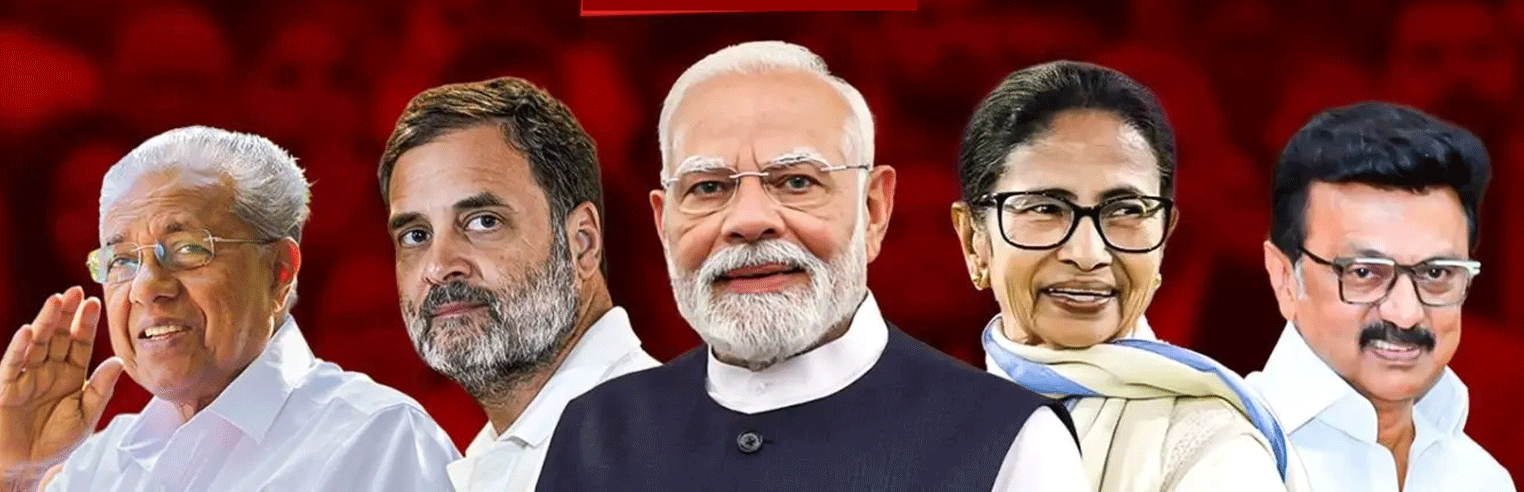
Results of the elections conducted for five states (West Bengal, Assam, Tamil Nadu, Kerala and UT of Puducherry) in the month of April were declared on 4th May 2026. Everyone eagerly awaited the outcome of the exact-polls in the background of the exit-poll results declared on 29 May evening. The biggest upheaval of these results is the outcome in the two states namely West Bengal and Tamil Nadu. In Assam, the BJP-NDA further tightened the screws and got more than three fourth majority mandate in the house. Congress led UDF dethroned the LDF in Kerala by securing a commanding majority. In Puducherry, NDA again got a comfortable majority that will be further reinforced with the nomination of three members to the Assembly in near future.
The biggest talking point on all news portals, channels, print media and other media platforms was indeed West Bengal. The BJP brought a virtual political earthquake in the state by completely sweeping the elections. It was the reverse of the 2021 election results thereby the BJP and the TRC will be exchanging their positions in the Assembly this time. In 2021, TMC led by Mamta Bannerji got 214 seats in the Assembly of 294 members while the BJP was in second position with 77 members. This time the BJP got 207 seats while the TMC got 80 seats. Further BJP’s vote share increased to 46% while the TMC’s share went down to 41%.
In Assam, the BJP under the able leadership of the Chief Minister, Hemanta Bisawa Sarma created a record by securing 80% of the seats in the Assembly. The BJP-NDA got 102 seats in the house of 126 while the Congress got reduced to 19 seats only. In Puducherry, the NDA repeated their last performance, rather improved it and the Congress has been reduced to one seat only in the UT Assembly.
The results in Kerala ended the rule of the Left Democratic Front (LDF) which was in office for the last ten years consistently. With this, the Left parties’ rule ended in all states of the country after a gap of almost five decades. This is a significant development in the political scenario of the country. Further, Congress led United Democratic Front (UDF) has come to the office after a gap of ten years with a very impressive number. The BJP has been able to win three seats in the assembly for the first time and has created a record. In 2011, BJP had won three seats in West Bengal as well. The historical context has a big meaning for the BJP in the future course of events.
The results in Tamil Nadu surprised all and sundry. The Tamil films superstar Joseph Vijay led Tamilaga Vettri Kazhagam (TVK) with 35% of votes emerged as the largest party with 108 seats in a triangular fight. Though it fell short of the majority mark by 10 seats, Congress and some other parties did show willingness to support TVK to form the government. The two main alliances led by DMK and ADMK have fallen flat and have been relegated to second and third place. The BJP though has won a seat in the Assembly has damaged its voter base by aligning with the ADMK. Its vote share has been reduced to 3% while it got 11% last time in 2024 when it fought the Lok Sabha elections alone. TVK leader Vijay promised freebies and he now faces a tough task of governance to fulfill his bundle of promises he made during his campaign as he has been ultimately invited by the Governor to take oath as the new CM. However, this brings to an end the Dravidian parties’ monopoly in Tamil Nadu politics and governance after a long period of six decades.
There are a number of lessons that can be learnt from these elections. The most important lesson for all is in regard to the power of the electorate in a democracy which some politicians try to undermine during their heyday. The government under the leadership of Mamta Bannerji was seen as the most intoxicated with the arrogance of power. People were so fed up with the 15-year old rule of the TMC, infested with seeds of violence, corruption, cut-money, appeasement of illegal infiltrators, syndicate and castigation of the majority communìty in the state, that they resolved to pull it down in a way that nobody could gauge its strength up to the last stage. People kept silent and translated their decisive powerful resolve into reality through the immense strength of their vote. Suvendu Adhikari, a senior BJP leader took oath on 9 May 2026 as the CM along with his other five colleagues as Ministers in the West Bengal new cabinet.
Almost similar was the case of the Tamil Nadu government which did everything under its control to denigrate Sanatan Dharma and attempted to create a wedge between the centre and the state on issues pertaining to funds, language, region and division of power between states and the centre. The Stalin government even went to the Supreme Court of India against the Centre for funds allocation but was defeated in the Apex Court that dismissed its case. The government and the politicians connected with the government eagerly attempted to lead the state to the path of separatist politics as a course of last resort but that backfired on them.
The Governor of Tamil Nadu wasn’t initially satisfied with the claim of the TVK led by Vijay as his party fell short of the majority mark, thus he didn’t extend any invitation to Vijay for the government formation. The Governor in this kind of a situation could have resorted to the Supreme Court judgement of 1998 when the apex court directed the Speaker of the UP Assembly to take a ‘composite vote’ on the floor of the house in the case of Jagadambika Pal v/s Union of Indìa. It could have also taken care of the Supreme Court verdict in the Bommai judgement wherein it was categorically directed by the apex court that the count of the votes should always be held on the floor of the house. The Governor could have gone for this formula in order to avoid any chance of horse-trading in the current case.
The polity of the nation was infested with a number of issues that damaged the course of democracy for a long time throughout the length and breadth of the country. That seems to have been curbed to a large extent if not defeated completely. Over the last several decades, vote bank politics on the basis of region, religion, caste and language had made a deep dent into the electoral scene and stage of the country. It has by and large lost its strength over the last one decade, slowly and steadily, the results of these five state elections being the latest format of the coming events in future.
The majority community throughout the country was given to understand by the political leaders especially of the regional political parties, Congress and the communal groups that it had no prospects or future so far as the electoral arithmetic and the political scenario of the nation and the states was concerned. Politics was compelled to take the parochial and separatist route as a sure guarantee for vote-catching in the elections. However, most of the elections held to the Lok Sabha and various state assemblies over the last one decade have reversed the clock; and the vote-bank politics has been decimated to a great extent. National security, true secularism, corruption-free administration, law & order, welfare schemes for all and an overall development have become the key issues for the general public now, under the leadership of the PM Narendra Modi.
Every political party, social group, intellectual circle, media domain and the social influencer need to take lessons from these subtle changes to evolve an egalitarian society. Illegal infiltration is a very serious issue that needs to be addressed quickly by the government followed by the steps towards UCC, NRC and one nation-one election proposal of the National Committee on the issue. There are several other lessons too but the first and the foremost is in regard to providing justice to the victims of violence during the tenure of TMC in West Bengal over the last 15 years and specifically the last five years. This is the time to start afresh…in order to build a promising great future…..not only in West Bengal but throughout the nation -India, that is Bharat…..!
(The author is a senior BJP and KP leader
 Follow our WhatsApp channel
