

Sunny Dua
sunnydua55@gmail.com
 In the work of Pradeep Wahule, there is a distinctive stillness, one that does not remain quiet for long, but gently draws the viewer into a deeper, more contemplative space. His art unfolds not in haste, but with a measured rhythm, revealing an enduring engagement with the landscapes he enAcounters and the emotions they evoke. A self-taught artist with over 25 years of practice, Wahule approaches creation as an act of immersion rather than observation.
He does not merely paint what he sees; he internalises it, allowing experience to find expression in whichever form arrives first. At times, a poem emerges before the brush meets the canvas; at others, colour leads and words follow. This natural interplay between poetry and painting lends his work a quiet cohesion, where each piece becomes less a representation and more a lived, felt moment translated into form.
Revisiting his early years, he recalls how his first inspiration came from watching his father sketch with a pencil, an experience that filled him with wonder and curiosity about art and the great masters his father spoke of. This early fascination was further nurtured by the 1991 edition of the World Book Encyclopaedia, particularly its section on paintings, which drew him deeper into a subject he was naturally inclined toward. Over time, through studying art history and experimenting with various mediums, he shaped his journey as a self-taught artist.
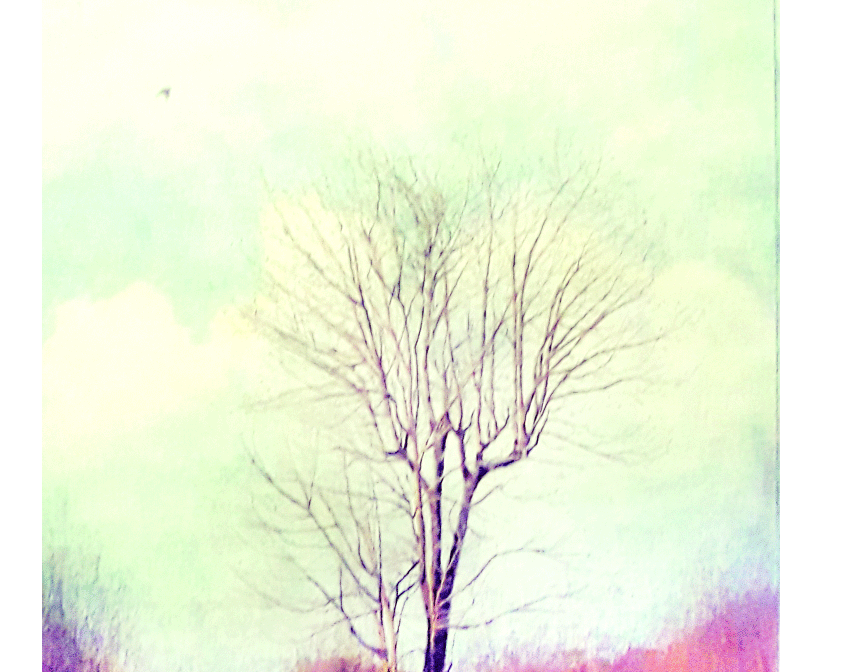
From the misty expanse of Tawang Valley to the dense silence of Ranthambore, from Nashik and the many regions he has served to the countless inner terrains he traverses, his works are more than realistic, they are emotional geographies. His works of kacha paths winding through forests and barren mountains, his lakesides paintings and fields heavy with harvest, his solitary trees waiting for spring or standing in silent lines along roads, all become metaphors of longing and stillness. Every painting carries poetry, every frame enhances its beauty like icing on the cake, and every composition draws the viewer into its depth, making one not just see distance but feel the journey within it.
Even his smaller abstract works, created with Indian colours and materials, speak with immense power. For Wahule, art is not an act, it is an instinct, a devotion, a lifelong conversation between nature, memory, and the restless poetry of the soul. An officer of the Indian Forest Service (IFS) currently serving as Conservator of Forests in Jammu & Kashmir, he inhabits two worlds with rare harmony: one of duty, the other of deep introspection. Before this, he began as an Assistant Professor in Zoology and also taught “Photography as an Art Form” at Mumbai University. Yet, beneath all professional identities, there remained a persistent, undeniable calling – art.
Every painting of Pradeep Wahule has been framed with such care that it enhances its beauty manifold, like icing on the cake, completing the narrative the canvas begins. There is also a recurring quietness in his motifs – trees. Tree lines rising along hills, trees flanking roads on both sides, a lone dried tree waiting patiently for Aspring, or clusters standing together in silent resilience. These are not just compositional choices; they are emotional anchors. They draw the viewer inward, into the depth and perspective of the painting. One does not just see the tree; one feels its solitude, its waiting, its time.
Wahule’s understanding of scale is particularly striking. His compositions allow viewers to not only see distance but experience it to imagine the walk from a lone tree into distant meadows, to feel the time it would take, the silence it would hold. The canvas becomes not just a surface, but a space one can enter. Even his abstract works, though often smaller in scale, carry immense emotional weight. Painted on simple sheets using Indian colours, paints, brushes, and mixed materials, these works speak with quiet intensity. They prove that size is not a measure of impact but sometimes, the smallest frame carries the deepest resonance.
His artistic language is further enriched by his use of varied mediums – oil, acrylic, watercolour, ink, and pastel combined with a subdued palette of burnt sienna, sap greens, muted blues, and yellows. This creates an atmospheric haze, almost like memory itself soft, lingering, and evocative. His landscapes often carry a Wordsworthian reserve filled with solitude, nostalgia, reverie, and half-seen recollections that seem to exist between time and space.
At its core, his work carries a message, simple yet profound: only by coming closer to nature can one truly understand its depth and feel the urge to preserve it. As he puts it, “Love for nature is the only prerequisite for its conservation.” It is this philosophy that lends his work both artistic and environmental significance. Wahule now envisions bringing his two worlds even closer through a forthcoming poetry book, one that will weave together his paintings and verses, offering readers a complete immersion into his creative universe.
His works have found space in prestigious exhibitions, from Lalit Kala Akademi in Delhi to Nehru Centre in Mumbai, from the Tawang Festival to Valley of Words in Dehradun and have been recognised by institutions and featured on national platforms like Doordarshan. Yet, despite recognition, his art retains a rare humility, an inward gaze that seeks not applause, but connection.
Asked about his most cherished work, Pradeep reflects on a piece inspired by the timeless heritage of Ajanta Caves, rendered in soft dry pastels. He describes it as a deeply personal response to the artistic and cultural richness of Ajanta, where the medium allowed him to capture the subtlety, depth, and enduring spirit of those ancient forms. For him, the work is not merely a painting but a humble attempt to preserve and reinterpret a legacy that continues to inspire generations.
Behind this journey, quietly and steadfastly, stands his wife, Rashmi Rao. His love and respect for her is as profound as his devotion to art. He credits her as a constant source of support, someone who has given him the freedom to spend hours immersed in his passion. More than that, she plays a vital role in curating his work, preserving it, and accompanying him through exhibitions, ensuring that each piece finds its rightful place and audience.
Today, while he creates, it is Rashmi who thoughtfully guides exhibitions and collectors – efforts that have helped place over 40 of his pieces in collections across India and abroad, including one at Kala Kendra in recent days. Now, Wahule and Rashmi are preparing to bring the two worlds into their closest proximity yet: a forthcoming poetry book that will weave paintings and verse into a single, immersive creative universe. Until then, his canvases do the speaking. And for those who pause long enough to listen, they say something quietly extraordinary that the most profound journeys are often the ones on paths that have no end in sight as he himself writes:
As the sun goes down, with the end of day,
The wind bears the sweet music of yore;
I’m wandering still, in the mist of thoughts,
I’m sure, I have witnessed this all before.
(The writer is senior journalist)
 Follow our WhatsApp channel
