

Col Satish Singh Lalotra
In the fertile plains of Jammu region bordering the plains of Punjab, agricultural practices have always been the mainstay of the masses. To support this oldest profession of mankind a vast network of irrigation canals was envisioned centuries back by the ruling Maharajas of the erstwhile state of Jammu and Kashmir. With distributries like Ranbir canal, old and New Pratap canal to name a few criss crossing the entire swathe of land of Jammu region ; the area was well irrigated drawing water from perennial rivers of Chenab, Tawi etc. Built to sustain fields and agriculture alike, the maze of these irrigation canals in the region were symbolic in equitable distribution of natural resources and rural productivity. Today, unfortunately, that proverbial life line of rural sustainability is severely choked– not due to some natural calamity. But due to monumental administrative neglect bordering on criminality. In the cross hairs of this apathy lies the decades old Ravi Tawi distributory which was conceived way back by the planning Commission of India in 1973.
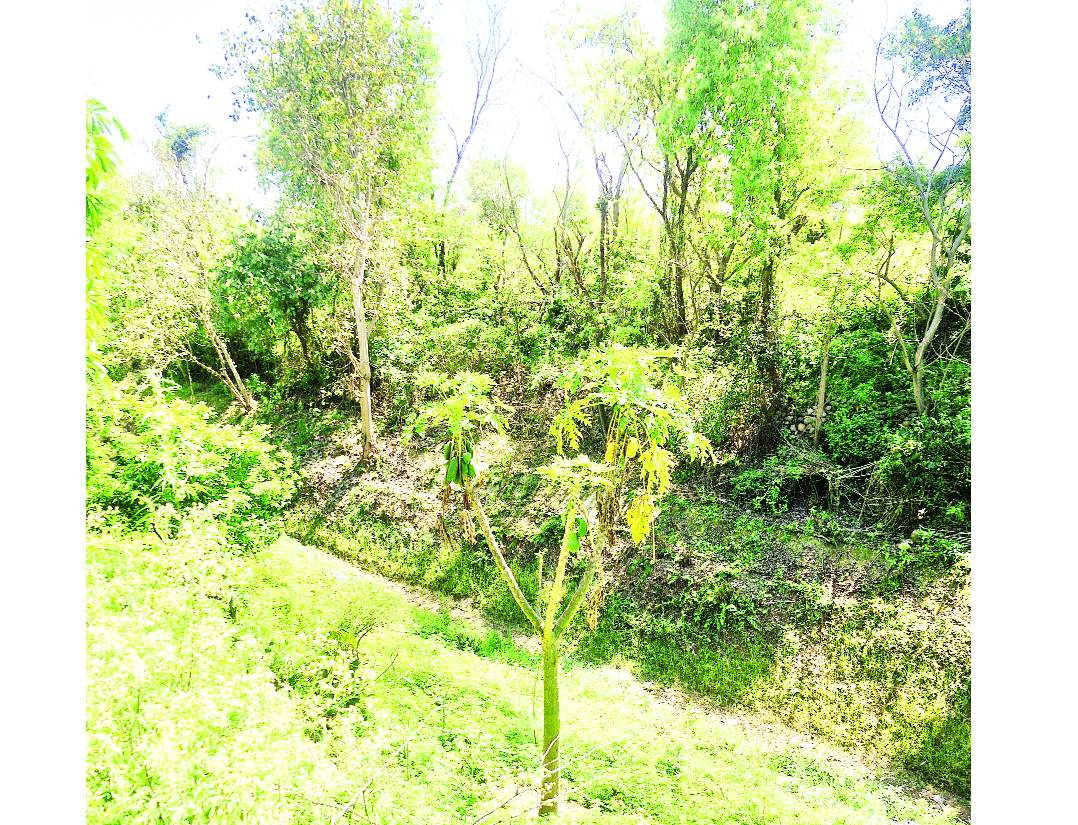
The impetus for writing this article took shape when I went to my village near Ghagwal recently to look and oversee my ancestral land that lies astride on both sides of this Ravi- Tawi distributory canal. My ground level observations revealed a disturbing reality- large stretches of this canal resembled wild growth zones rather than a functional irrigation channel. Thick vegetation, embedded silt, and even small trees now occupy what should have been a flowing water course. A little about this RTIC( Ravi Tawi irrigation complex). This entire irrigation system was envisaged way back in May 1973 with an estimated cost of Rs 29.84 crores. Having been seen as a flagship of interstate cooperation between Punjab and Jammu and Kashmir, the plan quickly got into the quagmire of bureaucratic labyrinthine due to cropping of differences between the two entities. Anyway reverting to my main theme of this write up, i.e the state of this Ravi Tawi canal which deserves the attention from powers that be in the UT of Jammu and Kashmir.
A canal lost under Green cover….
At first glance, one might mistake certain stretches of this Ravi Tawi canal for uncultivated land. Dense grasslands carpet the canal bed, where shrubs and saplings of all hues rise undisturbed along the embankments. In some sections of this canal, the growth is so extensive that the original alignment of the canal becomes difficult to decipher.This is by no means an aesthetic issue now. The presence of such mature vegetation inside the canal system indicates a prolonged neglect. Regular desilting and clearance operations which are essential for maintenance of Regular water inflows appears to have been totally shortchanged . The canal that was supposed to carry steady inflows of water is now struggling under the weight of uncleared silt deposits and biological crap. Where water should move freely, it now seeps struggling to find its way to reach the last beneficiary of this irrigation complex. ?
The Mechanics of Neglect
Irrigation canals require routine maintenance with criticality hinging on the following….
a) Desilting.. Removal of sediment deposits that reduces the carrying capacity of the water.
b) Weed clearance that entails cutting and removal of vegetation which eventually obstructs the water flow.
c) Embankment strengthening…This prevents erosion and structural failure of the canal per se.
In the ibid case none of the above facets were put into motion, and my photos of this canal system taken by me proves the adage., “a picture is worth more than thousand words”. It will be a damning indictment of the UT of Jammu and Kashmir to know that the above has resulted into raising the canal bed by more than a foot near Ghagwal thus further excaerbating an already dismal situation. Over time this has led to uneven distribution of water– head reach areas receive water, while tail end areas are left partially to fully parched. The canal embankments are now fully obscure due to heavy undergowth and pose risk to villages like Chhan Matlooni. Since any breach in the embankment can lead to serious man made disaster.
Farmers at the receiving end.
The most immediate victims of this damning apathy are the farmers. With most of the farmers in this region of Ghagwal comprising either small or marginal dependence on canal irrigation is what they hanker for. Crop cycles, seed choices and fertilizer applications all hinge on predictable water availability. When a canal fails to deliver, the consequences ripple through the entire agricultural system. In areas fed by this RTC (Ravi Tawi Canal), the farmers report the following…
a) Reduced water flow during critical crop stages.
b) Delayed irrigation cycles.
c) Increased dependence upon costly alternatives like tube wells etc.
This shift is not trivial. Tube well irrigation demands constant supply of electricity and diesel. Both are costly and not everyone’s pocket is deep enough to sustain such a method of irrigation. Unlike Punjab, this part of Jammu region is full of small or marginal farmers and the above methods if implemented will further erode the wafer thin profit margins of these cultivators. A cursory glance made me aware of the fallow land in abundance-thus proving as a corollary to the above facts.
The illusion of Maintenance
What makes the situation even more grim is the persistent claim of regular desilting operations by the concerned department. A few days back the Jal Shakti minister Mr Javed Ahmed Rana released water into the main Ranbir canal at Akhnoor with lot of fanfare. But what about the canal systems in Samba district? Did the minister bother to even have a cursory look at the Ravi Tawi canal near Ghagwal? On papers irrigation department often report regular annual maintenance activities with allocated budget and completion certificates. Yet the CAG (comptroller and auditor General), few days back had red flagged the UT for not providing the UCs( Utilisation certificates) to the tune of Rs 7539 crores dating as far as back to 2019-20 pertaining to myriad departments.?
Such presence of established growth on the canal banks takes time, often multiple seasons to talk of. Its existence is therefore a silent testimony against official claims. This disconnect raises serious questions of the following nature…
a) Were desilting contracts awarded but not executed?
b) Was the work done superficially, with out addressing deeper silt layers ?
c) Is there a lack of maintenance with accompanied accountability vacuum at the field level ?
Whatever be the explanation the outcome is the same- public funds appear to have failed in delivering public benefits.
A systemic problem, not an isolated case?
The present condition of Ravi Tawi canal is unlikely to be an isolated case. Across many regions irrigation infra suffers from a similar pattern…
a) Budgetary allocation without effective execution
b) contract based work with minimal oversight.
c) Absence of community involvement. Overtime this creates a vicious cycle where deterioration becomes normalized and maintenance shifts from being preventive to reactive. Addressed only when the system is on the verge of collapse.
Environmental and Structural Risks
Beyond agricultural impact, the neglect of canal systems introduces broader risks with the following patterns….
a) Flooding and Breaches.. Blocked or narrowed channels can cause water to overflow during peak flow periods. Coupled with unseasonal rains weak embankments compromised by poor? maintenance are more prone to collapse.
b) Waterlogging .. In some areas , uneven flow can lead to localised waterlogging , damaging crops and degradation of soil.
c) Biodiversity imbalance…While vegetation might seem beneficial, uncontrolled growth with in the engineered systems as is visible in the photograph of the Ravi Tawi canal near Ghagwal disrupts ecological balance and infra functionality.
The Governance deficit.
At its core, the issue reflects a governance gap. Effective irrigation management requires….
a) Regular inspection by field engineers.
b) Transparent reporting of maintenance activities.
c) Third party verification of completed works.?
d) Active grievance redressal mechanism for farmers of this region who are dependent on RTC( Ravi Tawi canal).
When these elements are weak or absent, systems deteriorate despite timely budgetary support. The Ravi Tawi canal in its present condition exemplifies this failure. Its a prefect case of “accountability vacuum.”.
The way forward – From Neglect to Restoration..
Reversing the decline of the RTC is possible, but it demands intent and action…
a) Immediate measures –
i) Comprehensive desilting across the effected stretches of this RTC.
ii) Mechanical removal of vegetation including the root systems on the embankments.?
iii) Repair and reinforcement of embankments.
b) Medium term measures.
i) Establishing a fixed maintenance calendar with public disclosure.
ii) Using technology ( GPS tagging, Geo tagged photos) to track work.
iii) independent audits of irrigation projects
c) Long term measures..
i) involving local farmers and their groups in monitoring the maintenance of this RTC.
ii) creating accountability frameworks for contractors and officials.
iii) Linking fund release to verified ground outcomes.
A call for accountability
The Ravi Tawi canal was built not merely as an engineering structure, but was conceived as a public asset keeping the much touted KWD ( Kandi watershed development) programme at the center of all irrigation initiatives for the district of Kathua and Samba. Its current condition is a stark reminder that infrastructure no matter how well organised can’t function without consistent care. The overflowing canal bed, choked with silt and weeds is more than a visual of Neglect- it is hard evidence that demands answers .
Evidence that calls for scrutiny of records, contracts and claims.
Let the Canal flow again….The story of Ravi Tawi canal is not yet beyond repairs. But ignoring its condition will only deepen the crisis. Restoring the canal is just not clearing the silt or cutting weeds. It is about restoring faith and trust between the administration and the people it serves. Until then the green overgrowth will stand as a stark symbol — not of? nature reclaiming space but of governance that has quietly slipped away..
(The writer is a retired army officer)
 Follow our WhatsApp channel
