

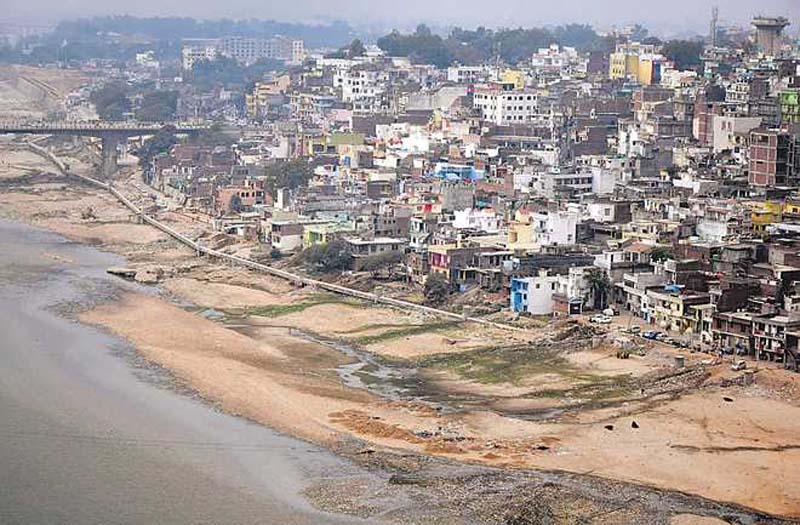
There is something deeply troubling about a city that grows faster than the vision meant to guide it. Jammu, one of India’s most strategically vital and rapidly expanding urban centres, finds itself in precisely this predicament. The Jammu Master Plan 2032 – the statutory blueprint that should be directing every road laid, every colony approved, every school site earmarked, and every green lung preserved – remains mired in bureaucratic quicksand, years after it should have been notified. The consequences are no longer theoretical. They are visible in every choked arterial road, every illegal colony sprouting on the city’s periphery, and every neighbourhood where civic infrastructure has simply given up trying to keep pace with demand.
Question is what a Master Plan actually is ? It is not an aspirational document crafted for bureaucratic shelves. It is the legal and technical backbone of urban governance – the instrument through which planning authorities regulate land use, allocate space for housing, commerce, industry, open recreation, hospitals and schools, and chart the trajectory of a city’s growth over decades. Without it, planners are navigating blind. Developers and encroachers, however, are navigating very well indeed – into whatever space happens to be undefended.
The revision of the Jammu Master Plan 2032 was initiated in October 2021. That is nearly four years ago. During that time, the exercise has completed satellite-based mapping, land-use surveys, traffic assessments, socio-economic studies, an 80-day public consultation period, and a formal board of inquiry. The planning area has been expanded from 652 square kilometres to nearly 778 square kilometres, bringing 350 revenue villages within its ambit. All statutory requirements have, by any reasonable account, been fulfilled. Yet the document sits in official corridors, awaiting Cabinet approval, its fate described in the maddest of administrative euphemisms: “under consideration”.
In the meantime, Jammu has not paused. Urban sprawl has consumed peripheral villages in an almost entirely unregulated fashion. Chaotic land-use patterns have taken root and will cost an enormous amount – financially and socially – to correct. The city’s population swells seasonally as families from Kashmir and Ladakh maintain secondary residences here, pushing water networks, power supply and civic services to breaking point every winter. Monsoons repeatedly expose drainage systems that were never designed for the density they now serve. Traffic has reached a state of chronic gridlock with no viable solution at present. Hospitals and schools operate under relentless pressure, whilst open spaces and recreational grounds – the very amenities that make urban life liveable – are swallowed by construction before anyone has formally decided what should go there.
Nearly 350 villages now exist in a regulatory no-man’s land – neither fully rural nor properly urban – without the clarity of planning norms to guide development, attract investment or ensure basic services. The proposed relocation of Government offices from the old city core, which was meant to free space for public amenities, has reportedly seen the opposite occur: additional structures have come up in those very zones over recent years, directly contradicting long-term planning objectives. This is the cost of delay. And it compounds with every passing month.
In the digital age, the argument that interdepartmental coordination requires years of waiting is simply untenable. Pending inputs from the Revenue and Forest Departments cannot be permitted to hold an entire city’s future to ransom. If a file has been circulating without resolution, that is not an administrative bottleneck – it is an administrative failure. Any document of this nature faces three logical outcomes: approval, rejection with reasons stated, or return for specific modifications with a defined timeline. Sitting on it indefinitely serves none of these purposes and serves no one at all.
Urban planning science is unambiguous on this point: delayed regulation is not neutral – it is actively destructive. Ecological damage crosses thresholds from which recovery is impossible. Infrastructure retrofitting becomes financially unsustainable. What is manageable today becomes catastrophic tomorrow. The Government of Jammu and Kashmir must act now. The Jammu Master Plan 2032 must be placed before the Cabinet and notified without further delay. A city of Jammu’s scale and strategic importance deserves nothing less. There is a difference between governance and indefinite deliberation. The inordinate delay serves neither the public nor the Government.
 Follow our WhatsApp channel
