

Dr. Dinesh Gupta
guptadinesh918@gmail.com
Every year on 8 May, humanity pauses to reaffirm one of its noblest ideals through the observance of World Red Cross and Red Crescent Day. This is not merely a commemorative occasion; it is a moral reminder that beyond nations, ideologies, and identities, there exists a universal duty-to alleviate human suffering with dignity, neutrality, and compassion. The day marks the birth anniversary of Henry Dunant, whose extraordinary vision transformed the pain of human conflict into a global movement of humanitarian service, now known as the International Red Cross and Red Crescent Movement.
The theme for 2026, “United for Humanity,” carries profound relevance in the contemporary world. Humanity today stands at a critical crossroads. Armed conflicts, climate emergencies, pandemics, forced displacement, and deepening social inequalities continue to erode the very fabric of human dignity. In such an environment, the Red Cross is not simply an institution-it is a moral force. It represents the enduring conscience of society, a reminder that even in the darkest of times, compassion must prevail over indifference.
Guided by its fundamental principles-humanity, impartiality, neutrality, independence, voluntary service, unity, and universality-the Movement has consistently demonstrated that humanitarian action must rise above all divisions. These principles are not symbolic declarations; they are operational imperatives that define conduct in the most challenging circumstances. From disaster response to healthcare delivery, from restoring family links to promoting community resilience, the Red Cross continues to embody service in its purest and most selfless form.
However, any institution that seeks to remain relevant must also possess the courage to introspect. The passage of time has introduced complexities that were perhaps unimaginable at the time of the Movement’s inception. In several contexts, there is an emerging concern that excessive bureaucratization and centralized administrative control have begun to overshadow the foundational ethos of volunteerism and community engagement.
The Red Cross must not become distant from the people it serves. It must remain vibrant, accessible, and deeply rooted in society. A humanitarian movement derives legitimacy not from authority, but from trust. It thrives not only on control, but on participation. Therefore, it is imperative that the Red Cross functions within a framework that is democratic, inclusive, and responsive-rather than overly bureaucratic.
In this regard, the Branch Committee Rules, 2017 of the Indian Red Cross Society assume critical importance. These rules, enacted through due legislative process and assented to by the President of India, provide a robust framework for transparent, accountable, and participatory governance. Their adoption by the Jammu and Kashmir Red Cross on 27 May 2022 was a progressive and necessary step toward institutional strengthening.
Yet, the true measure of reform lies not in adoption, but in implementation. The spirit of these rules must be fully realized in practice. They envisage an active and meaningful role for public representatives, members of civil society, and dedicated volunteers in the functioning of the Red Cross. This participatory model is essential in ensuring that the organization remains connected to grassroots realities and responsive to community needs.
A democratic structure within the Red Cross is not a matter of administrative convenience; it is central to its identity. When governance is inclusive, it enhances transparency, builds credibility, and fosters a sense of collective ownership. When civil society and volunteers are empowered, the organization becomes more dynamic, more compassionate, and more effective. Conversely, an overreliance on bureaucratic mechanisms risks diluting the spirit of service and alienating those who are the true custodians of humanitarian values.
This is, therefore, a call for renewal-a call to restore equilibrium between structure and spirit, between governance and grassroots engagement. The Red Cross must evolve as an institution that is professionally efficient yet profoundly humane; structured yet participatory; disciplined yet compassionate.
The role of youth in this transformation is indispensable. Young volunteers bring not only energy and innovation, but also an unburdened sense of idealism. They have the capacity to reimagine humanitarian action in ways that are both contemporary and deeply rooted in core values. By embracing responsibility and leadership, they can ensure that the Red Cross remains relevant to future generations.
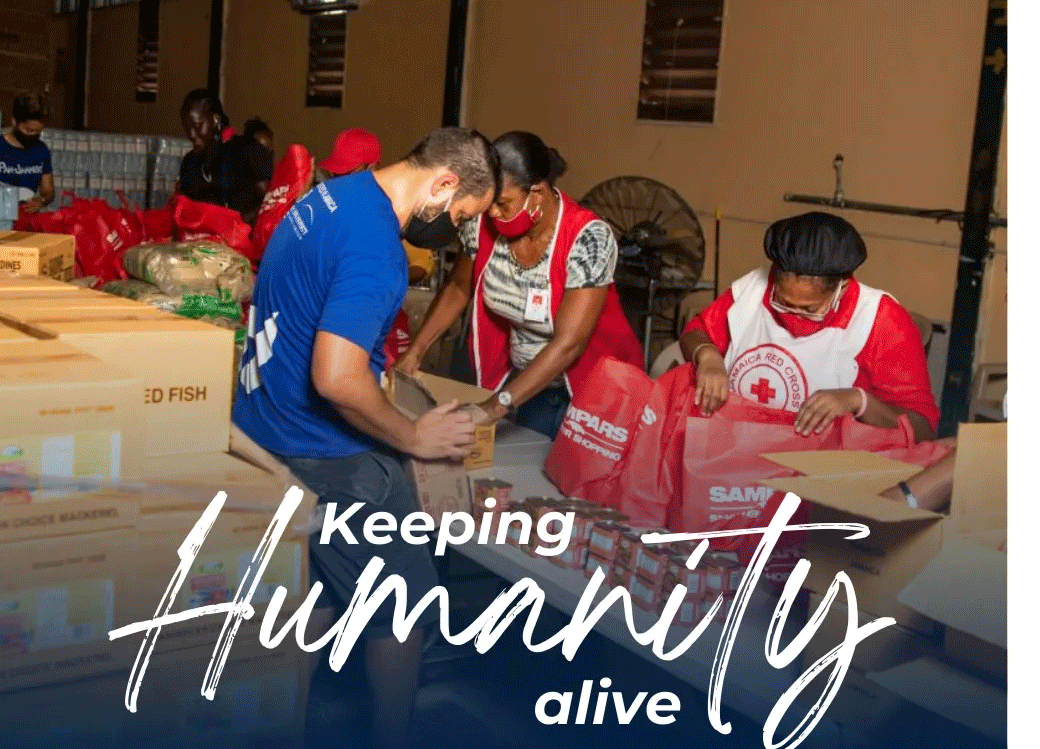
“Keeping humanity alive in Changing Times” is not confined to moments of crisis. It is reflected in everyday actions-in empathy, in solidarity, in the willingness to stand beside those who are vulnerable and voiceless. It demands that we uphold human dignity not as an obligation, but as a shared responsibility.
As we observe World Red Cross Day 2026, the need of the hour is not mere celebration, but conscious commitment. A commitment to revitalize volunteerism. A commitment to uphold transparency and accountability. A commitment to ensure that democratic principles guide institutional functioning. And above all, a commitment to preserve the humanitarian soul of the Red Cross.
(The author is Patron, IRCS, J&K)
 Follow our WhatsApp channel
