

Security challenges before country to come up for review
Major focus on indigenization and Aatmanirbharta
Sanjeev Pargal
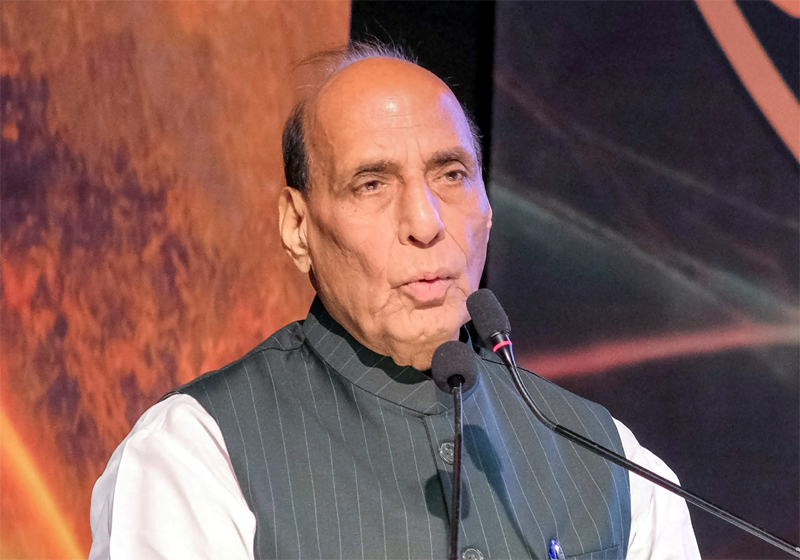
JAMMU, May 6: On first anniversary of Operation Sindoor, second edition of two-day Joint Commanders’ Conference is being held in Jaipur on May 7 and 8 in which Defence Minister Rajnath Singh will reviews security challenges of the country with top brass of the tri-services.
Follow the Daily Excelsior channel on WhatsApp
It was on May 7, 2025 that to take revenge of April 22 Pahalgam terror attack in which 26 civilians including 25 tourists and a local guide were killed, the Indian Armed Forces carried out Operation Sindoor targeting terror camps and military installations deep inside Pakistan and PoJK in which number of terrorists and their commanders were eliminated. The Operation Sindoor was carried out from May 7-10.
The Joint Commanders Conference is being held on first anniversary of Operation Sindoor and will be attended by Defence Minister Rajnath Singh, Chief of Defence Staff Gen Anil Chauhan, tri-service chiefs and their top commanders.
Excelsior had earlier reported that the Joint Commanders Conference is being planned in Jaipur on the anniversary of Operation Sindoor.
The Defence Ministry described it as a landmark tri-services mission that stands testament to India’s “unflinching political will and military resolve characterized by surgical precision”. Rajnath and the top military brass are expected to review various aspects of the country’s military preparedness in view of the evolving regional security scenario.
An official statement issued ahead of the Joint Commanders Conference said the modern warfare is transitioning into a more complex and tech-driven paradigm with transformative impact of AI, development of unmanned systems and emerging threats that extend beyond traditional battlefields and target invisible frontiers.
The conference will provide a pivotal forum to evaluate the challenges in emerging domains of cyber, space and cognitive warfare and chart a roadmap for capability development for resilient and future ready force with a decisive edge, the statement said, adding that central to the agenda will be to accelerate indigenization and Aatmanirbharta in defence production by fostering a domestic ecosystem of innovation and civil-military fusion.
PTI adds from New Delhi: Operation Sindoor, launched weeks after the dastardly Pahalgam terror attack last year, marked a paradigm shift in India’s national security calculus through the extensive use of drones, networking and the integration of artificial intelligence in target analysis and acquisition.
The operation, billed as the Indian military’s most expansive multi-domain combat mission in half a century to punish Pakistan for its relentless support to cross-border terrorism, redefined India’s overarching security and strategic goals.
India’s action was largely seen as a statement of its “political will” to inflict a blow to Pakistan for supporting terrorism, with Prime Minister Narendra Modi asserting that India will not tolerate any nuclear blackmail by Islamabad.
In the course of the last one year after the operation, India’s three services have drawn up extensive plans, strategy and policy initiatives to bolster their combat readiness by acquiring new platforms, missiles and a variety of long and short-range drones, and boosting the overall air defence apparatus.
In response to the Pahalgam terror attack on April 22 in which 26 people, mostly tourists, were killed, India launched Operation Sindoor on May 7 last year, carrying out airstrikes on nine terror infrastructures in Pakistan and Pakistan-occupied Jammu Kashmir eliminating at least 100 terrorists.
The strikes at the terror camps included the Jaish-e-Mohammed (JeM) headquarters at Bahawalpur, the Lashkar-e-Toiba’s base at Muridke and terrorist infrastructure in Mehmoona Joya in Sialkot, Sawai Nala and Syed Na Bilal in Muzaffarabad, Gulpur and Abbas in Kotli, Barnala in Bhimber, and Sarjal.
The action triggered a rapid escalation in tensions with Pakistan launching retaliatory strikes, though most of them were thwarted by the Indian military. The hostilities ended with an understanding on halting the military actions on May 10 following talks over the hotline between army officials of the two sides, but the episode brought into focus the need to enhance India’s military might.
While India delivered a befitting response to Pakistan, the three services analyzed the hostilities to refine operational strategies and integrate advanced technologies and platforms.
The three services have been specifically focusing on procurement of unmanned platforms and infusion of high-end technologies, including artificial intelligence for target acquisitions and surveillance.
India has added significant military might in the last one year, and the credit goes to a whole-of-government approach to bolster military prowess.
Definitely, lessons learned from Operation Sindoor are being implemented, said a senior military official.
The months following the conflict saw the government green lighting several mega procurement projects in line with the national security strategy and priorities.
The procurement proposals cleared to further crank up the military’s overall strike capabilities included a green signal to acquire a fresh batch of five S-400 missile systems from Russia and the purchase of 60 medium transport aircraft.
In March alone, the government greenlighted the acquisition of military hardware worth Rs 2.38 lakh crore.
In February, the government cleared another long-pending proposal to procure 114 Rafale fighter jets under a government-to-government framework with France, nearly two decades after the plan was originally rolled out to boost the Indian Air Force’s combat prowess.
The Defence Ministry also approved buying six US-made Boeing P8-I surveillance aircraft for the Indian Navy to enhance the force’s surveillance and anti-submarine warfare capabilities.
 Follow our WhatsApp channel
