

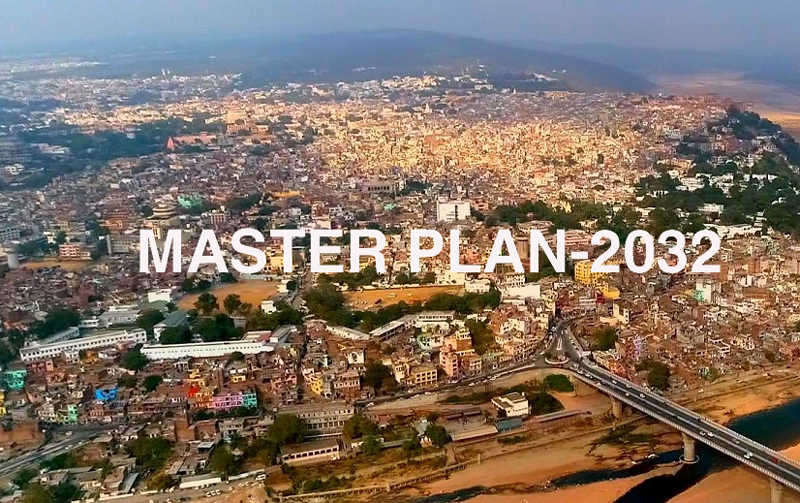
Urban expansion slipping beyond regulatory control
Revision of Master Plan-2032 still awaits final nod
Mohinder Verma
JAMMU, May 6: Even months after the Government admitted that the revision of Jammu Master Plan-2032 was ‘under consideration’, there is still no movement on its final approval despite the fact that prolonged delay has effectively left the fast-expanding urban landscape of Jammu without a statutory roadmap.
Follow the Daily Excelsior channel on WhatsApp
When the issue of revision of Jammu Master Plan-2032 was raised in the Legislative Assembly in the month of February this year, the Chief Minister, who is also Minister Incharge Housing and Urban Development Department, stated: “the revision of Jammu Master Plan-2032 is under consideration by the Government. The rectification of incorrect land-use zoning and boundary alignment with revenue villages, incorporation of sustainable public objections and suggestions and time taken in obtaining and verifying data from multiple departments, including pending inputs from the Revenue and Forest Departments are the reasons for delay in final approval”.
Today, when the EXCELSIOR approached the officers of the Housing and Urban Development Department and Jammu Development Authority, they said, “the revision of the Jammu Master Plan is still under consideration of the Government”, adding “final decision is supposed to be taken by the Cabinet as such we are not in a position to specify any time-frame for the approval and subsequent notification”.
“What makes the delay particularly indefensible is that the revision exercise has already crossed all critical stages. Initiated in October 2021 under the J&K Development Act, the process involved extensive groundwork—satellite-based mapping, land-use surveys, traffic and transport assessments and socio-economic studies conducted by reputed agencies”, sources said while disclosing that the planning area was expanded from 652.33 sq km to 777.84 sq km, bringing 350 revenue villages within its ambit in anticipation of future urban expansion.
The draft revised plan was also placed in the public domain for 80 days between October 2024 and January 2025, inviting objections and suggestions. Following this, a Board of Inquiry conducted public hearings in January 2025.
“Despite completion of these statutory requirements, the proposal continues to gather dust in official corridors, with no clarity on when it will be placed before the Cabinet for approval”, sources further said, adding “the Government had earlier attributed the delay to rectification of land-use anomalies, incorporation of public feedback and pending inputs from departments such as Revenue and Forest. However, the persistence of these explanations months later has only amplified concerns over lack of inter-departmental coordination”.
The consequences of this delay are already visible on the ground. Jammu’s urban sprawl continues to expand into peripheral villages in a largely unregulated manner, leading to chaotic land-use patterns, mushrooming constructions and mounting stress on civic infrastructure.
“In the absence of a revised Master Plan, there is no unified framework to guide critical sectors such as transportation, housing, sanitation, water supply and environmental conservation”, sources said, adding “the revised plan envisions integrated infrastructure development and economic growth, including allocation of over 44 sq km for commercial use and more than 14 sq km for industrial zones. These proposals were expected to generate employment and attract investment. However, with the plan stuck in limbo, these opportunities remain largely on paper”.
The experts in the field of urban planning, while commenting on the inordinate delay, said, “the inability to finalize the Master Plan despite completing procedural formalities reflects a deeper systemic issue where policy formulation is not matched by timely implementation”, adding “as Jammu continues to grow at an unprecedented pace, the continued delay in finalizing the revision of Master Plan-2032 is not merely a bureaucratic lapse but a critical governance failure”.
“Unless the Government moves swiftly to clear and notify the document, the city risks drifting further into unplanned expansion, with long-term consequences that could prove both costly and irreversible”, they added.
 Follow our WhatsApp channel
