

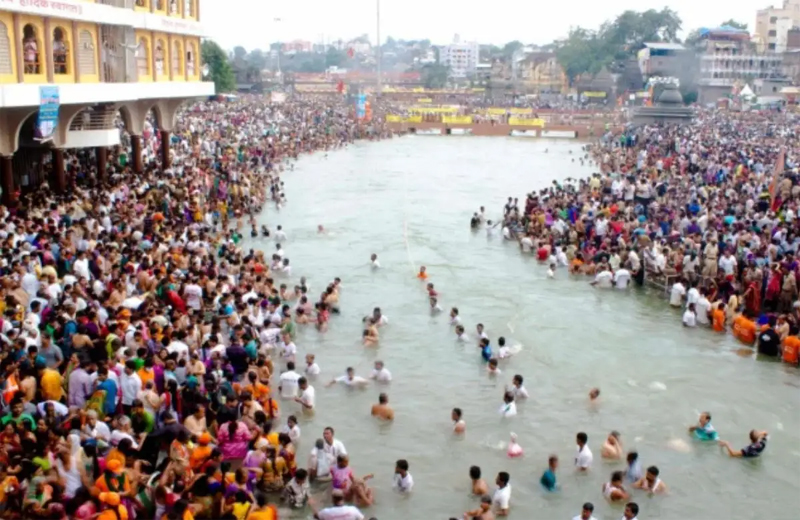
NASHIK, May 6 : Maharashtra Chief Minister Devendra Fadnavis on Wednesday said the upcoming Simhastha Kumbh Mela in Nashik district will be the most digitally advanced yet environmentally responsible gathering.
Fadnavis asserted that his government aims to organise the most digitally savvy Kumbh Mela on the banks of the Godavari river with maximum use of technology while rejecting concerns over ecological damage.
He said the state government wants to leverage technology to manage large crowds efficiently at the Simhastha Kumbh Mela despite space constraints in Nashik as compared to Prayagraj, where the mega religious gathering was organised in 2025 across a sprawling 4,000-hectare area.
The administration is working in a coordinated manner to ensure that even if significantly higher footfall is witnessed, devotees will have a seamless and spiritually enriching experience, he insisted.
“We will assess the carbon footprint after the Kumbh, and I am confident it will be positive, not negative,” the CM maintained.
Elaborating on the approach while addressing an event in Nashik related to industries and investment as part of the Kumbh preparations, Fadnavis said technology will be deployed extensively to ensure efficient crowd management, better coordination and a seamless experience for devotees.
He underlined that the use of digital tools will not dilute the spiritual essence of the Kumbh, but rather enhance accessibility and convenience.
On the environmental front, the CM dismissed allegations of indiscriminate tree cutting and emphasised sustainability is central to the planning of the event organised every 12 years.
He pointed to ongoing efforts such as river cleaning, creation of sewage treatment infrastructure and other eco-friendly measures, adding that the government will carefully evaluate the event’s overall environmental impact after its conclusion.
Fadnavis said the Kumbh Mela is a powerful engine of economic activity and not just a religious event.
“The Kumbh is a gathering where there is no caste, no religion, no distinction between the rich and the poor — it is a true festival of equality. The narrative that Kumbh harms the environment or involves large-scale tree cutting is completely incorrect,” he stressed.
Addressing environmental concerns, Fadnavis rejected claims that organising the Kumbh would lead to indiscriminate cutting of trees or ecological damage, terming such narratives as”misleading”.
“While some tough decisions are required, we are ensuring that environmental damage is minimised and sustainability remains a priority. For every devotee, the Kumbh is a spiritual experience, and we will ensure that this essence remains intact,” he affirmed.
“Even if footfall increases multiple times, we will ensure that inconvenience is not caused and the spiritual experience of devotees is not affected. Our effort is to make the Kumbh more accessible, efficient and seamless through the use of modern technology,” Fadnavis stated.
Speaking about preparations for the Kumbh, he emphasised that the event reflects the diversity of Sanatan culture, bringing together multiple beliefs, traditions and forms of worship under one platform.
The state government is working to ensure that the event contributes to both economic growth and sustainable development, with initiatives such as the Nashik Ring Road expected to open up large areas for investment, the CM said.
Fadnavis highlighted the ongoing efforts to clean the Godavari river, build new sewage treatment plants and implement environmental measures.
He lauded the integration of industry and innovation with the event through initiatives like hackathons and start-up participation, calling it a “Kumbh-Industry Sangam (confluence)” aimed at connecting all sections of society.
The Simhastha Kumbh Mela will begin on October 31, 2026, with ‘Dhwajarohan’ (flag hoisting) at Trimbakeshwar (near Nashik city) as well as Ramkund and Panchvati, and will be underway till July 24, 2028.
On July 29, 2027, ‘Nagar Pradakshina’ (traditional circumambulation of the city) will be held at Nashik, while the first ‘Amrut Snan (holy dip)’ will be held on August 2, 2027.
The second Amrut Snan will be held on August 31, 2027, and the third and last one will be held in Nashik on September 11, 2027 and on September 12, 2027 at Trimbakeshwar.
The flag will be taken down on July 24, 2028, which will mark the conclusion of the Simhastha Kumbh Mela. (PTI)
 Follow our WhatsApp channel
