

*Demands action on political representation
Excelsior Correspondent
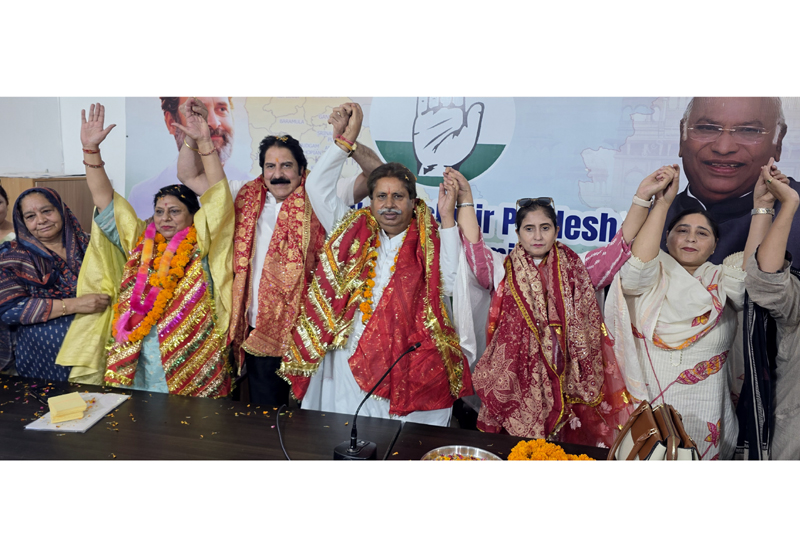
JAMMU, May 6: Mahila Congress convention held at Jammu under the leadership of JKUT president, Shamima Raina, broadly focused on the pressing issues confronting women across Jammu and Kashmir.
The event, attended by senior Congress leaders including JKPCC working president Raman Bhalla and former minister District Jammu Urban president, Yogesh Sawhney, witnessed detailed deliberations on women’s welfare, and political representation.
Raina, along with senior women leaders of the party, carried out a symbolic protest-cum-awareness initiative by visiting the Head Post Office in Jammu, where they collectively sent postcards addressed to Prime Minister Narendra Modi, pressing for immediate implementation of 33% reservation for women in legislatures.
Mahila Congress leaders asserted that women’s political empowerment has remained a repeatedly announced but long-delayed commitment, with little tangible progress on the ground. They said that while the Women’s Reservation Bill has been discussed for years, its effective and timely implementation is still awaited, leaving women underrepresented in decision-making bodies at both the national and state levels.
They further stated that women across the country have consistently contributed to social, economic, and political development, yet continue to face structural barriers in political representation. The leaders urged the Centre to take immediate corrective steps, ensuring that the 33% reservation is implemented in letter and spirit so that women can play a decisive role in shaping policy and governance.
Mahila Congress leaders emphasized that the issue is not just political but also a matter of democratic fairness and gender justice. They urged the Government to avoid what they termed as “delay tactics” and to respect the long-standing aspirations of women by translating commitments into concrete legislative action at the earliest.
Shamima strongly underlined that women in Jammu and Kashmir continue to face systemic challenges despite multiple welfare announcements. She pointed out that widow pensions, old-age support schemes, and financial assistance programmes are often delayed, forcing vulnerable women into economic distress.
She stressed that bureaucratic delays and lack of accountability at the grassroots level have weakened the impact of welfare schemes meant for women. She said without safe public infrastructure and stronger enforcement mechanisms, true empowerment of women cannot be achieved in the Union Territory.
Raman Bhalla, in his address, expressed concern over what he described as “growing administrative apathy” towards women-centric issues in J&K. He said that despite repeated assurances, the implementation of welfare schemes remains slow and uneven, particularly affecting widows, differently-abled women, and economically weaker sections.
Yogesh Sawhney also addressing the gathering, emphasizing the need for greater political representation of women at all levels of governance.
Prominent women leaders present on the occasion included-Inderjeet Kour, Parveen Akhter, Kamlesh Manhas, Asha Chandan, Santosh Majotra, Chandra Prabha, Suman Wazir, Pushpa Kumari, and Veena Manhas.
 Follow our WhatsApp channel
