

Prof M K Bhat
drmkb1963@ gmail.com
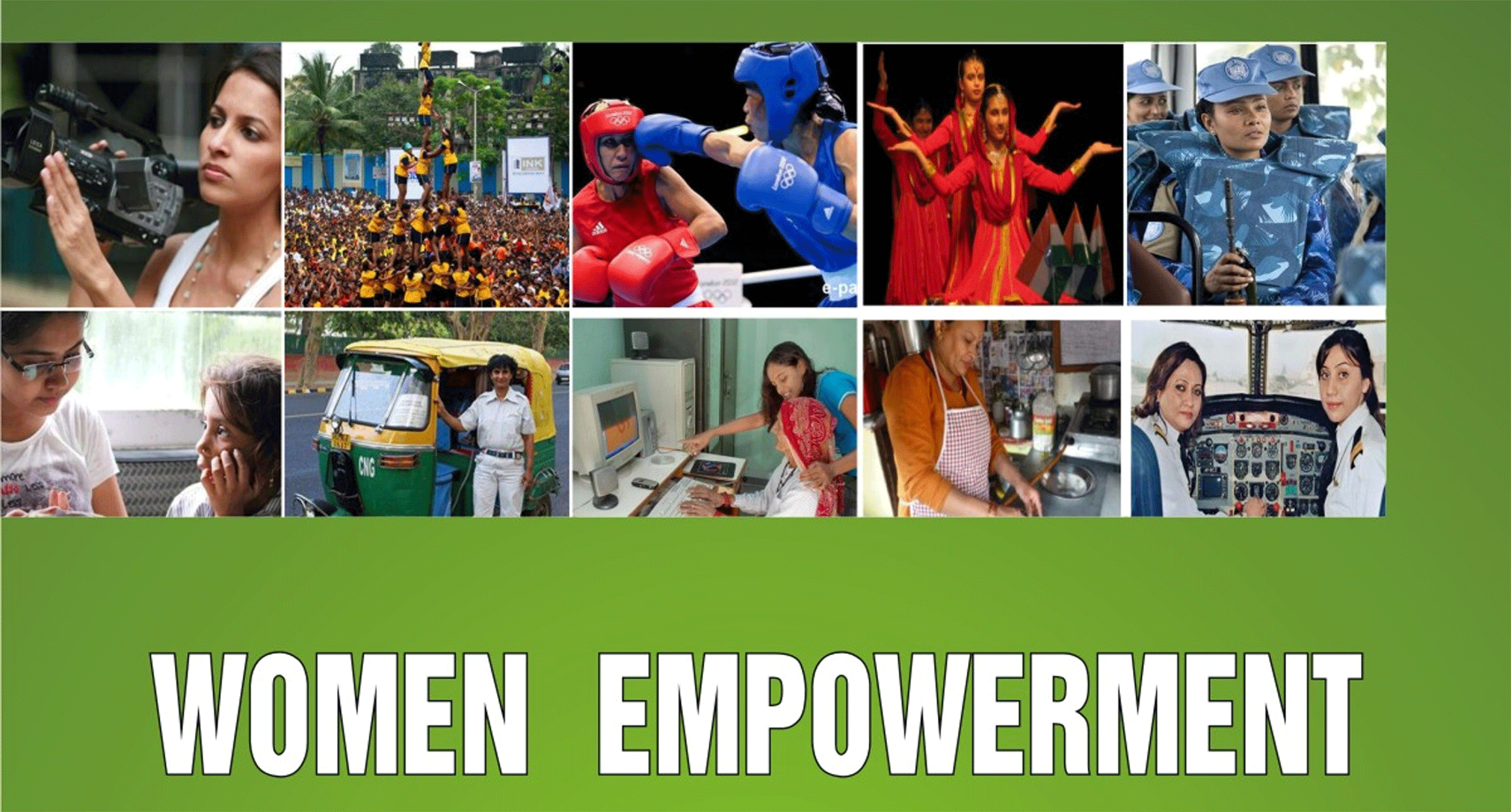
The much ado about women empowerment has come to a halt with the failing of the bill in the parliament and both protagonists and antagonists have got silent but the question whether reservation of a few hundred women in legislatures is enough for empowering half of the population of the country still remains as it was? The antagonists in their own expressions termed it as an election stunt while as protagonists held it as a sincere attempt to include women in the law formation activity of the country. The antagonists blamed the government for attaching it with delimitation while as Protagonists challenged the oppositions demand of reservation for Muslim women. In brief both parties want women upliftment after taking their own cost benefit in due consideration. In last seventy-five years of our independence, we had women Prime Minister, president, chief- ministers but still the plight of an average women has not changed. There is no gainsaying in the fact that the plight of woman in states with women chief ministers had not been anyway different from states with male chief ministers. It means that the problems is much more than what was discussed in parliament. A few hundred women entering legislature will not solve the problem in actual sense. If the political parties are really serious about empowerment of women, they shall allow their more participation in handling party matters, give more tickets to them in elections instead of making women reservation a pole plank to get votes. In the past we have seen instances where women got elected but power was being exercised by her spouse.
It is no doubt that the present government has taken various steps to uplift the women from their present level mention can be made of : Mission Shakti for safety, Beti Bachao Beti Padhao for education, showed enough courage in banning Triple Talaq by passing the Muslim Women (Protection of Rights on Marriage) Act, 2019 which renders all forms of instant , irrevocable divorce (talaq -e -biddat) by Muslim husbands as void and illegal to secure women’s rights, Strengthened the criminal law (Amendment) Act 2018 for stricter punishments against sexual offenders which increased minimum rape penalties, introduced death penalty for raping girls under 12 years and accelerated trial time lines to two months. In order to ensure gender equity in officer and soldier ranks in army, women were graduated from supporting roles to permanent commission, command positions and combat roles. Approx. 68 percent Mudra Loans were given to women for entrepreneurship. The latest initiative in this direction was Nari Shakti Vandan Adhiniyam to ensure their political representation. Thus, women’s bill can’t be held as a sudden idea with BJP to win the elections rather it remains an integral part of BJP philosophy. This was eloquently revealed by Prime Minister Modi in his tour to Banaras just after Bengal elections. He upheld his resolve for women’s bill and termed women empowerment as the pivot of Viksit Bharat.
All these steps by government have led to escalation in Worker Population Ratio (WPR) for women (aged 15+), increased from 22.0% in 2017-18 to over 40% in 2023-24. The female Labour Force Participation Rate (LFPR) improved from 23.3% in 2017-18 to 41.7% in 2023-24, with some fluctuations in 2025 and early 2026, hovering around 35-40%., primarily driven by rural women, engaged in informal agriculture-linked work. While rural participation has surged, urban participation remains significantly lower, and over 90% of working women are in the informal sector.
There is a dire need of holistic approach for women empowerment otherwise the piecemeal approach will lead to nowhere rather it may add to already existing women empowerment paradox of India. This is quite clear from the fact that nearly 50% of over 2.12 lakh DPIIT-registered startups in India have at least one-woman director as of early 2026, totalling over 1.02 lakh startups. Yet only 10% of unicorns have women founders. The female graduate employability has improved to 47.53% but their participation in 18th Lok Sabha is just 13.6 %. 89.2% of women hold now bank accounts yet only 13% are recognised as land owners despite making majority of the agriculture labour force. Women own approximately 20% of MSME in India when PM Mudhara yojana has contributed 68% of total loans to women led business. On an average Indian women spend 305 minutes a day on unpaid domestic activities compared to just 67 minutes for men.
The status of women at present is not so low that she can’t raise her voice against any discrimination. Women have been in India’s main stream because of their talent not reservation from times immemorial. Indian culture never obstructs the way of a woman rather keeps her in the highest esteem. The need of the hour is not reservation but the creation of an environment in which a woman can flourish easily. The irony is that we talk of women empowerment from western perspective, apply their solutions in our soil and the result is chaos.
The problem of our women is dowry, child marriage, poor nutrition especially in rural areas, share in ancestral property and in urban areas it gets the shape of harassment. Eradicating these practices necessitates comprehensive societal efforts, including educational programs, legal reforms, and community engagement. The things ought to have been dealt in last seventy-five years but the short cut approach without taking their problems into consideration has led Indian women nowhere. India grapples with the pervasive issue of violence against women, encompassing domestic violence, sexual assault, and harassment. While legal frameworks exist, the challenge lies in their effective implementation. Creating awareness, fostering a culture of respect, and ensuring swift justice are imperative steps. Support systems, such as helplines and counselling services, need strengthening to aid victims and survivors.
The reservation has given rise to certain pertinent questions like: Will the reservation solve the problem of women or only help the elite class in them? Will it come to the rescue of the poor and illiterate women from rural areas? Does it carry any weight in the upliftment of the social status of the women in India? It has every potential to divide women force into beneficiaries and non -beneficiaries of reservation
It will be prudent to develop awareness about the capabilities of our women folk by making them aware about the potential of women in the past and their contribution in different spheres of life. It is an irony that women warriors, rulers, players, scientists, bureaucrats are least talked about in our school curriculums. This can go a long way to instill confidence in the women folk of the country and soothe the males. Unless the mindset changes the reservation in legislature will be of little use. The students from a tender age shall know that fair sex is no way weak. Although India strides in education yet gender-based disparities persist. Access to quality education remains a challenge for many girls due to deeply entrenched societal norms, economic constraints, and a lack of infrastructure in certain regions. Besides education women empowerment needs skill development and opportunities in business.
India is the only large country where more girls die than boys. The solution can be through Indian value system rather than reservation for a few.
(The author is Professor Emeritus (M.A.I.T) Guru Gobind Singh Indraprastha University, Delhi)
 Follow our WhatsApp channel
