

Prof. D. Mukherjee
mukhopadhyay.dinabandhu@gmail.com
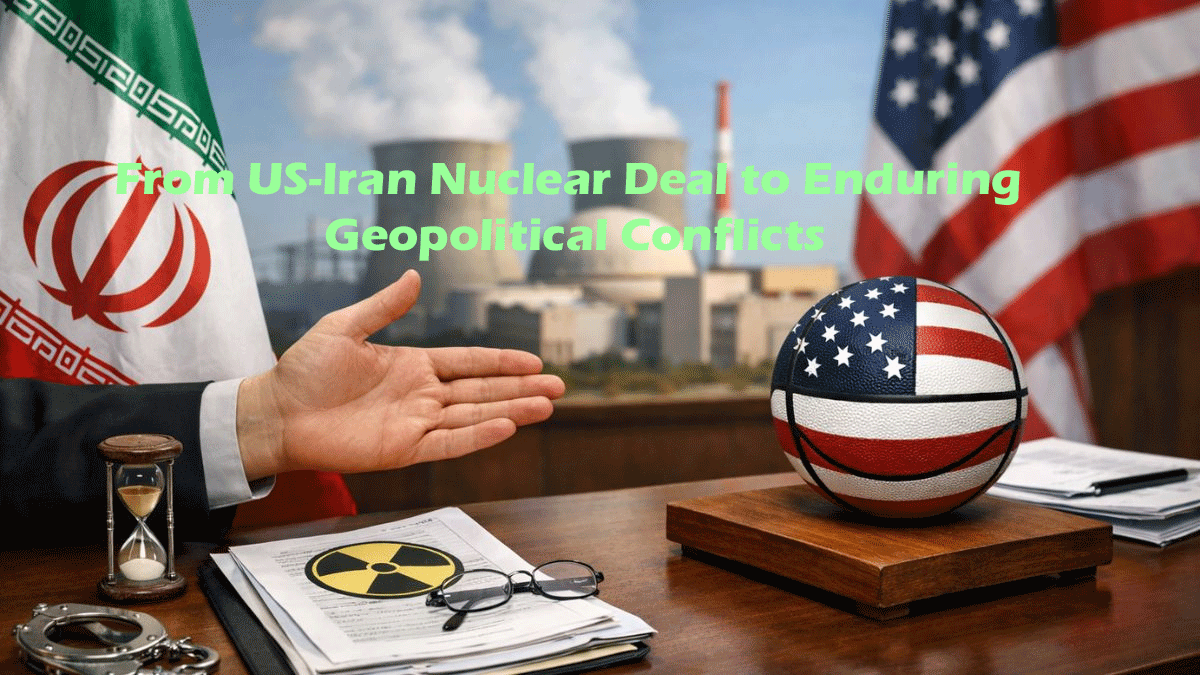
Tensions over Iran’s nuclear ambitions arise from decades of geopolitical mistrust, technological development, and competing regional visions. Initiated in the 1950s with U.S. backing, the programme became contentious after the Iranian Revolution, which reshaped Iran’s political identity. Since then, uncertainty over whether its activities are civilian or military has defined its relations with major powers. The 2002 exposure of undeclared facilities prompted scrutiny by the International Atomic Energy Agency, leading to prolonged tensions. The Joint Comprehensive Plan of Action briefly eased the crisis, but the U.S. withdrawal in 2018 renewed sanctions and uncertainty. At its core, the dispute reflects broader issues of strategic autonomy, deterrence, and ideological rivalry. Iran asserts its rights under the United Nations, while its rivals fear weaponisation, sustaining a cycle of negotiation and escalation.
Iran’s nuclear programme is closely linked to its pursuit of regional dominance. Surrounded by U.S.-aligned rivals, it views nuclear capability as a deterrent enhancing geopolitical leverage, particularly against adversaries like Israel and Gulf states. Its enrichment capacity has grown significantly, reaching up to 60% purity-well beyond civilian needs. According to the International Atomic Energy Agency, Iran holds enough enriched material that, if further refined, could potentially produce multiple warheads. While Tehran insists its programme is peaceful, its proximity to a “breakout” threshold raises concern. Beyond deterrence, nuclear progress strengthens Iran’s regional influence through ties in Iraq, Syria, and Lebanon. However, this has prompted counterbalancing coalitions, setting the stage for U.S.-Israel efforts to restrain Iran’s ambitions.
The United States-Israel alliance remains the principal counterweight to Iran’s nuclear and regional ambitions. Grounded in shared security concerns, it has developed into a coordinated strategy to contain and weaken Iran’s capabilities. Viewing a nuclear-armed Iran as an existential threat, Israel has employed pre-emptive and covert measures. A notable example is Stuxnet, which targeted Natanz and disrupted centrifuges, signalling a shift to cyber warfare. Alleged assassinations of nuclear scientists and explosions at key sites have also been linked to Israeli operations, often with tacit U.S. support. The United States complements this through sanctions, diplomatic isolation, and a sustained regional military presence, reinforced by Gulf partnerships and defence cooperation. Yet such pressure has not halted Iran’s programme and may have accelerated it, fuelling retaliation and complicating diplomatic resolution while intensifying economic strain under sanctions.
Iran’s economic trajectory has been shaped by the 1979 revolution. Under the Shah, it experienced rapid modernisation driven by oil wealth and integration with Western markets, becoming one of the fastest-growing developing economies by the late 1970s. After the revolution, however, recurring U.S.-led sanctions targeted banking, oil exports, and access to global systems such as SWIFT. At their peak, these sanctions cut oil exports from over 2.5 million barrels per day in 2011 to under 500,000 in 2019, severely eclipsing revenues. In response, Iran adopted a “resistance economy,” emphasising self-reliance and diversification, with manufacturing and agriculture gaining importance. Yet high inflation and currency decline have weakened living standards. While pre-revolution growth relied on openness, the post-revolution economy reflects resilience under isolation, though at significant social and economic cost.
The roots of U.S.-Iran tensions lie in Washington’s priorities in the Middle East-energy security, regional stability, and containing hostile ideologies. A key turning point was the 1953 Iranian coup d’état, backed by the U.S. and Britain, which fostered lasting Iranian distrust. During the Cold War, Iran under the Shah was a vital U.S. ally, ensuring oil supplies and countering Soviet influence. This alignment collapsed after the Iranian Revolution, followed by the Iran hostage crisis, which deepened hostility and severed ties. Since then, U.S. goals have remained consistent: protecting oil routes, supporting allies such as Israel, and preventing nuclear proliferation. Iran frames its stance as resistance to external control, sustaining cycles of confrontation and negotiation across military and non-military domains.
The U.S.-Iran conflict operates across military, economic, cyber, and diplomatic spheres without escalating into full-scale war. This “grey zone” rivalry relies on calibrated actions that signal strength while avoiding direct confrontation. A major flashpoint is the Strait of Hormuz, through which roughly 20% of global oil flows. Iran has periodically threatened to disrupt shipping in response to sanctions or military pressure. Incidents such as tanker seizures, drone attacks, and naval clashes have intensified tensions, with the 2019 downing of a U.S. drone showing how quickly escalation can occur. Alongside military activity, cyber operations and sanctions remain central tools. The U.S. targets Iran’s oil sector, while Iran develops cyber responses. These confrontations affect global energy markets and maritime security, highlighting the wider economic impact of regional instability.
U.S.-Iran strategic tensions extend far beyond the Middle East, shaping global energy markets, security frameworks, and diplomatic alignments. Oil price volatility is an immediate impact, as even minor Gulf escalations can trigger sharp fluctuations, placing inflationary pressure on import-dependent economies. The conflict also undermines nuclear non-proliferation efforts, as the weakening of the Joint Comprehensive Plan of Action has reduced trust in diplomatic mechanisms limiting nuclear expansion. Rising security risks have increased shipping and insurance costs, with maritime operators factoring instability into transit routes. Diplomatically, evolving ties between China, Russia, and Iran complicate Western isolation efforts, reflecting a shift towards a multipolar order. These impacts are central to the conflict and intersect with Iran’s proxy strategies, further internationalising tensions.
Iran’s strategic assets centre on asymmetric warfare, using proxy networks to expand influence while preserving plausible deniability. Groups such as Hezbollah and militias in Iraq and Yemen enable Tehran to challenge U.S. and Israeli interests without direct confrontation. In Lebanon, Hezbollah has become a major political and military force with a large rocket arsenal. In Yemen, support for Houthi forces allows pressure on Saudi Arabia, while in Iraq, Iran-backed militias continue targeting U.S. bases. This networked approach blurs the boundary between war and peace, sustaining low-intensity conflict and complicating response strategies. Countering it requires military, intelligence, and diplomatic coordination, yet such indirect warfare risks escalation as local conflicts can draw in wider powers, underscoring broader geopolitical stakes.
Iran’s nuclear trajectory has immediate and long-term geopolitical impacts. Rising enrichment levels increase the risk of pre-emptive strikes, with Israel signalling readiness to act if threatened. Over time, a nuclear-capable Iran could trigger a regional arms race, as Saudi Arabia and others consider similar paths, challenging non-proliferation efforts. At a broader level, Iran’s closer ties with China and Russia indicate shifting global alliances and a move towards multipolarity. This reduces the effectiveness of unilateral sanctions and complicates diplomacy. Overall, these developments heighten tensions while reshaping the global balance of power. Resolving the U.S.-Iran conflict requires renewed diplomacy supported by realistic concessions. Reviving a framework like the Joint Comprehensive Plan of Action, with stronger verification, could be a starting point. Confidence-building measures, including phased sanctions relief for compliance, are essential. Broader regional dialogue, especially involving Gulf states, can reduce mistrust, while multilateral efforts under the United Nations may support negotiations. De-escalation also depends on limiting proxy conflicts and cyber activity, alongside establishing reliable communication channels to avoid miscalculation. Economic engagement through trade and investment can further encourage stability. Though challenging, these steps are achievable with political will, but success ultimately depends on credible mediators capable of facilitating sustained dialogue.
Mediation in U.S.-Iran’s decades-old and ongoing kinetic and non-kinetic warfare depends on credible intermediaries. Pakistan has occasionally acted as a facilitator, but domestic and geopolitical constraints raise doubts about its neutrality. Effective mediation requires trust and the ability to offer neutrality . Neutral states such as Oman and Switzerland have been more successful due to balanced diplomacy; Oman notably helped enable talks leading to the Joint Comprehensive Plan of Action. Neutral actors reduce great-power pressure and create space for dialogue. Broader multilateral frameworks may offer a stronger path forward, but meaningful mediation must foster genuine compromise and bridge deep-rooted divisions. It is worth mentioning that dramatic entrusting Pakistan in the role of the mediator to restoring peace by bringing the warring nations to the table of negotiation in the current scenario raises eyebrows of many nations across the globe about US’ intents for ending the conflicts with Iran and its proxies immediately.
The U.S.-Iran military and economic war though centred on disrupting nuclear ambitions of Iran, extends far beyond them and remains a defining geopolitical challenge. It reflects a convergence of history, ideology, security concerns, and shifting global power structures. Regional rivalry, proxy warfare, sanctions, and energy dynamics sustain ongoing tensions among the warring nations . Rather than a single cause, the conflict stems from interconnected forces that resist simple solutions. Its persistence exposes the limits of unilateral strategies while underscoring the importance of diplomacy. Progress depends on recognising shared vulnerabilities alongside competing interests. Middle East stability is closely tied to global stability, making resolution essential for regional security, economic balance, and the credibility of non-proliferation efforts.
(The author is Bangalore based management scientist, independent geopolitics analysist and researcher.)
 Follow our WhatsApp channel
