

By K Raveendran
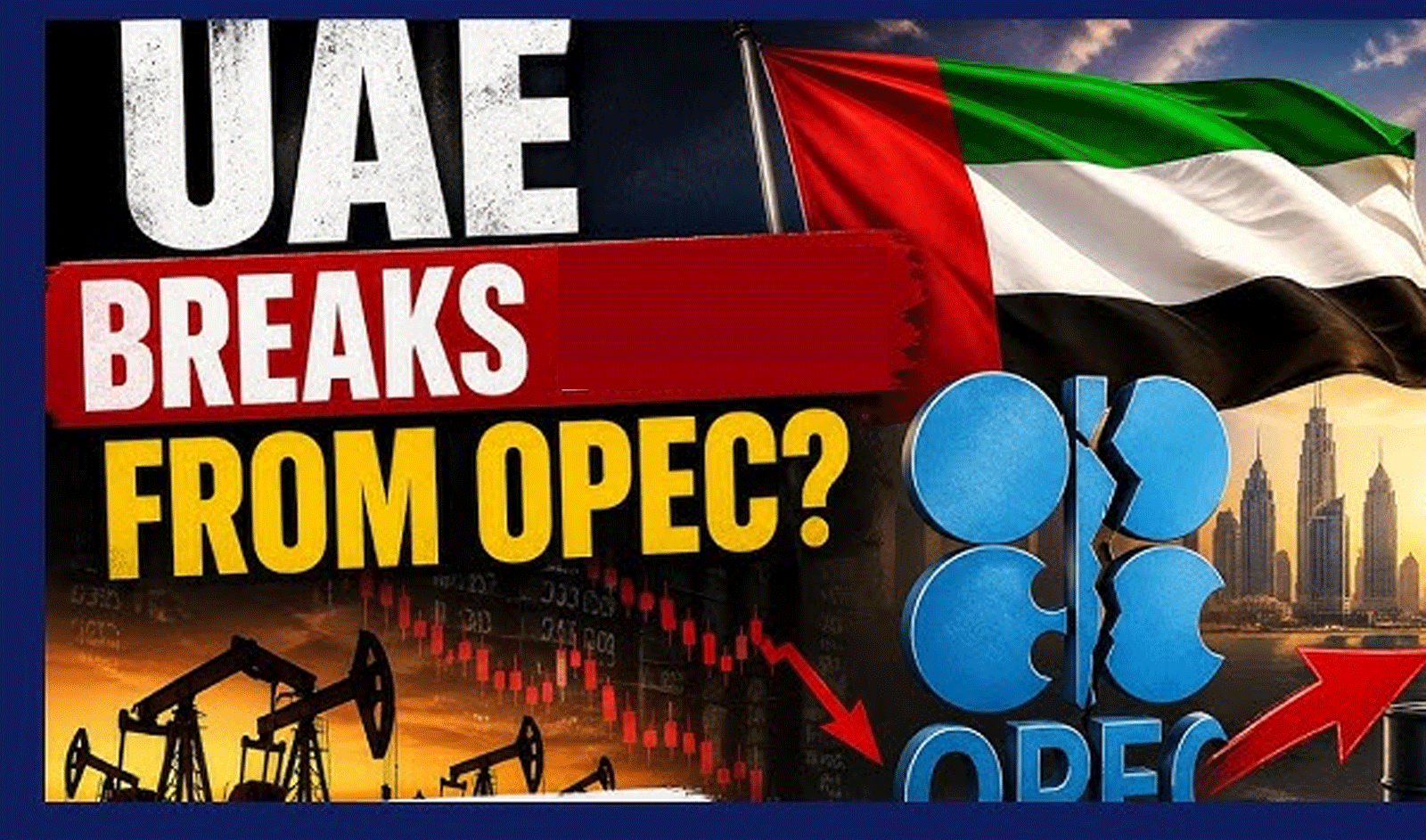
Abu Dhabi’s decision to walk away from OPEC marks more than a dispute over barrels. It signals a recalibration of Gulf power, energy strategy and security alignments at a moment when the Iran war has exposed the limits of regional consensus. For decades, the UAE operated inside a cartel system dominated by Saudi Arabia’s ability to balance supply, defend prices and impose discipline on producers with divergent fiscal needs. Its exit now suggests that the cost of that discipline has begun to outweigh the benefits for a state that sees itself as a global energy, finance and security actor rather than a subordinate member of an oil bloc.
The immediate market reaction should not be overstated. Brent crude hovering around $100 per barrel is primarily a function of war risk, disrupted shipping, sanctions pressure, insurance costs, military uncertainty and fears around the Strait of Hormuz. The price level cannot be attributed directly to the UAE’s announcement, especially when actual export flows from the Gulf remain shaped by conflict conditions rather than by ordinary production decisions. Traders are still pricing geopolitical risk first and producer politics second. Yet that distinction may not hold over time. Once the war premium fades or shipping normalises, the UAE’s freedom from OPEC curbs could become a meaningful bearish factor for crude.
The deeper importance of the decision lies in Abu Dhabi’s longstanding frustration with production limits. The UAE has invested heavily in raising capacity and has never been comfortable with a quota system that restricts monetisation of those investments. A country that spends billions expanding upstream capability does not want to leave barrels underground because a cartel formula says it must. This tension has surfaced before in disputes over baseline calculations, where the UAE argued that its quota failed to reflect its actual capacity and capital spending. The exit removes that constraint and gives Abu Dhabi the right to produce according to national priorities rather than collective targets.
That freedom matters because the UAE’s oil policy is tied to a broader economic vision. Abu Dhabi is trying to maximise hydrocarbon value while global demand remains resilient, even as it also invests in renewables, nuclear power, hydrogen, petrochemicals and low-carbon technology. Its leadership knows the energy transition will be uneven, but it also knows that the strongest producers will be those able to capture market share before long-term demand growth slows. Remaining locked into a quota system designed to defend prices may not suit a producer with spare capacity, low extraction costs and a sovereign strategy built around expansion.
Saudi Arabia, by contrast, has usually treated OPEC discipline as a strategic asset. Riyadh has been willing to cut output to support prices, absorbing the political burden of managing the group because it benefits from being seen as the central banker of oil. The UAE’s exit weakens that model. Even if OPEC survives institutionally, the departure of a sophisticated Gulf producer reduces the credibility of future production agreements. Cartels rely not only on formal membership but also on the expectation that major players will not defect when conditions become inconvenient. Once one capable producer leaves, others may be tempted to test the boundaries.
The Iran war adds a sharper geopolitical dimension. Gulf states have not viewed the conflict through identical lenses. The UAE’s proximity to Iran, its commercial exposure, its ties with Washington, and its security calculations have shaped a more assertive posture. Saudi Arabia has had to balance deterrence, oil stability, regional leadership and domestic transformation under Vision 2030. These priorities overlap but do not always align. If Abu Dhabi concluded that OPEC constraints were limiting its room for manoeuvre at a time of regional danger, the decision becomes not merely economic but strategic.
The possibility of an understanding with the United States cannot be dismissed, though it should be treated carefully until more details emerge. Washington has long viewed OPEC through the prism of consumer prices, inflation and geopolitical leverage. A UAE outside the cartel could serve American interests by weakening coordinated supply restraint and creating a Gulf partner more willing to respond flexibly to market needs. Abu Dhabi, for its part, may see closer alignment with the United States as useful insurance during a period of heightened threat from Iran and uncertainty over regional security guarantees. Even without a formal bargain, the incentives point in the same direction.
For consumers, the long-term implication is potentially favourable. More UAE production would add supply pressure, especially if demand growth slows in China, Europe or other major consuming regions. It could also complicate any future attempt by OPEC+ to cut output sharply to defend prices. Russia, Saudi Arabia and other producers may still coordinate, but the market would have to account for an important Gulf supplier operating outside the system. That does not guarantee a price collapse, because oil markets are shaped by demand, inventories, refining margins, sanctions and war risks. But it does reduce the cartel’s ability to act as a unified price-support mechanism.
For Abu Dhabi, the move carries risks. Leaving OPEC may invite diplomatic friction with Riyadh at a time when Gulf unity is already strained. It may also expose the UAE to accusations of undermining producer solidarity during a regional emergency. If prices fall sharply later, the UAE could face pressure from fellow exporters whose budgets require higher crude revenues. More production does not always mean more income if additional barrels accelerate a price decline. Abu Dhabi is betting that volume, flexibility and strategic autonomy will compensate for the loss of cartel protection.
The decision also raises questions about the future of OPEC+ itself. The expanded framework brought together OPEC members and outside producers, most notably Russia, to manage supply after the shale boom and the pandemic shock reshaped oil markets. Its strength lay in breadth. Its weakness has always been enforcement. Producers accept restraint when the benefits are clear, but discipline frays when national priorities diverge. The UAE’s exit is a reminder that OPEC+ is not a treaty alliance; it is a negotiation among states that will defect if the bargain no longer serves them.
Abu Dhabi’s move therefore should be read as part of a wider fragmentation of Gulf energy politics. The old assumption that Saudi Arabia and the UAE would move in tandem on oil, security and regional diplomacy no longer fully holds. Both remain partners in many arenas, but they are also competitors for capital, influence, logistics, technology, tourism, finance and strategic relevance. Oil policy is now another field where that competition is visible.
The timing makes the message sharper. During war, producer groups usually emphasise unity and stability. The UAE has chosen instead to assert independence. That does not mean it wants disorder in oil markets; Abu Dhabi benefits from predictability as much as any exporter. But it wants predictability on terms that recognise its capacity, ambitions and security relationships. The exit from OPEC is, at its core, an attempt to convert national capability into strategic freedom. Its full impact will be measured not in the first movement of Brent crude, but in how much oil Abu Dhabi chooses to bring to market once the guns fall silent and the cartel tries again to impose discipline. (IPA Service)
 Follow our WhatsApp channel
