

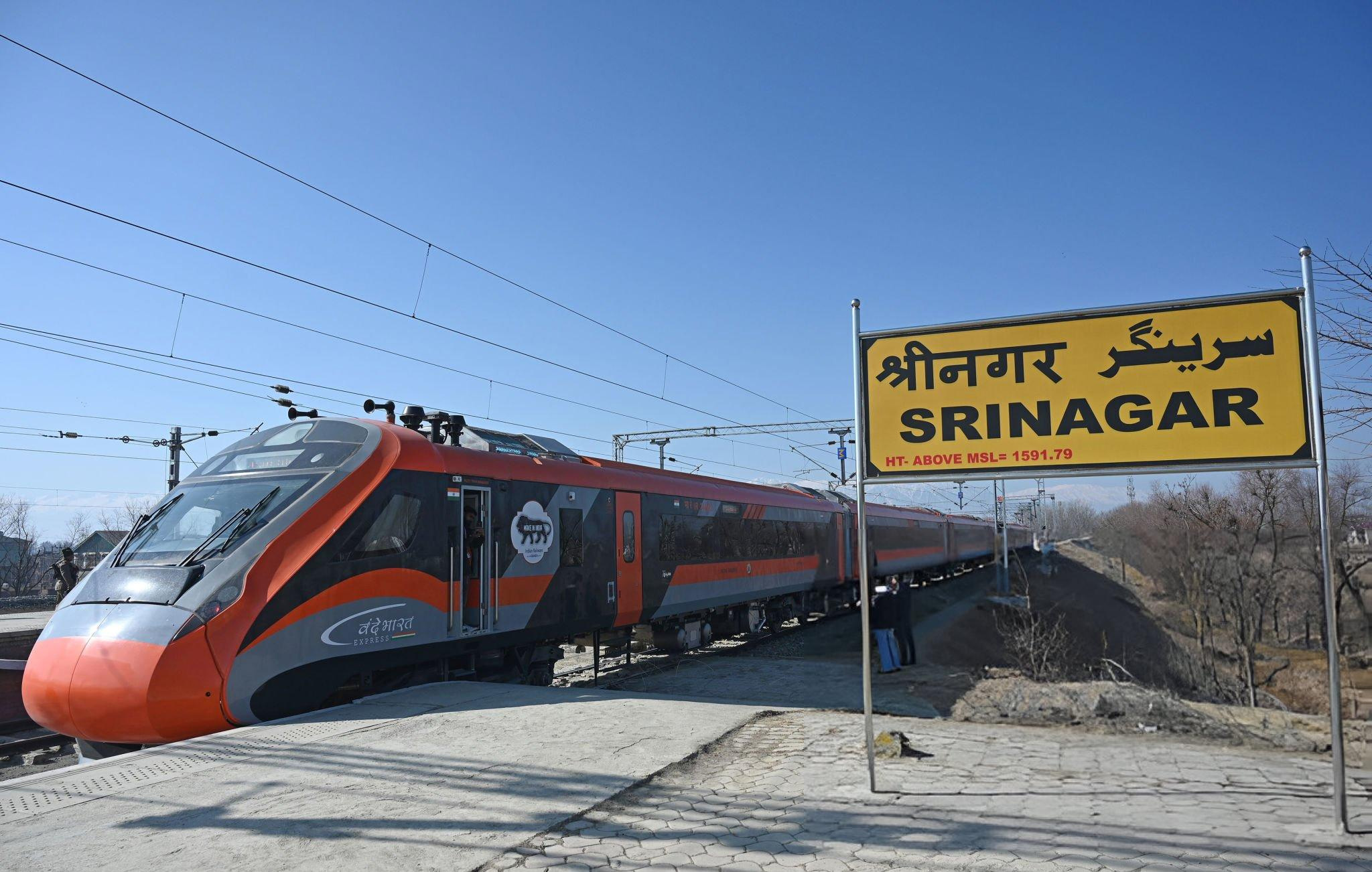
Dr Jitendra, Sinha, Omar to attend
Excelsior Correspondent
JAMMU, Apr 29: Railways Minister Ashwini Vaishnaw will flag off the extended Srinagar-Katra Vande Bharat Express service from Jammu Tawi Railway Station tomorrow in the presence of Union Minister of State (MoS) in the Prime Minister’s Office (PMO) Dr Jitendra Singh, Lieutenant Governor Manoj Sinha and Chief Minister Omar Abdullah.
Follow the Daily Excelsior channel on WhatsApp
The train, which previously operated from Srinagar up to Shri Mata Vaishno Devi Katra, will now run all the way to Jammu Tawi.
After flagging-off Jammu-Srinagar Vande Bharat Express train, Vaishnaw will subsequently inspect two of the most remarkable engineering structures on the Udhampur-Srinagar-Baramulla Rail Link (USBRL), the Anji bridge and the Chenab bridge.
The Vande Bharat, which was running between Katra-Srinagar had eight coaches which will be increased to 20 when it will start operations from Jammu in view of overwhelming response from the passengers.
Prime Minister Narendra Modi had flagged off the Katra-Srinagar Vande Bharat Express on June 6, 2025.
“For pilgrims who have watched seats sell out days in advance, for tourists planning a trip to the Valley, and for locals who rely on this service for everyday travel, the expanded rake means the train is now far less likely to turn them away. With the extension to Jammu Tawi happening simultaneously, the 20-coach Vande Bharat arrives at its largest catchment city with the capacity to match it, a train finally built to the scale of the demand it has always inspired,” the officials said.
Regular operations of the train will start from May 2 with two pairs of services operating across the corridor, covering a distance of around 266 km.
The first service (Train No. 26401) will depart from Jammu Tawi at 6:20 AM, halts at Shri Mata Vaishno Devi Katra, Reasi, and Banihal and reach Srinagar at 11:10 AM, a journey of four hours and fifty minutes. On return (Train No. 26402) will leave Srinagar at 2:00 PM and reach Jammu Tawi by 6:50 PM. This pair will run six days a week, except Tuesday.
The second service (Train No. 26404) will depart from Srinagar at 8:00 AM, will have halt at Banihal and Katra, and reach Jammu Tawi by 12:40 PM. On return (Train No. 26403) will depart Jammu Tawi at 1:20 PM and reach Srinagar by 6:00 PM. This pair will also run six days a week, except Wednesday.
Together, the two pairs ensure that passengers have a morning and an afternoon Vande Bharat option from both ends of the corridor on most days of the week, giving travellers meaningful flexibility in planning their journeys, the officials said.
Extending the Vande Bharat’s run from Katra all the way to Jammu Tawi is a straightforward but consequential change for ordinary travellers across the entire J&K region. Until now, pilgrims and passengers arriving at Jammu Tawi Railway Station, which is one of the busiest railheads in northern India, connecting trains from Delhi, Mumbai, and beyond had to change trains or arrange separate road transport to reach Katra. With the extension, they will be able to board the Vande Bharat directly at Jammu Tawi and reach the Vaishno Devi base camp at Katra, and travel onwards all the way to Srinagar, without a single interchange, the officials said.
The same seamless journey works in the other direction too. A traveller boarding at Srinagar will now be able to reach Jammu Tawi in a single, unbroken ride, connecting directly to the national rail network.
For the growing number of pilgrims who combine the Vaishno Devi darshan at Katra with the Amarnath Yatra, whose base camps at Pahalgam and Baltal are accessed from Srinagar, the entire pilgrim circuit of J&K is now achievable on a single, unbroken rail journey, without a change of train, a second reservation, or the anxiety of a missed connection, they added.
“Crucially, this matters most in winter. When heavy snowfall blocks the Jammu-Srinagar National Highway, sometimes for days at a stretch, the railway corridor becomes a lifeline. The Vande Bharat, designed to operate in temperatures as low as minus 20 degrees Celsius with heated windshields, advanced heating systems, and all-weather components, will provide a reliable, weather-proof link between the Valley and the rest of the country at precisely those moments when road travel becomes impossible or dangerous,” the officials said.
Further, they said, Kashmir’s economy runs on its crafts, the pashmina shawls, walnut wood carvings, hand-knotted carpets, and saffron that find buyers across India and the world. Artisans and traders from the Valley have long grappled with the cost and uncertainty of moving goods and themselves between Srinagar and Jammu.
 Follow our WhatsApp channel
