

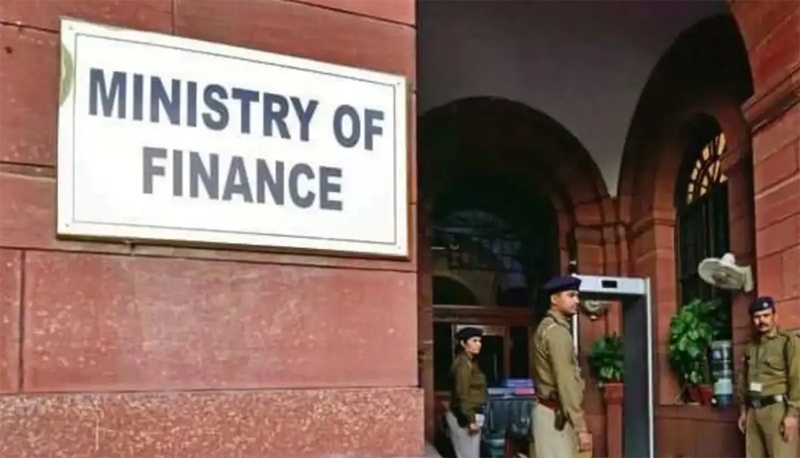
NEW DELHI, Apr 29: The ongoing conflict in West Asia poses a significant supply-side shock with rising risks to inflation, trade and financial flows, though India’s strong domestic demand, policy buffers, resilient financial system and continued public investment are expected to provide a measure of insulation to the economy, the finance ministry said in a report said.
Prolonged uncertainty, particularly around energy and fertiliser supplies, could test the resilience of India’s macroeconomic stability, the Monthly Economic Review for April released by the finance ministry said on Wednesday.
On top of this, the El Nino Southern Oscillation (ENSO) is expected to keep India’s Southwest monsoon below normal, it said, adding that most rainfall districts are expected to receive below-normal rainfall this season.
Therefore, it said, risks are tilted to the upside for inflation, fiscal and external deficits and to the downside for economic growth.
However, it said, while striving to sustain economic growth, policy is expected to safeguard medium-term fiscal and external stability.
Observing that India enters FY2026-27 at the intersection of domestic resilience and external turbulence, the report said, encouraging a 7-7.4 per cent forecast for the upcoming financial year, only to be clouded by an altered macro-outlook in the wake of the war in West Asia.
The Indian economy is estimated to grow at 7.6 per cent, the strongest in recent years.
Noting that a ‘supply shock’ is apparent in the economy, it said that an accompanying demand compression is a serious concern, given high prices, rising inflation, and a reduced pace of economic activity.
Inflation may become cost-push as businesses/producers pass on their increased input costs to protect their profit margins, it said.
A wide spectrum of downstream industries relies directly on the petroleum sector, and it is likely that input cost pressures will be felt widely across the economy, it said.
To temper cost pressures in critical sectors like agriculture, it said, the government has taken various measures such as increased allocation of natural gas to the fertiliser production, waiver of customs duty and around 12 per cent increase in nutrient-based subsidy for the upcoming kharif season.
Beyond the production structures, it said, the conflict has seriously dented investors’ confidence, disproportionately affecting Emerging Markets and Developing Economies (EMDEs), including India.
The consequent weakening of the rupee is another pressure point for domestic inflation, as that could raise import prices, it said.
The report said that repairing the damage to the oil and gas production/supply infrastructure in the Gulf region may take several months.
If such a gradual recovery is not supported by a good kharif output (a weather shock /below normal monsoon as predicted by the IMD – possible El Nino conditions), it is likely that the price shock felt at the headline inflation might spill over to the core measure through the cost-push channel, it said.
Yet it remains to be seen whether the spill-over effect will be strong/widespread or weak/ limited, as it depends on a range of factors such as the size of the shock, variability in the pass-through duration across different markets/commodities, price flexibility/ rigidity in sectoral markets, energy intensity of different sectors, etc, it said.
The crisis in West Asia is not expected to adversely affect financial stability, as key indicators for capital adequacy, liquidity, and asset quality in both SCBs and NBFCs remain strong, it said.
Further, it said, the RBI will continue its proactive approach to ensure adequate liquidity to meet the economy’s productive needs.
To sustain momentum in the country’s trade performance, the report said, the government has introduced targeted measures complementing its diversified trade strategy.
These include the RELIEF scheme; efforts to improve turnaround times and easier switching of fuels; and reforms under the Advance Authorisation Scheme to enable faster approvals and enhance transparency and predictability, alongside the approval for the establishment of the Bharat Maritime Insurance Pool, it said.
Additional interventions, it said, such as strengthened port coordination, advisories to improve transparency in shipping line pricing, monitoring of insurance risks, and relaxations to facilitate the movement of stranded cargo, further support trade flows.
Looking ahead, it said, the conclusion of recent free trade agreements is expected to reinforce trade performance by expanding market access and deepening integration with global value chains.
“For most economies, the current global drift is a source of vulnerability. However, for India, with its strong domestic fundamentals and tradition of strategic autonomy, it can be an opportunity,” it said.
First, it said, a multipolar world creates space for India to convert diplomatic goodwill into durable economic gains.
As a manufacturing destination, services hub and a large consumer, India can push for more ambitious trade agreements and diversified supply chains, it added.
Observing that recent developments underscore that resilience cannot be created overnight in times of crisis, but must be built through sustained and deliberate efforts over years, such as developing strategic energy reserves, accelerating the shift to renewables, and strengthening domestic manufacturing capacity.
As far as strengths go, India can capitalise on its strong domestic fundamentals and active trade engagement to move forward at the speed the moment demands, it added. (PTI)
 Follow our WhatsApp channel
