

Pushp Saraf
pushapsaraf@yahoo.com
In the late 1990s, the late Ladakh leader P. Namgyal led a delegation from Leh to the then Planning Commission in New Delhi. The mood was tense. A development project sanctioned for their region had been quietly redirected to the Kashmir Valley by the State Government, which exercised near-complete administrative authority over Ladakh as part of the erstwhile Jammu and Kashmir State. The J&K Government’s reasoning was not without logic – why invest heavily in a sparsely populated, remote corner of the State when the same resources could serve a far greater number of people in the Valley?
The Ladakh delegation, however, arrived with a counter-argument that was both principled and urgent: that geographic importance cannot be reduced to a headcount. Fewer people did not mean that a region could be denied the benefits of development, infrastructure, or the basic dignity of progress. Their first meeting was with Arun Shourie, who had recently joined the Union Council of Ministers under Prime Minister Atal Bihari Vajpayee with a portfolio that included Planning. Persuaded by their case, Shourie arranged an immediate meeting with a senior Planning Commission functionary. In a quiet but telling gesture of support, he walked briefly into the room himself – lending weight to the proceedings without formally participating.
This writer was present throughout. The discussion that followed was candid and substantive. Opinions moved back and forth about the contrasting needs of densely and sparsely populated regions. The Commission official was visibly sensitive to the position of the State Government, which was absent from the room, yet equally conscious that a project once sanctioned for a specific region could not simply be reassigned without consequence. This was particularly true in the case of Ladakh which was growing increasingly aware of its democratic rights and actively demanding separation from J&K.
The episode illustrates a tension that continues to define governance in a way. While it goes without saying that populations in distress must receive priority, in ordinary circumstances the people in authority must guard carefully against being seen to act in a discriminatory or politically convenient manner. Developmental decisions carry a moral weight that goes beyond economics.
Few regions in the country make the case for focused, sustained investment as compellingly as Ladakh. The arguments are several and mutually reinforcing. Strategically, Ladakh shares a border with two countries that have illegally occupied portions of its territory – China and Pakistan – making it one of the most sensitive frontiers. This geopolitical reality alone demands constant attention, robust infrastructure, and a well-administered civilian presence. But the region’s claims on the national conscience extend well beyond security.
Ladakh’s natural endowments are extraordinary. The mighty Indus river cuts through its terrain, nourishing life in an otherwise stark landscape. Its glaciers – among them Siachen, the world’s highest battlefield – are both ecologically critical and strategically significant. Its lakes, particularly Pangong Tso and Tso Moriri, are among the most breathtaking in the subcontinent. The snow leopard prowls its high-altitude slopes; the Changthang plateau is home to the goats that produce pashmina, arguably the finest natural wool in the world. Apricot orchards, sea buckthorn groves, geothermal vents, and some of the clearest skies on earth – ideal for astronomical observation – round out a natural portfolio that most regions can only envy. Leh, in particular, has often been compared to Shangri-La, the mythical Himalayan paradise, and not without reason.
Culturally, Ladakh is a living repository of Tibetan Buddhist heritage, with ancient monasteries perched on cliffsides that have endured centuries of isolation and yet preserved traditions that scholars and pilgrims travel from across the world to witness. The region is a trekker’s paradise and one of the premier adventure tourism destinations globally.
Equally noteworthy, is the social resilience of Ladakh’s people. Women in both Leh and Kargil have demonstrated a remarkable commitment to formal education, and the region consistently records some of the highest female literacy rates in the country. This is a quiet but profound achievement that often goes unacknowledged in national discourse.
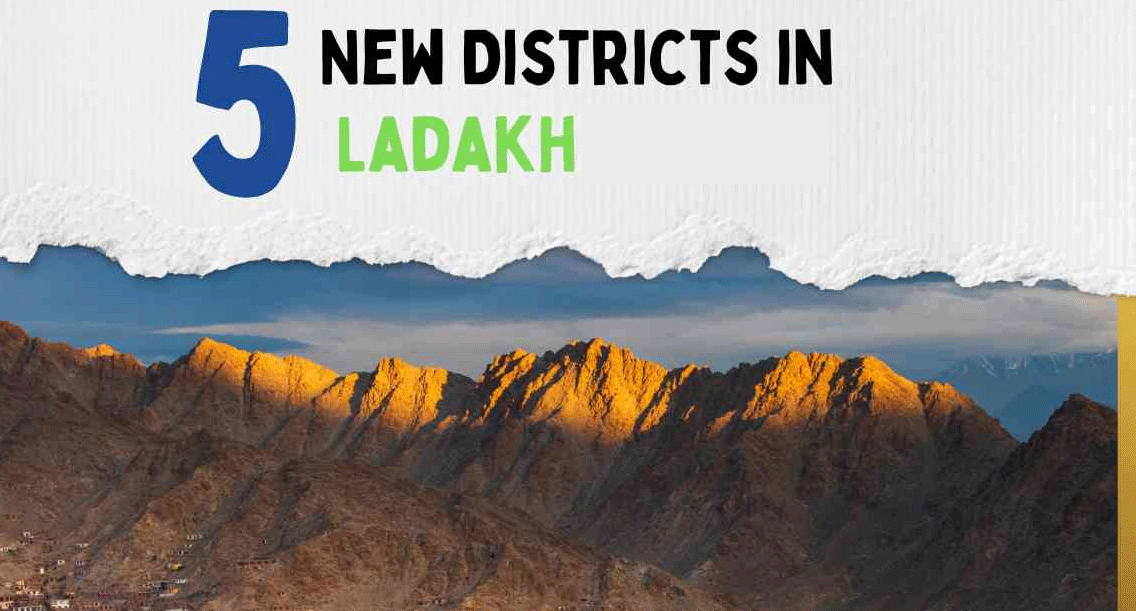
Against this backdrop, the Ladakh Administration’s formal gazette notification on April 27, approving the creation of five new districts, marks a significant administrative milestone. The new districts – Nubra, Sham, and Changthang, carved out of the erstwhile Leh district, and Zanskar and Drass, separated from Kargil district – represent a long-overdue recognition that governance must reach closer to the people, particularly in a Union Territory where distances are vast and terrain is unforgiving.
Each of these new districts carries its own distinct identity and promise. Nubra, often called the “valley of flowers” or the “orchard of Ladakh,” is renowned for its sand dunes, double-humped Bactrian camels, and fertile river valleys that contrast with the barren plateaus that surround it. Sham, the “apricot valley,” is among the more accessible parts of Ladakh and serves as the entry point for many visitors arriving via Srinagar. Changthang, lying at extreme altitude, is the homeland of the nomadic Changpa herders and the source of the pashmina wool that has made Kashmir’s artisans famous worldwide. Zanskar, long isolated by snow-blocked passes for much of the year, is home to ancient Buddhist monasteries and an extraordinarily hardy people who travel the frozen Zanskar river – the Chadar trek – when all other routes are cut off. Drass, meanwhile, holds the distinction of being the world’s second coldest inhabited settlement and is also home to the Dard people, widely regarded as the direct descendants of the Aryan race.
One hopes that the time elapsed between the Union Home Ministry’s initial announcement three years ago and this formal gazette notification has been used productive to design administrative frameworks and establish the institutional foundations necessary for the new districts to function effectively from day one.
The creation of these new districts is, at its core, a transformative decision. It is not merely administrative reorganisation, but a signal that the nation’s relationship with its most remote territories is maturing. Population density is a poor yardstick for the worth of land. Beneath Ladakh’s stark surface lie resources, strategic value, cultural heritage, and ecological significance that no census figure can capture. The new districts offer these remarkable sub-regions the opportunity to develop their own governance capacities, attract investment, and bring services within meaningful reach of their residents.
 Follow our WhatsApp channel
