

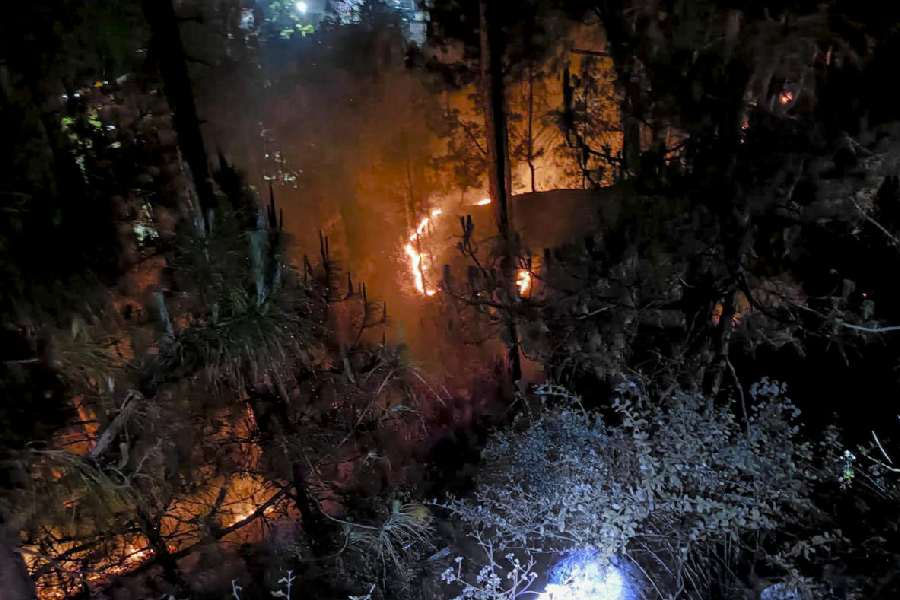
NEW DELHI, Apr 27: Under continued global warming, over one-third of animal habitats on land could face climate-driven extreme events, such as heatwaves or forest fires, by 2085, according to a new study.
Published in the journal Nature Ecology and Evolution, the findings also adds that rapidly cutting emissions to net zero could largely avert these impacts.
Researchers, led by those from the Potsdam Institute for Climate Impact Research in Germany, analysed climate projections and species data, including those from the International Union for Conservation of Nature (IUCN) Red List of Threatened Species.
They found that in a scenario in which warming starts to reverse in the latter part of the century, only nine per cent of land animals’ habitat could be expected to experience extreme events by 2085.
“I think climate change, and in particular extreme events, are still really being underestimated when it comes to conservation planning. It’s not just going to be a gradual shift of temperature over many years,” lead author Stefanie Heinicke, a postdoctoral researcher at the Potsdam Institute for Climate Impact Research, said.
Multiple extreme events can have compounding effects and create “synergistic” threats to biodiversity.
For example, a study on the 2019-2020 Australian fire showed a 27-40 per cent greater decline across plant and animal species when the fire was preceded by a drought, the researchers said.
The team predicted changes in exposure to droughts, heatwaves, river floods and wildfires for 33,936 terrestrial vertebrate species and 794 ecoregions (ecological regions).
“By 2050, under a medium-high emission scenario, on average 74 per cent of the area within species’ current geographic ranges are projected to be exposed to heatwaves, 16 per cent to wildfires, eight per cent to droughts and three per cent to river floods,” the authors wrote.
Species-rich areas, including those in the Amazon basin, Africa and Southeast Asia, could be affected, they said.
The researchers also projected that by 2050, 22 ecoregions, primarily in mid-latitudes, could be estimated to have at least 50 per cent of their area exposed to two or more types of extreme events, increasing to 236 ecoregions by 2085.
“By 2085, 36 per cent of the area within species’ ranges are projected to be exposed to multiple event types,” the authors wrote.
The findings highlight the need for further research into species’ sensitivity and adaptive capacity to extreme events, and for conservation strategies that address the impacts of multiple extreme events, they said. (PTI)
 Follow our WhatsApp channel
