

Dr Junaid Jazib
junaidjazib@gmail.com
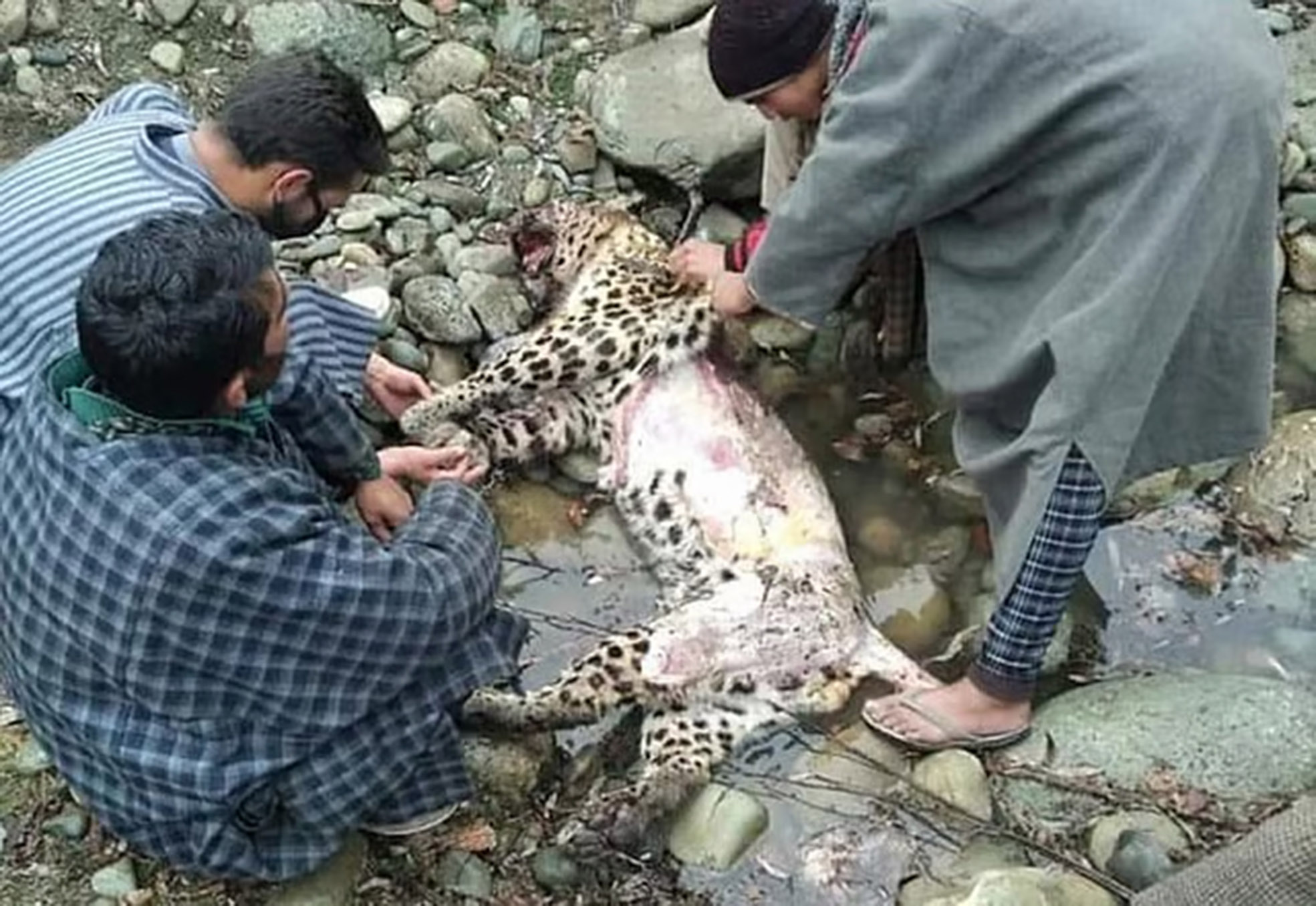
One winter night last year in Matho, Ladakh, Tsering Pani stepped out to find her livestock pen drenched in blood; a snow leopard had killed all seven of her Pashmina sheep, wiping out a season’s livelihood in hours. Hundreds of kilometres away, in Baramulla, five-year-old Ehsan Ahmad Shah went out to play in August 2023 and never returned; he was later found fatally mauled by a leopard, just days after another child was killed in Kupwara reportedly by the same beast. On this side of the Pir Panjal, in Rajouri’s Badhal village, troops of monkeys descend each year to strip terraced maize fields bare, leaving the farmers with little to harvest. More than mere isolated happenings, these incidents are a stark expression of a deeper rupture, where a silent war brews, not between nations, but between humans and the wild. The fragile boundary between humans and the wild in the Himalayas is rapidly, and dangerously, dissolving.
The Himalayas, celebrated as one of Asia’s most biodiverse and densely inhabited mountain systems, have always embodied coexistence rather than conflict. The Jammu & Kashmir and Ladakh Himalayas, forming the western arc of this vast system, compress this complexity into a striking microcosm. From the subtropical Shivalik forests of Jammu through the temperate woodlands of the Pir Panjal to the stark alpine meadows and cold deserts beyond, the region supports an exceptional range of flora and fauna including iconic species like snow leopards, common leopards, Himalayan and Asiatic black bears, wolves, markhor, musk deer, rhesus macaques, etc. alongside rich avifaunal diversity. It equally sustains indigenous human populations-pastoralists, agrarian communities, and forest-dependent groups-whose lives have traditionally been interwoven with ecological rhythms. No doubt, the relationship was never without friction, but it maintained a working equilibrium. This delicate equilibrium is now under unprecedented strain.
Human-wildlife conflict (HWC) in the region, once episodic, has evolved into an acute and persistent challenge threatening human life, livelihoods and conservation. Its manifestations are varied and spatially differentiated: livestock depredation in high-altitude pastures, crop raiding in mid-altitude agricultural belts, and direct, often fatal encounters in lower valleys and forest fringes. No longer confined to remote landscapes, such interactions have now penetrated farmlands, orchards and even peri-urban spaces, also revealing a fundamental shift in animal ranging behaviour.
Among the species most prominently implicated, the common leopard (Panthera pardus) and the Asiatic black bear (Ursus thibetanus) emerge as the principal drivers, each shaped by distinct ecological behaviours. Leopards, drawn to human settlements by the presence of stray dogs and unprotected livestock, account for a significant proportion of attacks, including those on children. Bears, particularly during fruiting and harvest seasons, increasingly venture into orchards and human habitations, resulting in a high incidence of injuries. Snow leopard (Panthera uncia), though rarely involved in direct human attacks, inflicts a substantial economic losses through livestock depredation in high-altitude pastoral systems, often provoking retaliatory responses. Species such as rhesus macaques, porcupines and occasionally wolves and jackals contribute to crop damage, livestock loss and localized conflict across Jammu and Kashmir.
The scale of the crisis is starkly reflected in official data recently presented by the Minister for Forests and Ecology in the Jammu & Kashmir Legislative Assembly. It indicates that 15,661 cases of human-wildlife conflict were recorded between 2023 and 2025, resulting in 32 human deaths and 350 injuries. While the total number of incidents shows a marginal decline-from 9,301 cases in 2023-24 to 6,360 in 2024-25-the severity of encounters has intensified, with injuries rising significantly. Districts such as Jammu, Kupwara, Kishtwar, Baramulla, Doda and Ramban continue to report high levels of conflict, underscoring its widespread and persistent nature. Over a longer period, from 2006 to March 2024, the Kashmir region alone recorded 264 human deaths and over 3,000 injuries, with a marked escalation in recent years. These figures point not merely to a conservation concern, but to a deepening socio-ecological crisis.
The impacts of this conflict extend far beyond recorded livestock or crop losses and compensation claims. For rural households operating at subsistence margins, a single predatory attack can mean a catastrophic economic setback-the loss of an animal that may represent months of income or a primary source of sustenance. Crop damage by macaques and wild boars, though less visible, steadily erodes food security and discourages agricultural investment. For transhumant Gujjar and Bakarwal community, whose seasonal migrations now intersect increasingly fragmented and predator-rich landscapes, the risks are especially acute. Livestock depredation strikes at the very foundation of their livelihood, deepening vulnerability and often provoking retaliatory responses.
Indeed, wildlife too bears the cost. Retaliatory killings-through poisoning, trapping, or direct confrontation-pose a serious threat to already vulnerable species, undermining long-term conservation goals.
This dual vulnerability highlights the central dilemma: the tension between conservation imperatives and livelihood realities.
At its core, the rise in human-wildlife conflict reflects a complex interplay of ecological disruption and human pressures, rather than a simple narrative of wildlife encroaching upon human space. Habitat fragmentation remains a key driver. Expanding infrastructure, road networks and settlements into forested landscapes have reduced and severed wildlife corridors, displacing animals into human habitations. Climate change compounds these pressures, with altered snowfall, shifting vegetation and erratic seasonal cycles pushing species from higher elevations into lower, inhabited areas.
Simultaneously, changing land-use patterns have created new attractants. Crops such as maize and fruit orchards provide easy food, while poor waste management draws animals closer to settlements. The decline of natural prey, driven by habitat degradation and other anthropogenic pressures, further forces predators towards livestock and, at times, humans. Human-wildlife conflict, instead of being an isolated issue, is a manifestation of broader ecological imbalance.
Efforts to mitigate human-wildlife conflict have shown some progress but remain inadequate in scale, speed and design. Compensation schemes, though implemented, are often undermined by delays and under-valuation, eroding both their effectiveness and public trust. Rapid response teams have improved crisis handling in accessible areas, yet their reach remains limited in remote and high-altitude regions where conflict is often most acute. Awareness initiatives, while necessary, cannot substitute for structural interventions.
What is needed is a shift from reactive response to proactive coexistence. Community-centred approaches must be prioritised, recognising local populations as active stakeholders in monitoring, decision-making, and benefit-sharing. This is both an ethical and practical imperative, given that effective conflict management depends fundamentally on local knowledge and participation. Equally important is, therefore, the integration of indigenous knowledge systems. Communities such as Gujjars, Bakarwals, Gaddis, Sippis and Changpas possess deep, experience-based insights into animal behaviour and landscape dynamics that can enable more context-sensitive and locally grounded solutions.
Besides, technological tools, including early warning systems, real-time monitoring and species tracking, can enhance preparedness, while predator-proof enclosures, non-lethal deterrents and crop insurance can reduce vulnerability.
To conclude, human-wildlife conflict in the Jammu & Kashmir and Ladakh Himalayas reflects deeper ecological imbalance and shifting human-nature relationship. These mountains have never been an empty wilderness, nor a space of exclusive human control. They are, and have always been, a shared landscape. Addressing the crisis, requires not just better management, but a rethinking of the relationship between conservation, livelihoods and governance. The urgency lies in restoring conditions for coexistence. For once the balance is lost, reclaiming it becomes far more difficult than sustaining it.
(The author is HoD Environmental Sciences, SCS Government Degree College Mendhar)
 Follow our WhatsApp channel
