

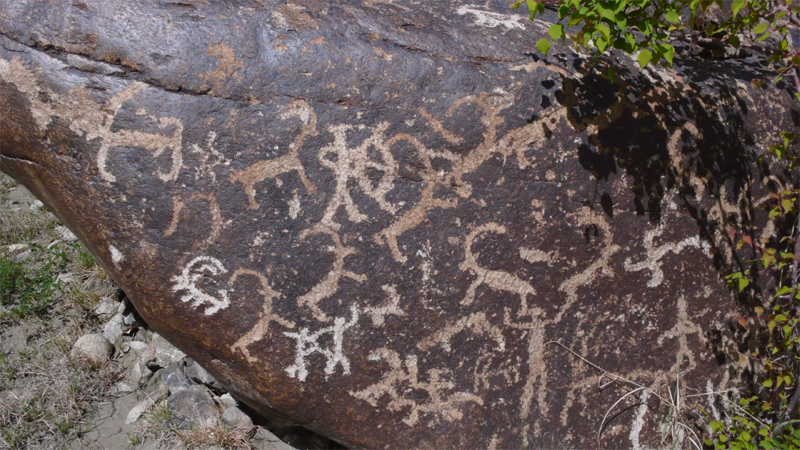
There are moments in governance when a single initiative manages to honour the past, serve the present, and secure the future all at once. The laying of the foundation stone for India’s first Petroglyph Conservation Park on the banks of the Indus River in Leh, on World Heritage Day, is precisely such a moment. It is a decision that deserves not merely applause but careful appreciation. Ladakh is no ordinary landscape. Carved by glaciers, shaped by centuries of trade along the Silk Route, and bearing quiet witness to the passage of civilisations, its rocks are not merely geological formations – they are pages of an unwritten library. Nearly 400 sites across this high-altitude desert contain petroglyphs: prehistoric images etched, pecked, and engraved onto stone surfaces depicting hunting scenes, Ibex and Snow Leopards, Buddhist stupas, ancient inscriptions in Sanskrit, Arabic, and Chinese, and the countless unnamed stories of people who lived, worshipped, and wandered here thousands of years ago. These carvings span from the Palaeolithic Age through later historic periods, making them a continuous and irreplaceable record of human civilisation. To lose even one is to tear a page from that record permanently.
Yet that is precisely what has been happening. Unregulated tourism, road construction, rock blasting, and sheer public unawareness have placed these silent treasures under grave and growing threat – particularly the isolated petroglyphs along the Indus and Zanskar rivers. The decision to carefully relocate endangered carvings to a dedicated, curated conservation park is not only pragmatic but deeply ethical. As Ladakh LG rightly observed, the conservation of heritage must be treated as an ethical responsibility and woven into the very fabric of development planning. That principle, stated plainly and acted upon firmly, is what separates thoughtful governance from mere administration.
In an age when sceptics argue that the digital world has rendered physical travel unnecessary – that one can see anything from anywhere through a screen – the enduring popularity of museums, the Ajanta and Ellora caves, and similar sites tells a very different story. First-hand experience is irreplaceable. Standing before a carving made by human hands thousands of years ago, feeling the texture of ancient stone, breathing the crisp Ladakhi air, and sensing the sheer weight of time – no screen can replicate that. Curiosity is a fundamentally human impulse, and what is unique will always generate the irresistible desire to see it for oneself. A world-class petroglyph park in Leh will do exactly that.
The timing is particularly apt for international visitors. Ladakh already draws scholars, monks, and spiritual travellers from across the globe who come to study its magnificent Buddhist heritage – its monasteries, thangkas, and sacred landscapes. This park will be a compelling value-add for these visitors, deepening their engagement with Ladakh’s cultural depth. Moreover, by consolidating over 300 scattered sites into one accessible location, the park resolves a practical challenge that has long frustrated serious enthusiasts: the near-impossibility of visiting all significant petroglyph sites across such vast, rugged terrain.
Ladakh’s people have long demonstrated a profound respect for their environment – a sensibility born of living in one of the world’s most fragile and magnificent ecosystems. This park aligns naturally with that spirit. It joins a growing constellation of environmentally friendly tourism initiatives in the region, including the Hanle Dark Sky Reserve with its state-of-the-art telescope, reflecting a consistent and commendable Governmental philosophy: that Ladakh’s future prosperity must be built on sustainable, responsible, and culturally enriching tourism rather than heavy industry or ecologically damaging development.
It is a necessity. With limited industrial scope and constrained agricultural potential, tourism is the lifeblood of Ladakh’s economy. Every unique, world-class attraction adds vital momentum to that sector, generating livelihoods, encouraging longer visitor stays, and drawing Ladakh onto the international tourism map with fresh distinction. As one of only a handful of such specialised parks anywhere in the world, the Petroglyph Conservation Park has every potential to become a landmark destination in its own right. The foundations laid on the banks of the Indus are more than concrete and stone. They are a promise to every future visitor who will stand before these ancient carvings and hear, quite clearly, civilisation whispering across the millennia.
 Follow our WhatsApp channel
