

Jagdish Chander Raina
rainajagdishchander@gmail.com
Parshuram Jayanti is being observed and celebrated on 19th April 2026 by millions across India, commemorating the birth of Bhagwan Shree Parshuram on the auspicious day of Akshay Tritiya. The sixth incarnation of Vishnu, he stands as one of the most powerful and enduring embodiments of India’s timeless heritage of dharma. Revered as a warrior sage, Parshuram embodies a rare synthesis of martial strength and spiritual depth. His life is not merely a tale of divine intervention, but a timeless message on justice, discipline, and the restoration of righteousness.
The Birth of a Divine Purpose
Bhagwan Parshuram was born to sage Jamadagni and Mata Renuka, who belonged to the revered lineage of Bhrigu Rishi. His birth, as described in ancient scriptures, was divinely ordained at a time when arrogance and tyranny had begun to overshadow dharma. Unlike other incarnations of Lord Vishnu, Parshuram’s mission was not limited to vanquishing a single evil force; rather, he stood as a corrective force against systemic injustice.
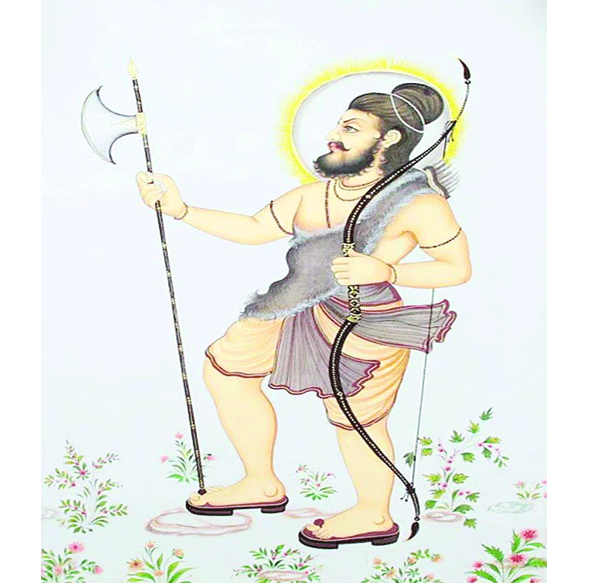
From an early age, Parshuram exhibited extraordinary qualities of unwavering discipline, devotion to his parents, and exceptional prowess in warfare. He is often depicted carrying an axe (parshu or farsa), a divine weapon granted to him by Lord Shiva, symbolizing both his strength and his commitment to uphold righteousness.
A Warrior with a Sage’s Heart
Bhagwan Parshuram’s uniqueness lies in his dual identity. Though born a Brahmin, he possessed the valour and duty of a Kshatriya. This synthesis of roles challenges rigid classifications and presents a deeper truth: that dharma is defined not by birth, but by action (Karma). This balance between knowledge and power forms the core of his legacy. His legendary confrontations with oppressive rulers are remembered for their fierce intensity and unwavering commitment to justice. Parshuram’s actions were driven not by anger, but by a profound and unyielding sense of dharma. His legendary campaigns against oppressive rulers, particularly like the tyrannical Kartavirya Arjuna (Sahasterbahu), were aimed at restoring balance in society. While often interpreted as acts of vengeance, they are better understood as a struggle against the misuse of power and authority. The king’s arrogance grew with his acquisition of power. During a visit to the sage Jamadagni (Parashurama’s father), he forcefully took the divine, miracle-granting cow Kamadhenu (or Sabala). This led to a conflict where Parashurama killed Kartavirya Arjuna, hacking off his thousand arms.
Symbol of Discipline and Duty
In today’s context, Bhagwan Parshuram’s life offers a powerful lesson on discipline and responsibility. He reminds us that knowledge without courage is ineffective, and power without restraint is dangerous. His unwavering obedience to his parents and gurus reflects the importance of values, respect, and moral grounding.
Parshuram also symbolizes the principle that one must rise above personal comfort when confronted with injustice. His life teaches that neutrality in the face of wrongdoing is not virtue-it is complicity. In a rapidly changing world, this message holds immense relevance.
The Teacher of Great Warriors
Beyond his role as a warrior, Bhagwan Parshuram is also remembered as a revered teacher. According to tradition, he imparted knowledge of warfare and ethics to legendary figures such as Bhishma, Dronacharya, and Karna. Through these warriors, his influence flowed into the epic narrative of the Mahabharata, subtly shaping its course and leaving an indelible imprint on the unfolding of history itself.
As a guru, Parshuram imparted not merely the art of warfare, but the deeper discipline of character. His teachings affirmed that true strength is forged in self-control, refined through humility, and anchored in an unwavering commitment to dharma. In essence, he shaped warriors into custodians of conscience, not just wielders of power. In this light, he emerges as a timeless beacon of leadership rooted in integrity and moral courage.
Cultural and Spiritual Significance of Parshuram Jayanti
Parshuram Jayanti is observed with deep devotion and reverence across diverse regions of India, as devotees gather in temples, organise Shobhayatras, offer Special Pujas, Bhandaras and immerse themselves in his timeless teachings. Yet, the day transcends ritualistic observance-it becomes a sacred moment for inner reflection and self-renewal. It invites us not only to remember his legacy, but to realign our lives with the principles of dharma, discipline, and righteous action.
The auspicious occasion reminds society of the need to balance strength with wisdom, action with restraint, and authority with accountability. It calls upon individuals to uphold ethical values in both personal and professional spheres.
Relevance in the Modern Era
In an age marked by rapid transformation, social complexities, and ethical dilemmas, Bhagwan Parshuram’s message resonates strongly even today. His life serves as a reminder that true progress is not merely material-it must be anchored in moral and spiritual principles. The challenges like corruption, inequality, or misuse of power that we are facing today echo and justify the conditions that led to his incarnation. His legacy urges us to confront these issues with courage, clarity, and a sense of duty.
At a broader level, Bhagwan Parshuram represents the highest ideal of self-mastery. In a world often driven by materialistic achievements, he reminds us that true greatness lies in inner discipline, moral clarity, and strength of character. His life inspires us to rise above mere success and strive for righteousness in thoughts, words, and actions. In essence, he teaches that the conquest of the self is far greater than the conquest of the world.
A Timeless Inspiration
Bhagwan Parshuram is not just a figure of the past; he is a timeless symbol of strength guided by wisdom and action rooted in righteousness. His life bridges the worlds of spirituality and responsibility, reminding us that true greatness lies in serving a higher purpose.
As we celebrate Parshuram Jayanti on 19th April 2026, it is an occasion not only to honour his legacy but also to reflect on our own roles in upholding dharma. In a world seeking balance and direction, the ideals of Bhagwan Parshuram ji continue to inspire-urging us to live with courage, act with integrity, and stand firmly for what is right.
 Follow our WhatsApp channel
