

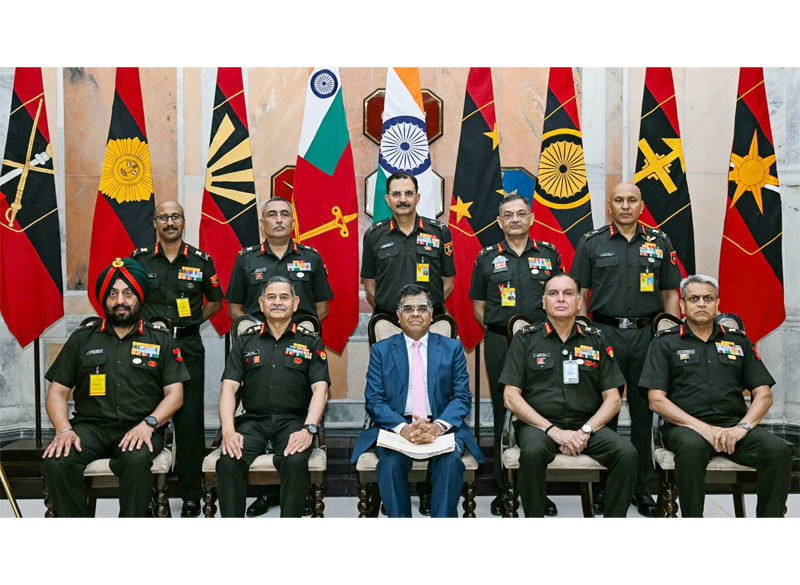
Operational preparedness along borders reviewed
Whole-of-nation approach for security challenges highlighted
Sanjeev Pargal
JAMMU, Apr 17: The four-day biannual Army Commanders’ Conference focused on operational capability requirements including employment of Unmanned Aerial Systems (UAS) and Counter-UAS based on the lessons learnt from last year’s Operation Sindoor.
The Conference held in New Delhi from April 13-16 saw the participants highlighting the need for a “whole-of-nation” approach to address complex security challenges, advocating enhanced synergy across Ministries and institutions.
Follow the Daily Excelsior channel on WhatsApp
“Based on the lessons learnt from Operation Sindoor, and in keeping with the current operational dynamics globally, senior army leadership also focused on operational capability requirements including employment of UAS and Counter-UAS,” the officials said.
UAS and Counter-UAS played significant role in Operation Sindoor which was carried out by the Indian Armed Forces inside Pakistan and PoJK from May 7-10 last year hitting terror camps, security installations etc in which large number of terrorists and their commanders were killed.
UAS and Counter-UAS were also seen in action during recent Israel-United States’ war with Iran.
The operational preparedness of the troops on all fronts mainly Pakistan and China figured prominently at the conference which was chaired by Chief of the Army Staff (COAS) Gen Upendra Dwivedi, and was attended by apex military leadership. It was addressed by senior functionaries in the Government including the Cabinet Secretary, Chief of the Defence Staff, Defence Secretary and Chairman NSAB besides Chief of the Naval Staff.
Troops have been maintaining very high alert all along the Line of Control (LoC) with Pakistan in Jammu and Kashmir to thwart infiltration attempts by the terrorists from across. However, the Line of Actual Control (LAC) with China in Ladakh and other States is presently peaceful though the troops remained deployed in strength in Eastern Ladakh.
The Northern and Western Command chiefs, who have their areas of operations in the Union Territories of Jammu and Kashmir and Ladakh, were part of the Army Commanders’ Conference. The Northern Command looks after entire Ladakh and Jammu and Kashmir excepting Jammu, Samba and Kathua districts, which are under operational control of the Western Command.
The senior military leadership outlined a roadmap to transform the Indian Army into a “future-ready force” through technology integration, modernisation and enhanced operational preparedness.
“Deliberations centered on modernising combat capabilities, integrating advanced technologies and strengthening doctrinal and training frameworks. The Army has designated 2026 as the year of “Networking and Data Centricity,” reflecting a shift towards digitally enabled warfare and real-time decision-making systems,” the sources said.
Senior commanders reviewed ways to enhance operational readiness in response to evolving security challenges, with particular emphasis on networked operations and data-driven strategies.
“Military leaders stressed the need to adapt to changing operational dynamics, noting that future conflicts are increasingly shaped by technology, speed and information dominance,” they said, adding the speakers underscored the importance of strengthening India’s defence manufacturing ecosystem amid global supply chain disruptions.
Besides, they said, there was a strong push for accelerating indigenous production capabilities to ensure long-term strategic resilience.
The discussions also emphasised the role of “hard power” in safeguarding national interests, while calling for greater coordination between civil and military institutions.
The conference had consensus on building a technologically advanced, self-reliant and agile force capable of responding effectively to emerging threats in an increasingly uncertain global security environment.
“The speakers highlighted the evolving geopolitical landscape and emerging global, regional and internal security dynamics. With specific reference to lessons emerging from global conflicts, the speakers alluded to the need for Hard Power for Guaranteed Protection of India’s strategic and security interests while emphasising on inter ministerial coordination, enhanced synergy between civil and military institutions and a whole of nation approach for a coordinated national response to complex security challenges,” an official statement issued after four-day conference said.
It emerged during the discussions that there is an urgent need to accelerate indigenous production capabilities, for strengthening self-reliance in defence and ensuring long-term strategic resilience in view of current supply chain crisis, the statement added.
 Follow our WhatsApp channel
