

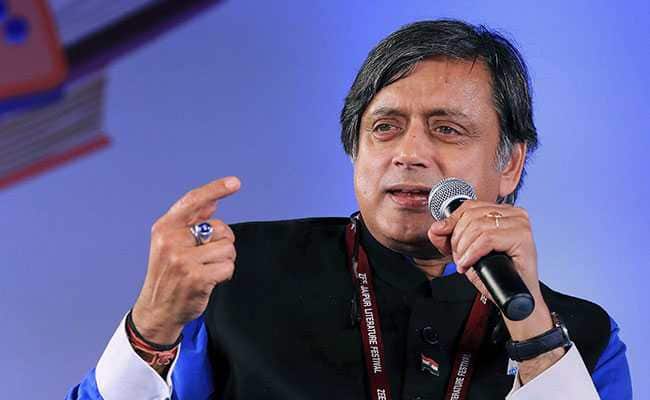
New Delhi, Apr 17: Prime Minister Narendra Modi has wrapped the gift of justice to ‘nari shakti’ in “barbed wire” by linking the implementation of women’s reservation to the expansion of Parliament, Congress leader Shashi Tharoor said on Friday and asserted that delimitation will turn out to be “political demonetisation”.
Participating in a debate in the Lok Sabha on the three bills introduced for amendments in the women’s quota law and setting up a delimitation commission, Tharoor demanded that delimitation be deferred. He called for ensuring that the “march toward a ‘New India’ does not give us a disunited India”.
The MP from Thiruvananthapuram said linking women’s reservation with delimitation is to hold the aspirations of Indian women hostage to “one of the most contentious and complex” administrative exercises in the country’s history.
“The issues surrounding delimitation require extensive consultation with all stakeholders, including all state governments, all political parties, and civil society. It cannot be rushed,” he said.
“I urge the government to decouple these issues and pass the Women’s Reservation Bill today, we will support it. The PM spoke with passion about nari shakti. Let it take effect in the next general election, using our current seat count. Show the women of India that your commitment is not mere rhetorical flourish,” the senior Congress leader said.
Delimitation, he stressed, must be deferred and a formal mechanism such as a joint parliamentary committee be constituted to debate a new federal settlement that protects the interests of all states.
“Let us give women their due now, and give our nation our Union of states, the time it needs to solve its demographic challenges with wisdom, not just arithmetic,” Tharoor asserted.
He pointed out that there is near unanimous political consensus in favour of women’s reservation. Every major party realises that the time for tokenism is over and the era of collective partnership must begin, he said.
“The prime minister (Narendra Modi) says the government has brought nari shakti a gift of justice but he has wrapped it in barbed wire, tethering the implementation of women’s reservation to the expansion of Parliament, to numbers from the 2011 census and an exercise of delimitation… Why must we entangle a moral imperative with a demographic minefield, he asked.
Women’s reservation, he said, is ready for harvest and can and should be implemented immediately based on existing parliamentary strength.
“Any delimitation exercise is fraught with complications that could tear at the very fabric of our federalism,” he said.
“You have proposed delimitation with such haste, the same haste that you showed on demonetisation. Unfortunately, we all know what damage that did to the country. Delimitation will turn out to be political demonetisation. Don’t do it, sir,” Tharoor said.
He stressed that delimitation requires serious discussion.
“There are at least three major fault-lines — the balance between small states and big states; the balance between states, particularly in the South like Kerala and Tamil Nadu, which have diligently implemented national goals of population control and invested in human development, and those, mainly in the North; the balance between the states that are the engines of our economy, contributing more to the national exchequer than they receive, and those that are net recipients of central funds,” he said.
A delimitation based purely on population would further marginalise the voices of those states that provide the lion’s share of the resources that keeps our Union afloat, Tharoor argued.
“We risk creating a tyranny of the demographic majority, where a handful of large, poor states could theoretically determine the fate of the entire country, leaving smaller states and those with distinct linguistic and cultural identities and economic contributions feeling like bystanders in their own country,” he said.
According to Tharoor, the “50 per cent formula” that was suddenly brought up by Home Minister Amit Shah in the House on Thursday, promising that no state will lose its current number of seats while the total House strength increases, remains a “precarious political assurance and not a political certainty”.
“This pledge is fundamentally contradicted by the existing text of the legislation itself, which gives total freedom to the delimitation commission appointed by the government, whose decisions cannot be challenged in a court of law. Since this formula is not codified as an immutable constitutional safeguard, it could be easily discarded or altered by a simple parliamentary majority, offering no guarantee that it will survive beyond the very short term,” Tharoor said.
Furthermore, expanding the Lok Sabha to an 850-member House would create a legislature that is, by far, the largest in any democracy, resulting in a body that is both unwieldy and unworkable, he said.
Another great concern is that that the size of the Lok Sabha is being expanded but there is no corresponding proposal to increase the strength of the Rajya Sabha, raising a serious structural concern, he said.
This, the Congress MP added, alters the relative balance between the two Houses, especially in cases of a joint sitting when the Lok Sabha would dominate the process.
This imbalance also extends to elections for the president and vice president, he said. Tharoor also cited the example of the European Parliament where “degressive proportionality” is practised and said such options need to be discussed and debated for arriving at a solution.
The Constitution (131st Amendment) Bill to tweak the women’s quota law was introduced in Lok Sabha on Thursday after a division of votes. Two ordinary bills — the Delimitation Bill and the Union Territories Laws (Amendment) Bill to implement the proposed amended women’s quota law in Union territories of Delhi, Puducherry and Jammu and Kashmir — were also introduced in the House. (Agencies)
 Follow our WhatsApp channel
