

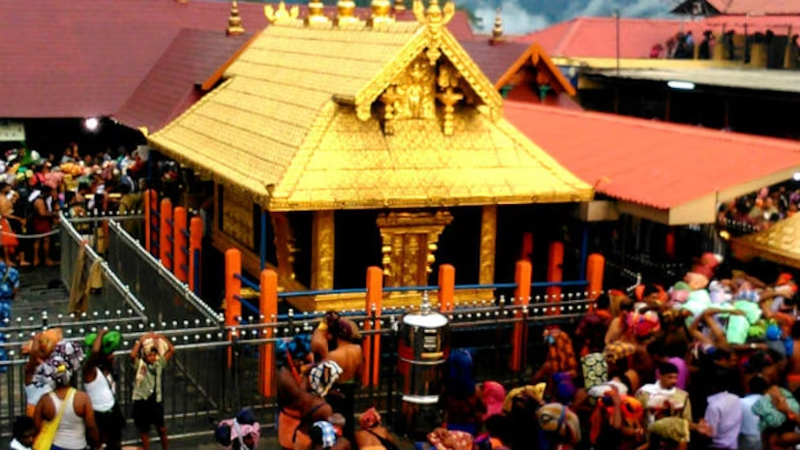
NEW DELHI, Apr 15 : The Supreme Court on Wednesday observed that while adjudicating issues arising from religious beliefs and practices, it cannot, in the name of social reform, render religion hollow, even as it indicated that it cannot completely shut its doors to Public Interest Litigations (PILs) concerning such practices.
The nine-judge Constitution Bench headed by Chief Justice Surya Kant, hearing the Sabarimala reference, is also examining key questions relating to the scope of judicial review, the balance between Articles 25 and 26 and Article 14, the role of “constitutional morality”, and the maintainability of PILs in religious matters.
Besides Chief Justice Surya Kant, the other judges on the Bench include Justice B.V. Nagarathna, Justice M.M. Sundresh, Justice Ahsanuddin Amanullah, Justice Aravind Kumar, Justice Augustine George Masih, Justice Prasanna B. Varale, Justice R. Mahadevan and Justice Joymalya Bagchi.
Appearing for the Travancore Devaswom Board, senior advocate Abhishek Manu Singhvi argued that courts should adopt a limited approach in religious matters and cautioned against expanding doctrines that allow judicial interference.
He opposed the doctrine of “essential religious practices”, contending that constitutional protection cannot be restricted only to what courts consider essential.
According to him, it is not for courts to determine whether a practice is essential or not, as religion must be understood through the beliefs of its adherents.
Singhvi also argued against the use of “constitutional morality” as a standard to test religious practices, submitting that the term does not find place in the Constitution and remains vague. He said it cannot be used as an external yardstick to invalidate religious beliefs, and cautioned that its application could have destabilising consequences for the framework under Articles 25 and 26.
On the issue of PILs, Singhvi argued that challenges to long-standing religious practices by persons not directly affected should be discouraged, and that the threshold for entertaining such petitions must remain very high.
The Bench, however, indicated that a blanket bar on PILs in religious matters may not be feasible. Justice Joymalya Bagchi observed that where a practice prima facie violates public order, health or morality, courts may have to intervene. Chief Justice Surya Kant added that in extreme cases, the Court could even act suo motu.
During the hearing, Justice B.V. Nagarathna cautioned that the power of social reform under Article 25(2)(b) cannot be used to dismantle the core of a religion. “In the name of social welfare and reform, you can’t hollow out the religion,” she observed.
Singhvi argued for a harmonious interpretation of Article 25(2)(b) and Article 26(b), stating that while entry into temples of a public character may be open to all sections, the manner in which rituals are performed in the sanctum sanctorum must remain within the domain of the religious denomination.
Justice M.M. Sundresh pointed to the concept of “social reform” under Article 25(2)(b), noting that legislative interventions such as the Hindu Succession Act could fall within its ambit.
The Bench also reflected on the difficulty of applying “constitutional morality” in religious contexts. Justice Sundresh indicated that it may be a fluid concept, while Justice Nagarathna cautioned against using it to judge religious practices subjectively.
Justice Bagchi noted that applying such a standard to non-State actors could introduce, say, a horizontal applicability into matters traditionally governed by faith.
The hearing will continue on Thursday, April 16, 2026.
(UNI)
 Follow our WhatsApp channel
