

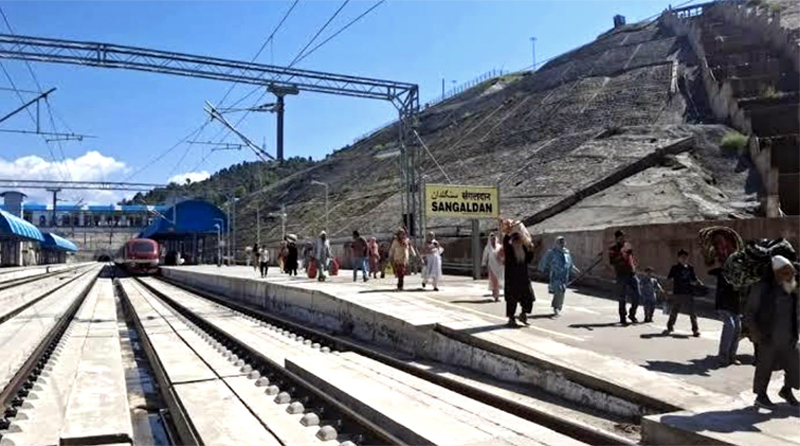
The Ministry of Railways has sanctioned a Final Location Survey for a proposed new railway line between Reasi and Poonch – a stretch of approximately 190 kilometres – at an estimated survey cost of Rs 26.41 crore. For the twin border districts of Poonch and Rajouri, long severed from the national rail network and long neglected in India’s infrastructure calculus, this is a moment worth marking. However, rail connectivity in these parts has been promised, surveyed, assessed and deferred before. The lesson of that troubled history is that a survey, however necessary, is not a guarantee. It is a beginning. The route now under scrutiny follows a more direct alignment from Reasi, which already serves as the terminus of the celebrated Udhampur-Srinagar-Baramulla Rail Link. The earlier proposal – a 223-kilometre line from Jammu via Akhnoor and Rajouri to Poonch, projected to cost Rs 22,771 crore – was effectively shelved after feasibility studies returned low traffic projections. That outcome was not surprising in a narrow technocratic sense. Traffic projections measure what is; they cannot measure what could be or what must be.
The case for connecting Poonch and Rajouri to the national rail network rests on multiple pillars. These districts lie along the Line of Control, and the Indian Army has historically borne the burden of transporting men, materiel and heavy logistics through treacherous mountain roads prone to disruption by weather, militancy and cross-border shelling. It is an operational constraint. A railway line, impervious to most surface disruptions and capable of vastly higher freight loads, would be a strategic asset of the first order. The second pillar is development. Poonch and Rajouri carry the unhappy distinction of being among Jammu and Kashmir’s most industrially underdeveloped districts. Tourism, despite the region’s spectacular landscapes and rich cultural heritage, remains a fraction of its potential – constrained by poor accessibility. Small enterprises struggle to compete with better-connected markets. Skilled workers migrate. Investment does not arrive. These are not independent pathologies; they are symptoms of the same infrastructural deficit. Rail connectivity has historically served as a transformative catalyst for remote regions, unlocking supply chains, reducing transport costs and making investment viable. There is no persuasive reason to believe the Poonch-Rajouri belt would be any different.
Communities along the Line of Control absorb, season after season, the costs of the India-Pakistan rivalry – shelling, displacement, interrupted livelihoods, and lives lived under the shadow of escalation. The least the nation owes these communities is proper connectivity. The Jammu-Srinagar railway, first surveyed during the Dogra Maharaja’s reign, took the better part of a century to come to fruition – with the USBRL only achieving full operationalisation in 2025 – and is a sobering reminder of how slowly the machinery of aspiration turns in the mountains.
There is also a broader strategic possibility that warrants serious exploration: aligning the Reasi-Poonch line along a corridor that could eventually be extended towards the Kashmir Valley via a route analogous to the Mughal Road. Such a link would create a second rail corridor connecting Jammu and Kashmir, reducing dependence on the single USBRL track and dramatically increasing overall rail traffic between the two divisions. With Jammu recently elevated to a separate railway division, the administrative framework for such an ambition now exists.
None of this is to minimise the significance of the survey. It is a rigorous technical exercise that will determine feasible alignment, assess geological and topographical challenges, and produce refined cost estimates upon which any subsequent sanction for construction must rest. But the larger lesson must be absorbed by planners and policymakers alike: the framework for evaluating border-area railway projects cannot be the same as the framework applied to the Delhi-Mumbai Industrial Corridor. Remunerativeness, as ordinarily understood, will almost always cut against investment in conflict-proximate, sparsely populated regions. A more intelligent approach would place strategic weight, developmental imperative and national equity alongside ridership forecasts in any cost-benefit calculus.
The people of Poonch and Rajouri have waited long. One hopes that this time they will see the project through with the urgency it deserves: not just as an infrastructure investment, but as a national obligation to communities that have given much and received far too little.
 Follow our WhatsApp channel
