

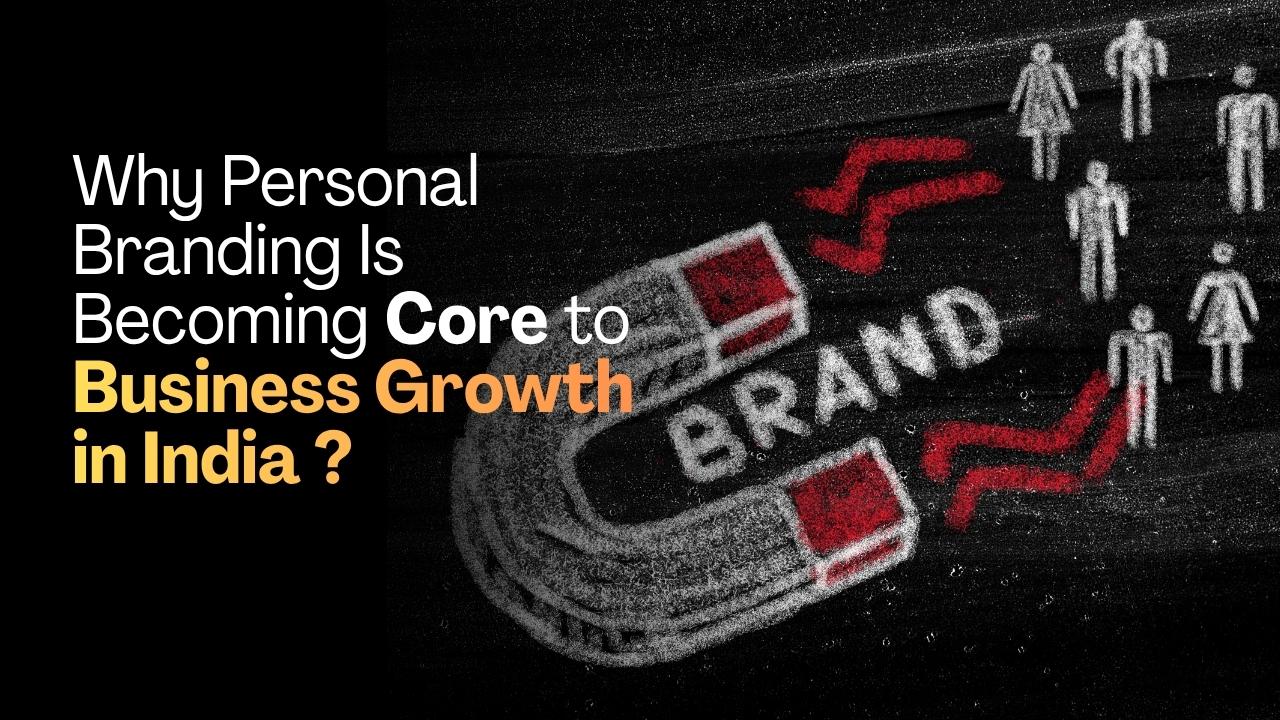
There was a time-not too long ago-when Indian businesses preferred anonymity. Founders stayed in the background, companies did the talking, and credibility was built through scale, not storytelling.
That model is quietly collapsing.
Today, in boardrooms and brainstorm meetings alike, a different question is being asked: Who is the face behind the brand?
Because increasingly, that face is what determines whether the brand is trusted, remembered, and ultimately chosen.
The Trust Deficit-and the Human Shortcut
India’s digital economy has exploded, but so has skepticism.
Consumers are more informed, more exposed, and significantly more cautious. Every category-whether it’s fintech, D2C, edtech, or marketing services-is saturated with options that look identical on paper.
In such a market, products compete on features, but people compete on trust.
And trust, in the digital age, rarely comes from logos. It comes from individuals.
A founder speaking directly to their audience, sharing insights, showing decision-making in real time-this creates a psychological shortcut. It reduces doubt. It builds familiarity. It humanizes scale.
This is precisely where personal branding stops being a vanity exercise and starts becoming a business asset.
From Optional to Operational
What was once considered an “extra” activity-posting on LinkedIn, sharing thoughts on Instagram, recording occasional videos-has now moved into the core operating layer of many businesses.
Personal branding is no longer about visibility alone. It is about:
- Reducing customer acquisition friction
- Improving conversion trust
- Attracting better talent organically
- Opening doors to partnerships and capital
In essence, it acts as a force multiplier across every function of a company.
Businesses that understand this are no longer asking if founders should build a personal brand-they are investing in how systematically it can be done.
The Distribution Reality Most Founders Miss
There is, however, a fundamental misunderstanding in how personal branding is often approached.
Most founders focus on content creation. Very few understand content distribution.
Posting consistently is not enough. Visibility is not guaranteed. Algorithms are indifferent to effort.
The real game lies in engineered reach-how content is circulated, repeated, and reinforced across platforms and ecosystems.
This is where structured frameworks like Content Distribution Management (CDM) come into play-ensuring that a single piece of content does not live and die on one platform, but travels, adapts, and compounds visibility over time.
It is a shift from posting content to building presence.
A New Breed of Founder
Among those actively working within this paradigm is Mohammad Zaid Khan-Entrepreneur, Speaker, and Marketing Evangelist, and Founder & CEO of Zedital Media.
His approach reflects a broader industry transition: combining business operations with a distribution-first content strategy.
Through his personal brand platform, The Wolf of Indian Street, Khan translates business insights into high-frequency, platform-native content-designed not just for engagement, but for recall.
At the company level, Zedital Media integrates this philosophy into execution-leveraging multi-platform distribution, meme-page amplification, and agency-owned digital assets to extend reach beyond traditional channels.
Complementing this ecosystem is Zinc Formula, an influencer marketing-focused vertical that aligns creator networks with brand narratives-further reinforcing how personal branding and influencer ecosystems are beginning to merge.
As Khan succinctly puts it:
“In today’s market, people don’t just buy what you sell-they buy how consistently they see you, hear you, and remember you.”
The Cultural Undercurrent
To understand why personal branding is accelerating in India, one must look beyond marketing.
This is also a cultural shift.
A younger, digitally native population is entering the economy-both as consumers and creators. They do not separate content from commerce. They discover products through reels, form opinions through stories, and build trust through repeated exposure to individuals.
In such an environment, a founder without a presence is often a brand without a narrative.
And a brand without a narrative is easily replaceable.
The Compounding Effect
The most underestimated aspect of personal branding is not its immediate impact-but its compounding nature.
A single post may not convert. A week of content may not show results. But over months and years, a consistent personal brand creates:
- Familiarity
- Authority
- Recall
- Preference
At scale, this reduces dependency on paid marketing. It shortens sales cycles. It turns cold audiences warm before the first interaction.
In other words, it builds demand before intent.
The Risk of Getting It Wrong
However, the rise of personal branding also brings with it a layer of superficiality.
Visibility without substance is increasingly easy to achieve-but difficult to sustain.
Audiences may engage with style, but they stay for depth. Founders who treat personal branding as performance rather than communication often struggle to translate attention into business outcomes.
The real challenge, therefore, is not just to be seen-but to remain relevant.
The Shift That Cannot Be Ignored
What is unfolding in India is not a passing trend. It is a structural shift in how businesses grow.
Marketing is no longer confined to campaigns. Branding is no longer confined to companies. And growth is no longer driven by products alone.
It is being shaped, increasingly, by individuals who understand how to occupy space in the public mind.
Closing Thought
In a market as competitive and crowded as India, silence is no longer neutral-it is invisible.
And in the years ahead, the founders who win will not just be the ones who build the best businesses.
They will be the ones who build themselves alongside them.
 Follow our WhatsApp channel
