

US-Iran peace talks collapse in Pak
WASHINGTON/Islamabad, Apr 12:
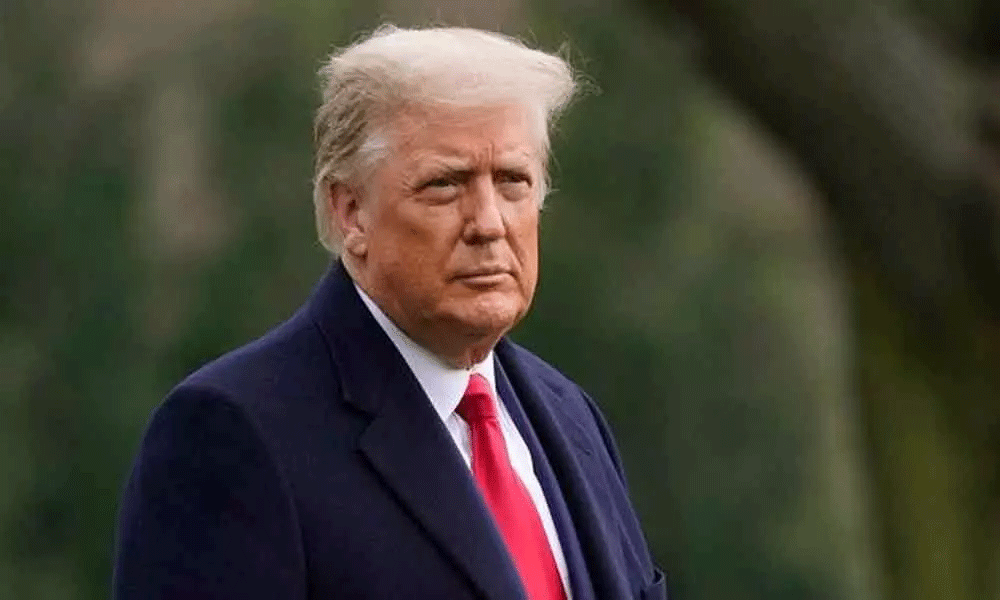
US President Donald Trump on Sunday announced that the US Navy would immediately begin a blockade on ships from entering or leaving the Strait of Hormuz, hours after the peace talks with Tehran failed on the issue of nuclear weapons.
Follow the Daily Excelsior channel on WhatsApp
In a post on Truth Social, Trump said he has directed the US Navy to seek and interdict every vessel in International Waters that has paid a toll to Iran.
“No one who pays an illegal toll will have safe passage on the high seas,” the US President said, claiming that other countries will be involved in this blockade of the Strait of Hormuz, a crucial narrow waterway used to transport a fifth of the global oil supplies.
“They want money and, more importantly, they want Nuclear. Additionally and, at an appropriate moment, we are fully “LOCKED AND LOADED,” and our Military will finish up the little that is left of Iran,” Trump said.
The US President said he was briefed by Vice President J D Vance, Special Envoy Steve Witkoff and Jared Kushner on the talks with Iranian leaders in Islamabad.
“So, there you have it, the meeting went well, most points were agreed to, but the only point that really mattered, NUCLEAR, was not,” Trump said.
The US President acknowledged the role played by Pakistan’s Field Marshal Asim Munir and Prime Minister Shehbaz Sharif in hosting the talks in Islamabad.
“They are very extraordinary men, and continuously thank me for saving 30 to 50 million lives in what would have been a horrendous War with India. I always appreciate hearing that – The amount of Humanity spoken of is incomprehensible,” Trump said.
The US President said the points agreed with the Iranian leadership were better than continuing military operations to conclusion.
“…but all of those points don’t matter compared to allowing Nuclear Power to be in the hands of such volatile, difficult, unpredictable people,” Trump said.
He said the three US representatives became very friendly and respectful of Iran’s Representatives – Mohammad Bagher Ghalibaf, Abbas Araghchi, and Ali Bagheri.
“… but that doesn’t matter because they were very unyielding as to the single most important issue and, as I have always said, right from the beginning, and many years ago, IRAN WILL NEVER HAVE A NUCLEAR WEAPON,” Trump said.
Since the US and Israel launched the war on Feb 28, it has killed at least 3,000 people in Iran, 2,020 in Lebanon, 23 in Israel and more than a dozen in Gulf Arab states, and caused lasting damage to infrastructure in half a dozen Middle Eastern countries.
Iran’s grip on the Strait of Hormuz has largely cut off the Persian Gulf and its oil and gas exports from the global economy, sending energy prices soaring.
Earlier, US and Iran failed to reach a peace deal at their historic 21-hour talks in Pakistan, leaving the fate of a tenuous two-week ceasefire in doubt, with both sides attempting to hold each other responsible for the collapse of the negotiations.
Vice President JD Vance, who led the US delegation at the negotiations in Islamabad, said the Iranian side did not accept Washington’s terms for ending the war even as the US presented its “final and best offer”. He indicated that Tehran’s reluctance to abandon its nuclear programme was one of the key sticking points.
Iranian Parliament Speaker Mohammad Bagher Ghalibaf, the head of the Iranian team, said it is for the US to decide whether it can “earn our trust or not”.
The Iranian Foreign Ministry, without elaborating, said the US side resorted to “excessive” and “illegal demands”
The failure to reach an agreement has dimmed the prospect of reopening the Strait of Hormuz to stabilise the global energy market. It is unclear whether the US will resume military operations against Iran.
“We have been at it now for 21 hours. We’ve had a number of substantive discussions with the Iranians, that’s the good news,” Vance said at a press conference before departing from the Pakistani capital.
“The bad news is that we have not reached an agreement and I think that’s bad news for Iran much more than it’s bad news for the United States of America.”
“But the simple fact is that we need to see an affirmative commitment that they will not seek a nuclear weapon and they will not seek the tools that would enable them to quickly achieve a nuclear weapon,” he said.
To a question on Iran’s nuclear programme, Vance said the US President Donald Trump’s “core goal” is to stop Iran from having nuclear weapons.
“That is the core goal of the President of the United States. And that’s what we’ve tried to achieve through these negotiations,” he added.
The US Vice President said the American side presented its “final and best offer” to the Iranian side but it did not accept it.
“We just could not get to a situation where the Iranians would accept our terms,” he said.
“We leave here with a very simple proposal, a method of understanding that this is our final and best offer. We’ll see if the Iranians accept it,” Vance said.
The Iranian media reported the talks collapsed after negotiators failed to bridge gaps regarding Iran’s nuclear program, control over the Strait of Hormuz, and release of frozen Iranian assets.
In a social media post, Ghalibaf said the Iranian side raised “forward-looking initiatives,” but the opposing side “ultimately failed to gain the trust of the Iranian delegation in this round of negotiations.”
“We consider every mirror to be another method of authority diplomacy, alongside military struggle, for upholding the rights of the Iranian nation, and we will not for a moment cease our efforts to consolidate the achievements of the forty days of Iran’s national defence,” he said.
The Iranian foreign ministry said the success of the “diplomatic process depends on the seriousness and goodwill of the other side, and refraining from excessive and illegal demands”.
Iran foreign ministry spokesman Esmaeil Baqaei said issues like the transit through Strait of Hormuz created some hurdles in the talks.
“These talks happened in the aftermath of a 40-day war and in an ambiance of mistrust and skepticism,” Baqaei said, according to Iran’s state-run IRNA news agency.
“Naturally, we should have never expected to reach a deal in one session. We will continue to work to bring the two views of Americans and Iranians closer together,” he said. (PTI)
 Follow our WhatsApp channel
