

Haroon Imtiaz
imtiazharoon990@gmail.com
Many people say, “Let there be war.” Yes, even I say it sometimes. I say it with pride, believing that our soldiers are ready, brave, and fearless. But then I stop and ask myself does anyone who demands war really understand its cost? Did they lose someone from their own family? Most people speak loudly about war, but very few have paid the price of it.
I once saw a mother an old, fragile mother with tears permanently settled in her eyes. Her name was Kesara Devi. She had lost her young son to this world, a son she raised with endless love, care, and dreams. Even today, she keeps a glass of water at the door of her house, believing that her son, who was declared missing in the 1965 war, will one day return. In her heart, the war never ended. For her, her son is still alive walking back home, resting his head in her lap, and sleeping peacefully once again.
I also saw a father who still waits. His name was Ram Saran. He speaks with pride that his son was a true soldier who served the nation with honour, and that his sacrifice fills his heart with dignity. But when the sun sets, his house becomes unbearably silent. That silence reminds him of his son his strength, his pride, his world. Patriotism gives him courage to stand tall before society, but loneliness breaks him quietly every evening.
Then there is a brother Prem Singh now old, with time deeply etched on his face, yet his eyes still search for someone. He waits with the hope that if his brother had returned, they would have shared their final moments together. War does not only take lives; it freezes time for those left behind, trapping them forever in waiting.
When I began reading about the 1965 Indo-Pak War, I read the same history that everyone reads dates, strategies, victories, and ceasefires. But I stopped when I reached the sacrifices. From 5 August to 23 September 1965, nearly 3,000 Indian soldiers laid down their lives for the nation. Around 100 soldiers were declared PKIA (Presumed Killed in Action) missing, with no bodies returned and no final closure for their families.
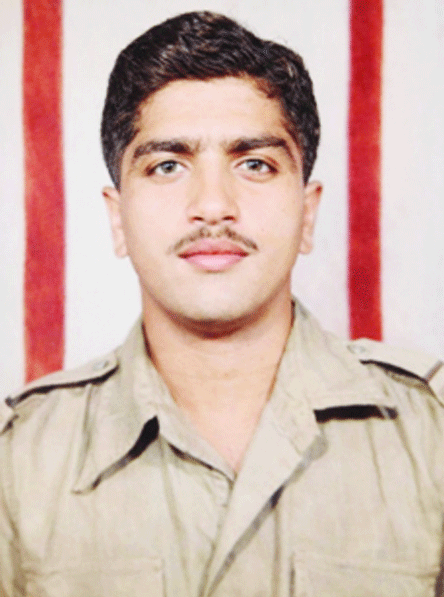
Among those names was Grenadier Munshi Ram, Service Number 2644510, from 3 GRENADIERS. He was born in Chanunta, Nambal, and his home address was Village Chanunta, District Udhampur, Jammu and Kashmir. For the nation, he became a name recorded in official history. But for his family, he remained a son, a brother, a presence that never truly left.
Grenadier Munshi Ram’s first posting was in NEFA (North-East Frontier Agency), one of the most difficult and harsh operational areas of that time. Later, during the 1965 war, his second posting took him to the western front Jaisalmer, Bikaner, / Nasirabad in the Rajasthan Operational Area. From the cold, unforgiving mountains of NEFA to the burning deserts of Rajasthan, his duty never changed to stand for India.
An important and deeply painful part of his life was his wife, Krishna Devi. When Grenadier Munshi Ram was declared PKIA, she was just one and a half months pregnant, nurturing a new life within her, even as her own world collapsed. The shock of his disappearance broke her from within. Though her body survived for a short while, her spirit could not bear the separation. A few months later, when she was around three months pregnant, she too passed away leaving behind not just grief, but a silence that words can never fill.
For this family, sacrifice was not a single moment it was a lifetime. Grenadier Munshi Ram may be remembered as PKIA, but his courage lives on in the tears of his parents, the waiting of his brother, and the silent loss of a wife whose life ended before it could truly begin. Such stories remind us that war does not end on the battlefield it continues in homes, in memories, and in hearts that never stop waiting.
Grenadier Munshi Ram joined the Indian Army on 28 October 1960, when he was just 20 years old. At an age when most young men are still discovering life, he choose discipline, duty, and sacrifice. Soon after joining the Army, he was posted to one of the toughest operational areas of that time NEFA (North-East Frontier Agency). From 17 November 1962 to 6 September 1965, he served continuously in this harsh and challenging region, known for its unforgiving terrain, extreme weather, and constant operational pressure.
Far away from his home, perhaps missing his mother, his brother, and his wife every single day, Grenadier Munshi Ram stood firm not for comfort, not for reward, but for the safety of his motherland. In the harsh and unforgiving land of NEFA, where cold pierced the bones and silence tested the mind, he carried more than a rifle on his shoulders. He carried memories of home, the warmth of loved ones, and the quiet pain of separation. Yet, he never complained. NEFA tested a soldier’s physical strength and mental endurance, but Munshi Ram endured with quiet determination, because his love for the nation had grown stronger than his personal pain.
During the 1965 Indo-Pak War, his posting was changed to the Western Sector, specifically the Bikaner and Jaisalmer sector (Rajasthan Operational Area). From 2 November 1965 to 3 December 1965, he served in the desert belt of Rajasthan. From the cold and rugged mountains of NEFA to the burning sands of the Thar Desert, one thing remained constant in his life standing guard for the nation. His love for India did not change with geography; it only grew stronger.
While gathering information about Grenadier Munshi Ram, one question kept coming to my mind, what is there in this Tricolour that makes a soldier wear his uniform like a shroud? What is so powerful in this nation that a young man chooses death over stepping back? When I tried to feel the sacrifice of a martyr like Grenadier Munshi Ram, I found the answer. His love began with the Tricolour pure, unconditional, and limitless. That love became so deep that resting forever in the lap of Mother India felt more peaceful than living for oneself. And so, he slept not in fear, but in honour.
On 3 December 1965, in a small skirmish in the Jaisalmer sector (Rajasthan Operational Area), Grenadier Munshi Ram went missing. During the fight, when some Pakistani troops opened fire, one of his comrades was hit. Showing extraordinary courage, Munshi Ram immediately protected his buddy, shielding him from further harm, and engaged the enemy alone, refusing to step back. He fought with unmatched bravery until the Indian Army backup team arrived. They searched the area thoroughly, calling out for him, but he was nowhere to be found.
Because his body was never recovered, he was officially declared Presumed Killed in Action (PKIA). There was even a possibility, however small, that he had been captured and was being held in a Pakistani prison. Pakistan, however, denied any such claim, and despite repeated leads or hopes, nothing could confirm his fate much like what happened later in 1971 with Captain Kamal Bakshi, who went missing in action during the war. There were many indications that he might have been in Pakistan’s custody, yet Pakistan consistently denied it.
For the family of Grenadier Munshi Ram, this was a deep, unending shock and grief. The uncertainty of not knowing whether their son, their pride, was alive or dead is a pain that never truly heals. Yet even in this void, Munshi Ram’s courage and sacrifice shine brighter than any fear or doubt. He gave everything for the nation, his youth, his life, and the safety of others without ever asking for recognition or reward.
 Follow our WhatsApp channel
