

By Poonam I Kaushish
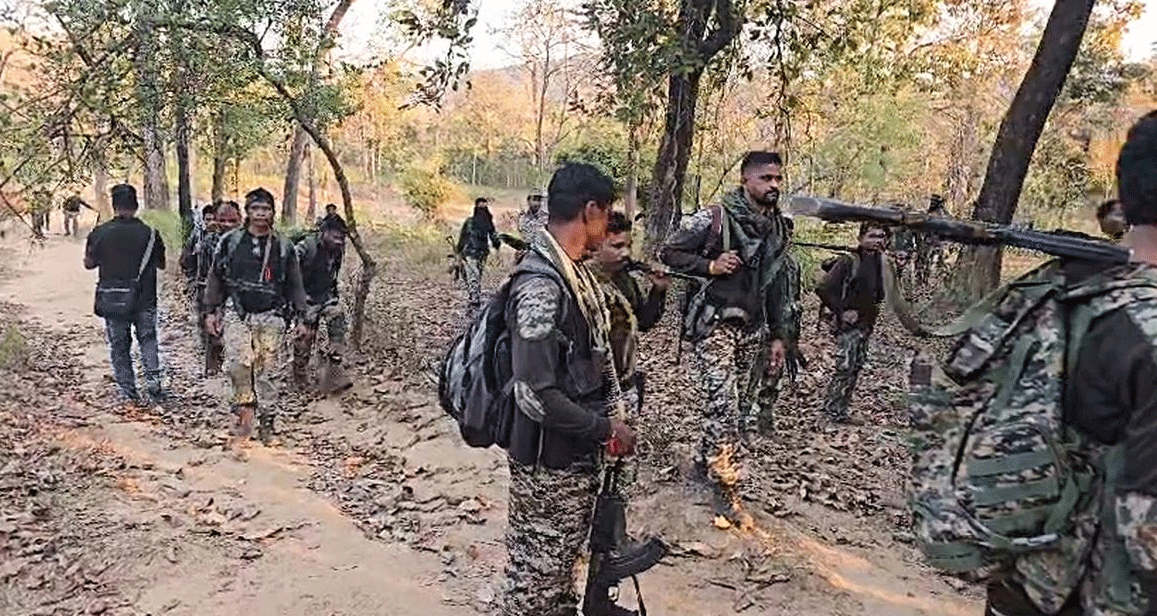
Goodbye Maoists. After over six decades of relentless Maoist insurrection which cast a long shadow across North, South, East and West, the dreaded ‘Red Corridor’ is clear of all encumbrances. With over 1858 Maoists killed between 2016-24 and over 2000 cadres having surrendered since 2024 just two districts are now in Maoists tentacles asserted Home Minister Shah.
Primarily due to two factors: One, as top Maoists leaders were killed or arrested the chain of command weakened whereby lower cadres felt abandoned along-with disillusionment due to poor living conditions, constant movement and fear of encounters. Topped by loss of jungle sanctuaries due to police camps, drones and long-duration area domination making old hideouts unsafe with escape routes between Chhattisgarh, Maharashtra, Telangana narrowing sharply. Two, attractive surrender policy of cash rewards, housing, skill training, job security which made surrender an exit, instead of imprisonment.
Recall, Naxalism emerged from agrarian unrest in West Bengal’s Naxalbari in 1970’s, a hungrier more violent Naxal movement spread to parts of Andhra Pradesh, Telangana, Bihar, Chhattisgarh, Jharkhand and Orissa in the 1990’s reaching its peak in 2000-2014 due to multiple State abdications and political failures where the State was often absent or coercive.
In fact, late Prime Minister Manmohan Singh underscored Left extremism as the biggest internal security concern 2006. Extremism drew sustenance from Government’s failure to establish a credible presence through welfare interventions among marginalised communities. Specifically in forest areas where the State’s writ was weak, Maoist groups established parallel governance structures, collecting levies, dispensing justice and tapping people’s anxieties displaced by infrastructure projects.
Sadly for years Governments response oscillated between neglect and use of force. An ill-advised attempt to create a citizen’s militia against rebels only ended up antagonising the tribal population while committing human rights violations.
The success against Left wing extremism can be measured across three levels. First, States capacity and policies that took the fight to Maoist cadres. Second, concerted efforts to facilitate surrenders and rehabilitation of those “waging war “ against the Indian State. Third, splits within Maoist leadership and realization of futility of armed struggle weakened them.
Another factor for the Government’s success was more muscular and tougher stances against insurgents — bullet for bullet approach. Alongside, there was a kernel of discontent among ordinary people who felt abandoned by Authorities specially when tragedy or disaster struck.
Undeniably, one of the reasons for the decisive shift is thanks to Central and State Governments development initiatives: Roads, markets, schools, hospitals, mobile towers, police outposts etc which were set-up up in once-inaccessible areas and direct benefit transfers which enhanced efficacy of welfare schemes. Besides, better equipped security forces supported by effective intelligence dealt a string of reverses for Maoists.
However, the moment calls for sober reckoning not triumphalism. The squeezing of Naxalites over two years — arrests, surrenders and killings — is undoubtedly a military defeat of Maoism.
Several Maoists who have laid down arms speak about futility of violent means and recognition of democratic possibilities of the State they once criticised as “semi feudal” and “semi colonial.”
Today, Adminstrations have to build on this opening, guard against trust erosion and deepen democracy. Tribal alienation, land rights disputes, lack of roads, schools, healthcare and local governance need long-term attention. Also, their deeper challenges have to be addressed and overcome.
Policy and politics needs to establish a credible and transparent civilian Administration with fair elections that ensure active participation of local communities. As soon as areas are secured, the Administration must begin the move from a securitised to a democratic approach. This will require change of gears from a muscular securitised approach to a softer more humane, democratic one, bolster law and order, protect and ensure development and representation.
Uneven development, land acquisition for infrastructure projects and environmental degradation remain fraught issues. Complaints of human rights abuses must be addressed on priority and Government initiatives evenly distributed. The State needs to double down on participative development, democratic representation and accountability.
Corruption and apathy, often the bane of civic authorities must not be allowed to take roots. The next phase in the Red Corridor needs a transformative vision. Issues like forest rights, just and transparent acquisition must be addressed. The marginalised must be made part of India’s larger story. As also ensure Naxalism does not return in any form.
The strength of Indian democracy lies in its capaciousness, its ability to turn critics and rebels into stakeholders. New Delhi must put its best foot forward and there should be planned deployment of time -bound resources to States inflicted by decades of Maoist conflict. It is crucial now when the enemy is annihilated for the Government to realize if there is disconnect between its objectives, tactics, resources and ground conditions, all stratagems and measures are rendered redundant.
It needs to deal with distortions in the social system on a war footing to alleviate poverty, ensure speedy development and enforce law and order strictly. Police needs reorientation, equipment which can only be achieved through genuine police reforms and dramatic augmentations in general policing capabilities to ensure Maoists don’t raise their head again
For that both Centre and State need to act together. Remember, nations live or die by the way they respond to a challenge. History shows insurgencies can re-emerge if the causes that fed them remain unresolved. Rehabilitation will decide success. If they get livelihoods, dignity, land/forest rights access, social acceptance, psychological support then insurgency is unlikely to regenerate. Bastar’s current skill and rehabilitation push is encouraging.
Governance must replace fear as the real victory is not military, it is administrative legitimacy. If the State is visible only as camps and mining leases, resentment can return. People need to feel police is fair, roads help villages, not only troop movement, schools and health centers function and local tribal voices matter. Tribal rights and mining are the biggest long-term test. If Adivasis feel bypassed, a new grievance ecosystem can emerge. This is where the future will truly be decided.
Succinctly what lies ahead is less “war” and more a “battle” for trust, justice and development. A phase that is politically and morally tougher than jungle operations. Hence, the road ahead should be traversed carefully with deliberation and empathy. It must be one of development and democratic promise. The State should not only be efficient, it must also be seen to be, just . What gives? —- INFA
(Copyright India News and Feature Alliance)
New Delhi,
6 April 2026
 Follow our WhatsApp channel
