

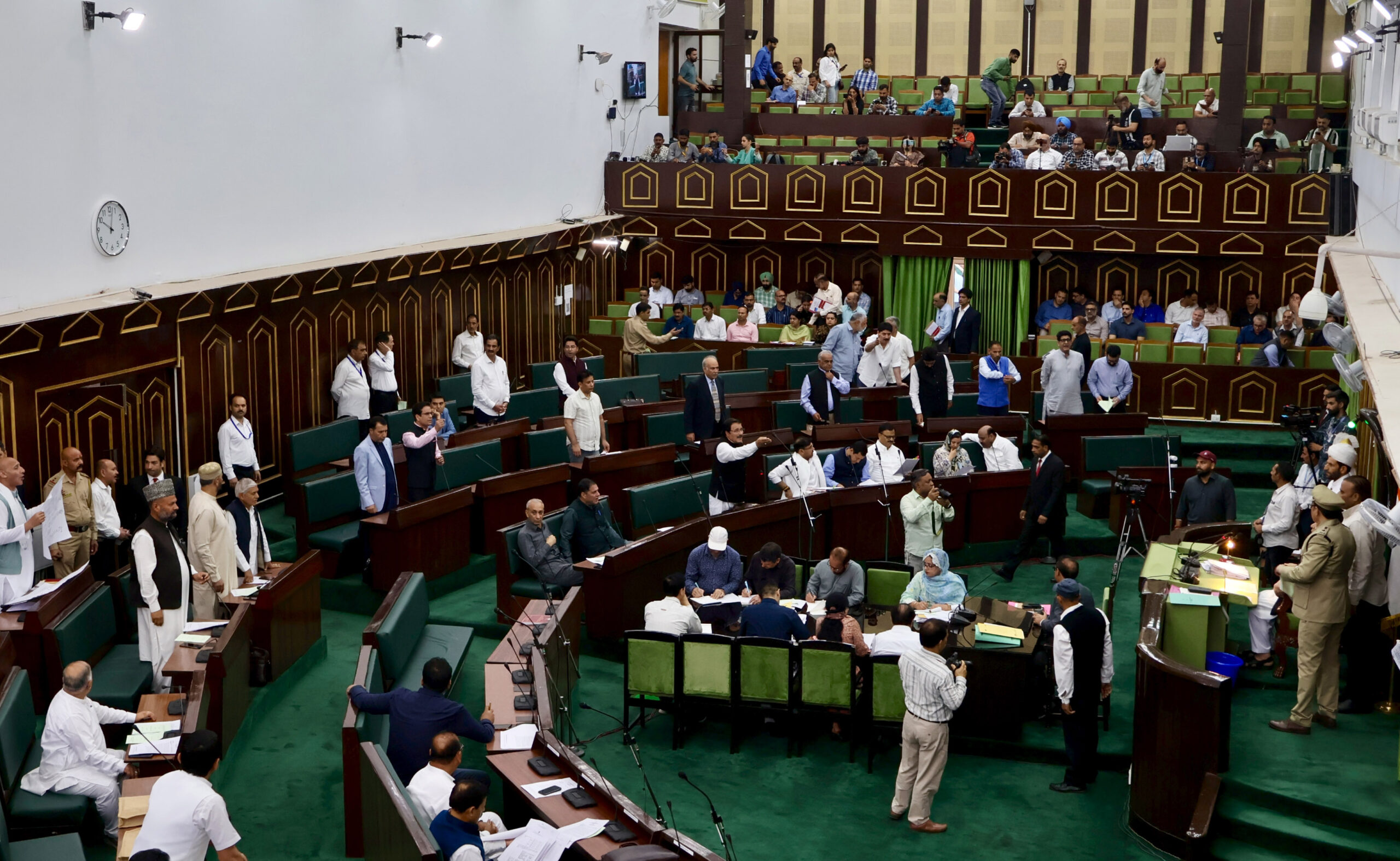
Get Order of Precedence withdrawn in 2 months: Speaker to Govt
Avtar Bhat
JAMMU, Apr 4: Speaker Legislative Assembly Abdul Rahim Rather today issued directives to UT Government to get the Order of Precedence withdrawn within two months. Sharing the concern of Legislators over the issue, he said this order needs to be corrected.
Follow the Daily Excelsior channel on WhatsApp
The directions from the Speaker came over the short duration notice served by Deputy Leader of Opposition, Pawan Kumar Gupta on the role of dignity of the House and MLAs.
Though the Dy CM, Surinder Choudhary assured the House that strict action will be taken against officers violating protocol of MLAs in future. However the Speaker gave clear-cut directives to get order withdrawn within two months.
Earlier, the Dy CM said dignity of members will be maintained at every cost and protocol will be observed by all officers in the functions. If any instance of violating protocol by officers comes into the notice of Government where protocol was not adhered to appropriate action against the officers will be taken, he warned.
He said further steps will be taken for better coordination between Legislators and administration. The established protocol will be implemented in letter and spirit and Government will not allow any breach in MLAs protocol, he added.
Choudhary said that Chief Minister is also concerned about the same and Government will not tolerate that MLAs are being undermined.
The members also showed their grave concern over undermining the protocol of the Legislators and demanded that Order of Precedence be withdrawn immediately.
While raising the issue, Pawan Gupta said in any democracy, governance rests on a delicate balance between elected representatives and the administrative machinery. When this balance is disturbed, the consequences go far beyond procedural lapses — they begin to affect the very credibility of democratic institutions. He demanded the situation in Jammu & Kashmir demands urgent attention.
He said at the centre of the issue is a perception that the role and authority of elected representatives, particularly Members of the Legislative Assembly (MLAs), have diminished after the reorganisation of the erstwhile State. However, this perception does not align with the legal position. Under Section 30 of the Jammu and Kashmir Reorganisation Act, 2019, the Legislative Assembly of Jammu & Kashmir is vested with substantive law-making powers over subjects in the State List (with certain exceptions) and the Concurrent List. This clearly establishes the Assembly as a functional and empowered Legislative Body, he added.
The problem, therefore, is not one of legal authority, but of its implementation. There is a widening gap between what the law provides and how governance is being conducted on the ground, Gupta said.
He said a key dimension of this gap is the weakening of the oversight role of MLAs. In a Parliamentary democracy, elected representatives are not merely lawmakers; they are also responsible for monitoring administration, reviewing development works, and raising public grievances. This oversight is not interference — it is an essential pillar of accountability. When this role is undermined the governance risks becoming opaque and disconnected from the people, he added.
There are increasing instances where communications from MLAs are not acknowledged, let alone responded to in a timely manner. Even more concerning is the inaccessibility of officials, with phone calls from elected representatives often going unanswered. This is not merely discourtesy — it directly hampers the ability of representatives to address public issues effectively.
What makes this situation particularly troubling is that it runs contrary to existing legal provisions. Under Section 46(2) of the Jammu and Kashmir Reorganisation Act, 2019, all standing orders and circulars issued by the erstwhile State Government continue to remain in force. Several circulars issued by the General Administration Department (GAD) clearly mandate prompt acknowledgment of communications from elected representatives, time-bound responses, and courteous conduct by officers. These are not optional guidelines; they are binding instructions. Their non-compliance reflects a serious lapse in administrative discipline.
Another significant concern is the limited involvement of MLAs in development planning. In many cases, projects are being conceptualized and executed without adequate consultation with the concerned representatives. This leads to misalignment with local needs and weakens accountability. Development, to be effective, must be participatory. Excluding elected representatives undermines both efficiency and democratic legitimacy, he said.
Gupta said the absence of a revised Warrant of Precedence following reorganisation has further contributed to confusion. The lack of clarity regarding roles and protocol has led to friction between different elected bodies, particularly between MLAs and District Development Council Chairpersons. A clear institutional hierarchy is essential for smooth governance, he added.
Congress MLA Nizam-ud-Din Bhat said “We have acknowledged UT which came through a Parliamentary Act,. But nothing changed except Article 370 and 35 A,. The dignity of House and MLAs remains un-disturbed’’, he added.
Bhat said “All members dignity has been reinforced and no one can over-right Constitution except Parliament,. There are clear guidelines for House and its members,. Their membership is as good as of MPs in their privileges and we have not been made subordinate to any Government order’’, he added.
He said the confusion has been created in Warrant of Precedence and the DDC Chairman has been kept above MLA. “The LG can avail administrative powers but this does not dilute my dignity or that of House,. He asked show my any order where this House can’t raise any issue’’? He said the bureaucrats should change their mindset. The House can discuss IAS and IPS officers as they are not barred from the same.
NC’s Hasnain Masoodi said “We imposed ourselves that our privileges have been snatched on August 5 in 2019,. Privilege means my protocol. It has wider scope. My right as member to get right information from Government and this right has been isolated which is serious breach of privilege’’, he added.
Masoodi also gave reference to the Parliament proceedings especially of Zero Hour proceedings where the cognisance is taken about the points raised by members by Minister or his staff while no one takes cognisance of issues raised in Assembly during Zero Hour, he added.
 Follow our WhatsApp channel
