

A Book That I Read
Suman K Sharma
s2m2nr@gmail.com
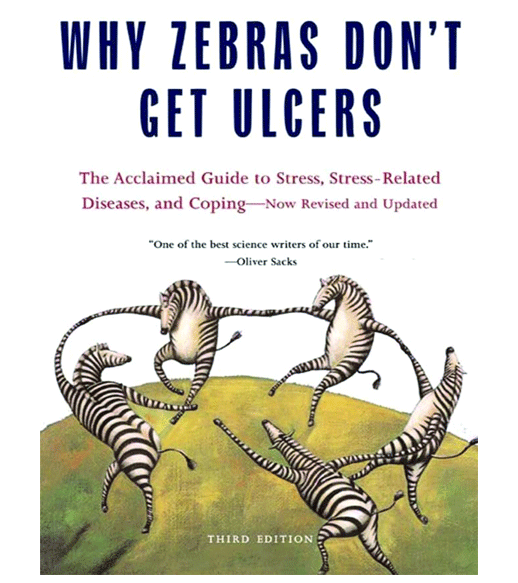
Prof. Robert M. Sapolski has chosen a teaser to caption his book. He has the penchant for saying weighty thing in this droll manner. Why Don’t Zebras Get Ulcers is all about stress – or ‘tension’ as we call it – that afflicts the modern man. Originally published in 1994, the book has run into third edition within a decade. The 2024 edition carries two additional chapters – one on interaction between stress and sleep, and the other on what stress has to do with addiction. The author claims that he “rewrote about a third to half of the material” that appeared in the previous edition.
Robert Sapolski (born, 1957; Brooklyn, New York, USA) teaches biology and neurology at the University of Stanford, USA. He is an atheist and yet a determinist. Man does not have free will, he holds, and our actions are determined by “neurobiology, hormones, childhood and life-circumstances.”
Sapolski is reputedly one of the best science writers of our time. But here is a catch: he has taken upon himself “to teach, (emphasis added), with a minimum of pain (p. xii)”. That means we are expected to adhere to the plan of study he has laid down for us in his book. That means further that we cannot afford to jump over a few chapters to see what he has to say about something particular that grabs our attention in the book. The worthy professor adroitly takes us back to where we had left in our unseemly hurry. Also, out of necessity, there is in it a smattering of daunting words such as glucocorticoids and sundry other scientific jargon which could deter the uninitiated. But no worries. The author has taken care, with his anecdotal, half-jocund style and lots of matching illustrations “to make the subject interesting and accessible even to those who would not normally be caught dead near the subject (p. xiii).”
So, what is stress? Look at these scenarios. A person wide awake at 2 in the morning, apprehensive that his intermittent headache could well be caused by a tumour in his brain. Or that you are the junior-most in a hierarchy, subject to harassment by anyone and everyone up there. Conversely, you find yourself in a dominant position in an unstable pecking order and are unsure how long you’d hold that position. Or that you are the luckless zebra, face to face with a lion, and don’t know what to do about it. Or that you are a starving lion who would die if you don’t find enough food soon enough to sustain you. Psychological, social or physical, when such extreme emotions disturb us, we are stressed.
Scientists have noted that our brain seeks homeostasis – “a state in which all sorts of physiological measurements – level of oxygen, degree of acidity and temperature et cetera – are kept at the optimal level.” Stressors disturb this balance and cause stress. The body then tries to reestablish this balance. However, the concept of homeostasis has become dated. It dwelt on fixed parameters of the body system. The latest thinking is of allostasis – highlighting the dynamic nature of physiological regulation. The values of ideal blood pressure, for instance, is bound to differ when you are sleeping, at rest or running.
It is a game mainly of hormones. A response to any stressor involves “the secretion of certain hormones, the inhibition of others, the activation of particular parts of the nervous system, and so on.” Brain regulates functions of our body. Through nerves it sends messages to the spine and then to the periphery of the body. There is the voluntary nervous system which controls our conscious actions. Our involuntary actions, such as sweating, digestion and the like, are controlled by the autonomic system. In an emergent situation, it is the sympathetic part of the autonomic nervous system that takes charge for an apt response, whether of fight, flight, fright or sex. The sympathetic nervous system achieves its end by secretion of the hormones adrenaline and noradrenaline (termed in America as epinpherine and norepinpherine). Then, there is the other part of autonomic nervous system, viz, parasympathetic nervous system, which has an opposite role to play. It promotes growth, storage of energy and the like processes. Adrenaline acts in seconds. Its activity is backed up by glucocorticoids for a longer duration, for hours. At the end of the day, it is the brain which commands the release of these hormones through CRH (Corticotropin Release Hormone).
Tired of the medical-school jingo? What it all means is that our body has an elaborate system in place to respond to stress. But like any other system, it too has its limitations. Here comes the answer to the question: “Why zebras don’t get ulcers?” Why indeed? Because, unlike man, when zebras, lions and other beasts are up against an acute stressful situation, they may either be mauled, die or live on to learn to avoid it. Man, on the other hand, is given to worries and anxiety about the calamities that his overactive imagination works out for him. “Essentially,” Sapoliski observes, “we humans live well enough and long enough and are smart enough, to generate all sorts of stressful events purely in our heads (pp 4-5).” Zebras don’t get ulcers because, poor souls, they are too simple to brood over intangibles.
It is the chronic stress that makes us sick. Sapolski has devoted as many as 14 of the 18 chapters of his book on correlation of stress with a whole lot of today’s diseases and disorders relating to heart, metabolism, reproduction, immunity, memory and so on. Stress has indeed become a bane of the modern world. Yet, optimistic of man’s resilience, he offers some practical advice to cope with the grim situation:
* “…Hope for the best and let that dominate most of your emotions, but at the same time let one small piece of you prepare for the worst.
* “…When faced with the large wall of a stressor, it is great if there emerges one singular solution that makes the wall crumble. But often, a solution instead will be a series of footholds of control, each one small but still capable of giving support, that will allow you to scale the wall.
* “It is generally helpful to seek predictable, accurate information. However, such information is not useful if it comes too soon or too late, if it is unnecessary, if there is so much information that it is stressful in and of itself, or if the information is about news far worse than one wants to know.
* “Find that outlet for your frustrations and do it regularly. Make the outlet benign to those around you – one should not give ulcers in order to avoid getting them. Read the fine print and the ingredient list on each new form of supposed anti-stress salvation, be skeptical of hype, figure out what works for you.
* “It is important to find sources of social affiliation and support. Even in our obsessively individualistic society, most of us yearn to feel part of something larger than ourselves. But one should not mistake true affiliation for mere socializing. A person can feel vastly lonely in a vast crowd or when faced with a supposed intimate who has proved to be a stranger. Be patient; most of us spend a lifetime learning how to be truly good friends and spouses (p.416).”
***
PS: Sapolski seems to have addressed this book to the Western readership, particularly the Americans. I learnt a new Americanism from the text: ‘dissed’, past-participle of the verb ‘diss’, which means ‘to treat with disrespect or contempt’ (Merriam Webster).
 Follow our WhatsApp channel
